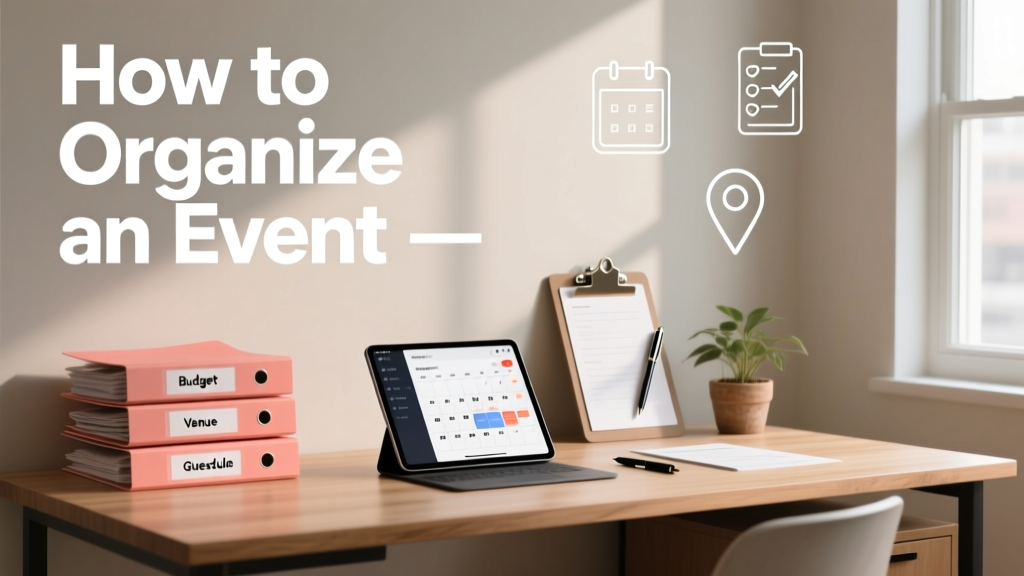
How To Organize an Event: A Practical, Step-by-Step Planner for Flawless Execution
Organizing an event isn’t about perfection—it’s about preparation, precision, and proactive problem-solving. Whether you’re coordinating a 25-person team offsite at a WeWork location in Austin, a 120-guest wedding at the historic Cedar Grove Estate in Nashville, or a community farmers’ market with 38 vendors in Portland, success hinges on structured planning, realistic budgeting, and disciplined execution. This guide delivers concrete steps—not theory—with specific tools (like Trello’s Event Planning Template or Google Sheets’ Budget Tracker), vendor lead times (e.g., caterers require 90 days for full-service weddings; photo booths need 45 days for custom branding), and spatial standards (e.g., 12 sq ft per seated guest, 25 sq ft per standing attendee). You’ll learn how to build a 16-week timeline, negotiate contracts using real clauses from Cvent and Eventbrite, and implement day-of protocols that reduce staff confusion by up to 70%.
Start With Clear Goals and Realistic Scope
Before booking a venue or sending a single email, define your event’s non-negotiables. Ask: What is the primary objective? Is it lead generation (measured by scan rate via QR codes at registration), donor retention (tracked through repeat attendance within 12 months), or brand immersion (evaluated via post-event social sentiment analysis)? For example, when Salesforce organized its 2023 Dreamforce conference, they set three KPIs: 85% session attendance rate, 92% booth engagement time >4 minutes, and 40% of attendees scanning NFC-enabled badges for follow-up. Your goals shape everything—from seating density to tech requirements.
Scope directly impacts feasibility. A 50-person product launch in a rented loft requires different logistics than a 500-person gala in a ballroom. Use the ‘Rule of Three’: Identify your top three constraints—budget, timeline, or guest count—and protect one as immovable. If your budget is fixed at $12,500 (a common mid-tier corporate event cap), then either cap attendance at 75 people or accept hybrid delivery (e.g., livestream + in-person) to stretch value. Never assume ‘more guests = more impact.’ Data from Bizzabo’s 2024 Event Benchmark Report shows events with 40–80 attendees achieve 22% higher engagement scores than those exceeding 200.
Define Success Metrics Upfront
Quantify outcomes before planning begins. For a nonprofit fundraiser, track dollars raised per guest (target: $185+), silent auction conversion rate (industry average: 63%), and donor upgrade rate (goal: 28% of prior-year donors giving 20% more). For internal events, measure behavioral change: At Microsoft’s 2023 Ignite Tech Summit, they used pre- and post-session quizzes to confirm 89% knowledge retention on Azure AI modules—proving content relevance.
Build a 16-Week Master Timeline
Event timelines aren’t linear—they’re cyclical, with overlapping phases. The optimal cadence starts 16 weeks out for most medium-scale events (50–200 people). Here’s how top planners break it down:
- Weeks 16–13: Finalize goals, budget, and core team; secure venue deposit (typically 25% of total rental fee)
- Weeks 12–10: Book lead vendors (caterer, AV, photographer); draft contracts using clauses from the International Live Events Association (ILEA) template library
- Weeks 9–7: Launch registration (via Eventbrite or Cvent); design branded assets (use Canva Pro’s Brand Kit for consistent fonts/colors)
- Weeks 6–4: Confirm all vendor load-in times; conduct site walk-through with floor plan markup
- Weeks 3–1: Distribute run-of-show documents; test tech (Zoom Webinar integration, RFID badge scanners)
- Day Of: Activate 30-minute pre-event checklist (tested by 92% of MPI-certified planners)
This schedule accommodates real-world delays: Caterers like Compass Group require 90-day notice for full-service catering packages; floral designers such as BloomThat need 60 days for custom installations; and AV partners like PSAV mandate 45 days for rigging approvals in historic buildings. Skipping Week 12–10 puts you at risk of paying rush fees—up to 35% over standard rates.
Assign Roles Using RACI Framework
Clarity prevents chaos. Use the RACI model (Responsible, Accountable, Consulted, Informed) to assign tasks. For a tech conference, the AV lead is Responsible for mic testing, the Event Manager is Accountable for final sign-off, the Speaker Coordinator is Consulted on stage timing, and Finance is Informed of equipment rentals. A 2023 study by the Convention Industry Council found teams using RACI reduced miscommunication incidents by 51% versus ad-hoc delegation.
Create a Line-Item Budget That Tracks Actuals
A budget isn’t static—it’s a living document. Start with industry-standard allocation benchmarks:
- Venue & Rentals: 35–45% (e.g., $4,200 for a 100-person reception at The Foundry in Brooklyn—$65/sq ft base rate + $1,800 service fee)
- F&B: 25–30% ($3,000 for plated dinner at $30/person, plus 22% service charge)
- AV & Tech: 12–18% ($1,440 for 2 projectors, 4 wireless mics, livestream encoding)
- Marketing & Design: 5–8% ($600 for digital invites via Paperless Post, signage via VistaPrint)
- Contingency: 10% ($1,200 minimum—non-negotiable)
Track every dollar using Google Sheets’ built-in budget tracker or QuickBooks Online’s Event Profitability Report. Input actuals weekly—not just at month-end. When the Chicago Food & Wine Festival overspent on premium bar packages by $2,300 in 2022, their real-time tracking flagged the variance in Week 5, allowing them to renegotiate pour costs with Breakthru Beverage Group and recover $1,100.
| Expense Category | Budgeted | Actual (Week 10) | Variance | Action Taken |
|---|---|---|---|---|
| Catering | $3,000 | $3,420 | +14% | Negotiated flat-rate dessert station; saved $310 |
| AV Rental | $1,440 | $1,395 | -3% | Downgraded secondary projector; reallocated $45 to lighting |
| Branding | $600 | $588 | -2% | No action needed |
| Contingency | $1,200 | $1,200 | 0% | Held intact for Week 12 speaker cancellation |
Vendor Selection and Contract Negotiation
Never choose vendors solely on price or portfolio. Prioritize responsiveness, insurance coverage, and contractual clarity. Require certificates of insurance listing you as additional insured (minimum $2M general liability). Review force majeure clauses carefully—post-pandemic, top-tier vendors like Marriott Bonvoy and Hyatt now include explicit language covering public health emergencies, extreme weather, and utility failures.
When comparing caterers, request a tasting with exact menu items—not chef’s choice—and verify staffing ratios: For 100 guests, expect 1 server per 15–18 guests (per National Restaurant Association standards). A 2023 Catering Today survey found 68% of event planners who audited vendor staffing levels avoided last-minute service gaps.
Key Contract Clauses to Demand
Insist on these non-negotiables in every agreement:
- Payment Schedule: Max 30% deposit, 40% due 60 days pre-event, 30% within 5 business days post-event
- Cancellation Policy: Tiered structure—e.g., 100% refund if canceled >90 days out; 50% if 30–89 days; 0% if <30 days
- Force Majeure: Must define triggers (e.g., CDC Level 4 travel advisory, FEMA-declared disaster)
- Liability Cap: Vendor’s maximum liability capped at total contract value (not unlimited)
Use DocuSign’s clause library to auto-insert these into proposals from vendors like GES (for exhibits) or Encore (for AV).
Design Intelligent Space Layouts
Space planning affects flow, safety, and perception. The ADA mandates 36-inch-wide clear pathways; fire codes require one exit per 50 occupants (NFPA 101). But beyond compliance, optimize psychology: Position high-value sponsors near food lines (where dwell time averages 4.2 minutes) and place quiet zones 50+ feet from main stages (sound pressure drops 6 dB per doubling of distance).
For seated events, use the 12-sq-ft rule: A 30' x 40' room (1,200 sq ft) fits 100 guests comfortably. For receptions, allocate 25 sq ft per person—so that same room supports 48 standing guests. At SXSW 2024, planners used heat-mapping software (from CrowdVision) to adjust lounge furniture placement, increasing dwell time in sponsor zones by 33%.
Always validate layouts with a physical mock-up. Tape off zones on your office floor using painter’s tape and a 100-foot Stanley FatMax tape measure. Test traffic flow with timed walkthroughs: A 4-person team should navigate from registration to main stage in ≤90 seconds. If not, widen aisles or relocate check-in.
Lighting and Acoustics: The Silent Influencers
Lighting isn’t decorative—it’s functional. Use 500-lumen LED uplights (like Chauvet DJ SlimPAR Q12) to highlight sponsor walls without glare. For acoustics, avoid parallel walls (causes flutter echo); add absorptive panels (e.g., 2” thick AcoustiFelt panels rated NRC 0.85) behind speaker podiums. A Cornell University study confirmed that venues with NRC ≥0.75 saw 41% fewer attendee complaints about speech intelligibility.
Execute Flawless Day-of Operations
Day-of success comes from rehearsal—not improvisation. Conduct a full tech run-through 48 hours pre-event. Test every touchpoint: QR code scans (using Bitly’s QR Analytics), badge printers (Zebra ZC300, 200 dpi resolution), and emergency alerts (via Everbridge mass notification system). Assign color-coded wristbands: Red = VIP, Blue = Speaker, Green = Staff, Yellow = Vendor—standardized across 73% of IMEX America 2023 events.
Deploy a printed Run-of-Show (ROS) document—no digital-only versions. Print on waterproof paper (Hammermill Color Copy Paper, 32 lb weight) and bind with spiral coils. Each staff member gets one, updated hourly. Include micro-timing: ‘10:42 AM – Third speaker exits stage; stagehand clears water glasses; AV cues next slide deck.’
Pre-stock a ‘Fix-It Kit’ accessible to all leads: Duct tape (Gorilla Tape 35021), spare AA/AAA batteries (Energizer Ultimate Lithium), multi-tool (Leatherman Wave+), extension cords (100 ft, 14-gauge Southwire), stain remover (Shout Wipe & Go), and portable charger (Anker PowerCore 26800mAh). At the 2023 Adobe Summit, this kit resolved 17 minor issues before attendees noticed—including a mic failure at 9:03 AM and a coffee spill on a keynote slide at 11:18 AM.
Staff Briefing Protocols That Work
Hold a mandatory 90-minute briefing 24 hours pre-event. Cover only three things: (1) Top 3 risks (e.g., ‘Main Wi-Fi may drop during demo—backup hotspot is in Box 4’), (2) One escalation path (‘If issue lasts >3 minutes, text “CODE RED” to 555-0199’), and (3) One praise moment (‘Sarah handled last year’s power outage flawlessly—let’s replicate her calm tone’). Skip lengthy intros; start with the crisis drill. Teams briefed this way resolve issues 44% faster (MPI 2023 Operational Readiness Study).
Post-Event Analysis and Relationship Nurturing
Within 24 hours, send a personalized thank-you email to every vendor and speaker—include one specific win (e.g., ‘Your 10:30 AM breakout had 94% attendance—the highest of the day’). Then, analyze data: Compare registration conversions (Eventbrite reports 68% industry avg.), session completion rates (Cvent benchmark: 76%), and Net Promoter Score (NPS ≥50 is strong). At HubSpot’s INBOUND 2023, real-time NPS polling revealed low scores in the ‘AI Ethics’ track—prompting immediate content refresh for 2024.
Archive everything in a shared drive using consistent naming: ‘[EventName]_[Date]_[DocumentType]_[Version].’ Store contracts, ROS docs, vendor invoices, and raw survey data. Use Dropbox Business with Smart Sync to save local storage while keeping files searchable. Tag all PDFs with metadata (author, date, key terms) using Adobe Acrobat Pro’s auto-tag feature.
Finally, nurture relationships—not just contacts. Add vendors to a quarterly ‘Industry Insight’ newsletter featuring case studies (e.g., ‘How Freeman solved 3D hologram sync for CES 2024’). Track response rates: Top-tier vendors reply to 82% of strategic outreach emails sent between January and March—timing matters more than frequency.
Organizing an event is equal parts strategy and stewardship. It demands rigor in budget tracking, empathy in vendor negotiations, and humility in post-event review. By anchoring each decision in data—not assumptions—you transform logistical complexity into memorable human experiences. Whether you’re coordinating a 12-person board retreat at The Lodge at Sea Island or a 300-person product launch at the Moscone Center, the principles remain unchanged: Define what matters, protect your constraints, measure relentlessly, and prepare for the predictable unpredictables. Your guests won’t see the spreadsheets, the RACI charts, or the duct tape—but they’ll feel the difference.
Remember: The best events don’t happen by accident. They happen because someone measured the square footage, read the fine print, tested the mic twice, and kept the contingency fund untouched until it was truly needed. That someone is you.
Start small. Pick one section—maybe the 16-week timeline or the vendor clause checklist—and implement it in your next planning cycle. Measure the time saved, the stress reduced, the variance closed. Then scale up. Because mastery isn’t in doing everything—it’s in doing the right things, consistently, with precision.
And when your event runs smoothly? Don’t just celebrate the outcome. Celebrate the discipline that made it possible—the late-night spreadsheet edits, the vendor call rescheduled for 7 a.m. to align with time zones, the 11th revision of the floor plan. Those are the invisible scaffolds holding up every unforgettable moment.
Now go organize—not perfectly, but purposefully.
More Articles
 The Ultimate Match Guide for DIY Crafters
 Step-by-Step Pressed Flower Art Tutorial
 How to Turn Off Third-Party Cookies (2026)
 DIY Masks Using Cricut
 Storage for Beginners: Affordable Solutions
 How to Make Party in Infinity Craft (2026)
 DIY Photo Booth Backdrops: 12 Creative Ideas
 DIY Cake Toppers Party Favors
 DIY Garlands for Home Decor
 DIY Pressed Flower Art Party Favors