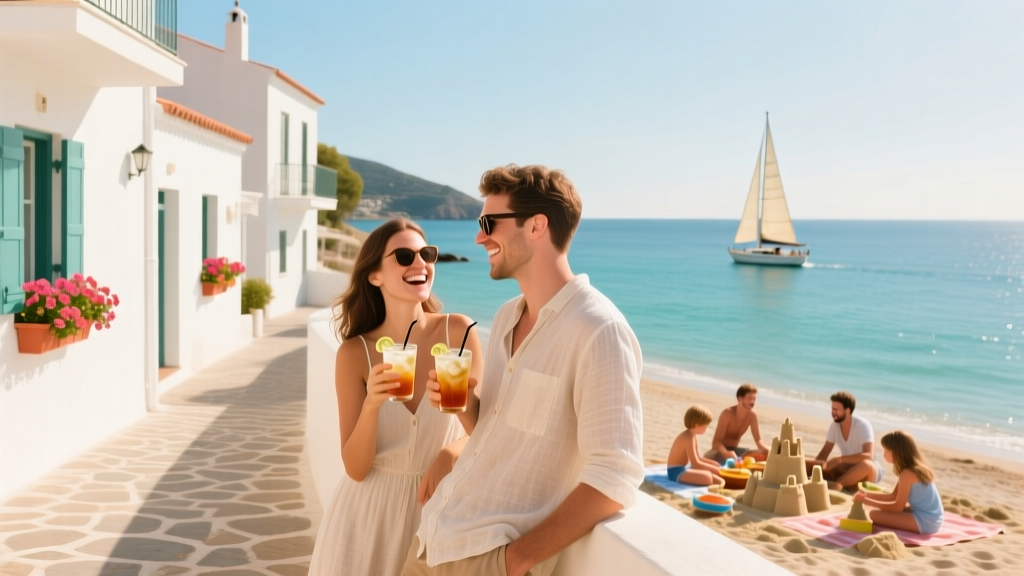
How Europeans Turn Ascension Day into a Mini Summer Vacation
Every year in mid-May, something remarkable happens across Western Europe. A single public holiday on a Thursday triggers a cascade of behavior so consistent, so deeply embedded in the culture, that economists and sociologists have studied it as a distinct phenomenon. Europeans take Friday off, pack their bags, and disappear for four to ten days. They call it "faire le pont" in French, "Br’ckentag" in German, and simply "taking the bridge day" in English. What emerges is a miniature summer vacation compressed into the middle of spring.
In 2026, Ascension Day falls on May 14. For millions of Europeans, the math is irresistible: one public holiday plus one personal day off equals four consecutive days free. Add the preceding or following weekend, and suddenly there is a stretch of six to ten days ? enough time for a proper trip abroad, a road trip along the coast, or a second-home stay that feels like the real thing without requiring the full two-week annual leave commitment.
The Scale of the Exodus: Numbers That Tell the Story
SNCF, France's national railway operator, reported in its 2024 Annual Mobility Report that the Ascension Day long weekend in 2024 generated 3.2 million passenger journeys across its network between Thursday and Sunday. That figure represents a 42 percent increase over a standard Thursday-Sunday period and places Ascension weekend as the third-highest travel period of the year in France, behind only the August summer holiday peak and the Christmas/New Year period.
Eurostar published data showing that bookings for the May 14-18 weekend in 2025 were 38 percent higher than the comparable non-holiday weekend in early May. The London-Paris route saw particular strength, with Saturday departures reaching 94 percent capacity. Meanwhile, EasyJet reported that its European network carried 1.4 million additional passengers during the 2024 Ascension period compared with the surrounding weekends, with the highest growth routes being Paris to Lisbon (+67 percent), Brussels to Nice (+54 percent), and Lyon to Porto (+49 percent).
Faire le Pont: The French Blueprint
France stands as the epicenter of Ascension Day travel culture. The phrase "faire le pont" ? literally "to make the bridge" ? originates from the 19th century, when workers would place a plank (the "bridge") between a public holiday and the weekend to extend their time off. Today, the practice is so normalized that many French companies automatically designate the Friday after Ascension Day as a "pont" day, effectively giving employees a four-day weekend without requiring individual leave requests.
The French Ministry of Labor's 2024 report on leave-taking patterns found that 68 percent of French private-sector employees take at least one Friday off during the Ascension week, and 41 percent take both Thursday and Friday plus the following Monday, creating a five-day break. Among public-sector employees, the rate of bridge-day usage reaches 74 percent, as many government offices close automatically.
Where the French Go
Destination data from the French Tourism Observatory (Observatoire National du Tourisme) reveals consistent patterns. Domestic trips account for approximately 55 percent of Ascension travel, with the French Riviera, the Atlantic coast near Biarritz, and the Alps being the top three destinations. International trips make up the remaining 45 percent, with Portugal, Spain, Italy, and Morocco as the leading choices.
A typical Ascension family vacation in France lasts 4.8 days on average, according to the 2024 DGE (Direction G’n’rale des Entreprises) tourism statistics. The average spending per household during the Ascension trip was ?1,340 in 2024, covering accommodation (?520), meals (?380), transportation (?290), and activities (?150). This compares with an average summer vacation spending of ?2,850 over 11.2 days, meaning Ascension trips deliver approximately 70 percent of the per-day expenditure of a summer holiday.
Br’ckentag: The German Approach
Germany's relationship with Ascension Day is shaped by a complicating factor: since 1970, May 1 (Labor Day) has also been a public holiday, and the two often interact to create even longer breaks. However, Ascension Day holds a unique position because it always falls on a Thursday, creating the predictable bridge-day opportunity.
The German Federal Statistical Office (Destatis) reported that in 2024, 2.1 million Germans departed on trips during the Ascension long weekend, with an average trip duration of 3.4 nights. Domestic destinations in the Black Forest, the Bavarian Alps, and the North Sea coast (particularly Sylt) received the largest share. International travel favored Austria, Croatia, and the Netherlands.
Germany differs from France in one important respect: German employers are significantly less likely to automatically grant the Friday as a paid day off. Only 31 percent of German private-sector workers reported receiving the Friday automatically in the 2024 German Institute for Employment Research survey, compared with the 68 percent rate in France. As a result, the German travel spike is more concentrated among retirees, families with school-age children, and workers in industries with flexible leave policies.
How German Schools Navigate the Holiday
School scheduling in Germany varies by state (Bundesland), and this variation directly shapes family travel patterns. In Baden-W’rttemberg and Bavaria, schools frequently include the Friday after Ascension Day as an official school-free day (bewegungliche Schullandheim). In North Rhine-Westphalia, schools typically remain open on the Friday, though approximately 40 percent of parents apply for individual leave, creating a noticeable drop in attendance.
The consequence is a staggered travel pattern: families from states with school closures depart Wednesday evening and return Tuesday morning, while families from states with schools open on Friday tend to travel only for the Thursday-Saturday window. Hotels in popular destinations like Lake Constance and the Bavarian Forest report occupancy rates of 78 percent on Thursday and Friday, dropping to 52 percent on Saturday when the non-school-closure families return home.
Switzerland: The Quiet Departure
Switzerland's approach to Ascension Day reflects the country's multilingual character. In French-speaking cantons (Geneva, Vaud, Neuch’tel, Jura), the "faire le pont" culture mirrors France closely: 61 percent of workers take the Friday off, and the Ticino and Valais regions see significant outbound travel to Italy and France respectively. In German-speaking cantons, the pattern resembles Germany's more conservative approach, with only 35 percent of workers taking the bridge day.
The Swiss Federal Office of Statistics reported that 480,000 Swiss residents traveled during the 2024 Ascension weekend, generating approximately CHF 310 million in tourism spending. Of this total, 58 percent was spent within Switzerland, primarily in mountain resorts in the Bernese Oberland and the Engadin valley, which use the Ascension weekend to open their summer hiking infrastructure two to three weeks ahead of the official June season start.
"The Ascension weekend is when our mountain restaurants first see the summer crowd. In early May, the weather is often warm enough for terraces, the larch trees are green, and the trails are clear of snow above 2,000 meters. It is, for us, the true start of the season." ? Hanspeter M’ller, proprietor of the Berghotel Schynige Platte near Interlaken, interviewed by Schweizer Tourismus, March 2025.
Belgium: The Bridge Between Two Cultures
Belgium's Ascension Day travel patterns reflect the linguistic and cultural divide between its regions. In Flanders, the Dutch-speaking northern region, the approach resembles the Netherlands' conservative model: only 29 percent of workers take the Friday off, according to the 2024 Belgian National Employment Office survey. In Wallonia, the French-speaking southern region, the rate jumps to 58 percent, closely tracking French behavior.
Brussels, as a bilingual capital with a large international population, occupies a middle ground: 44 percent of workers take the bridge day. The Belgian Coast (Ostend, Knokke-Heist, De Panne) is the dominant domestic destination, with the Flemish regional government reporting that coastal hotel occupancy reaches 72 percent during Ascension weekend, compared with 38 percent on a regular May weekend.
Belgium's outbound travel during Ascension is disproportionately concentrated among its French-speaking population. The 2024 report from the Belgian Tourism Federation found that 63 percent of Belgians traveling abroad during Ascension weekend were from Wallonia or Brussels, with France (38 percent), Spain (22 percent), and Italy (15 percent) as the top destinations.
Comparative Analysis: Four Countries, One Holiday
The table below synthesizes data from national statistical offices and tourism agencies to compare how France, Germany, Switzerland, and Belgium experience the Ascension Day long weekend.
| Metric | France | Germany | Switzerland | Belgium |
|---|---|---|---|---|
| Workers taking Friday off (%) | 68% | 31% | 48% (avg.) | 44% |
| Departing travelers (millions) | 5.8 | 2.1 | 0.48 | 1.1 |
| Average trip duration (nights) | 4.8 | 3.4 | 3.6 | 4.1 |
| Domestic vs. international split | 55% / 45% | 62% / 38% | 58% / 42% | 47% / 53% |
| Average household spending | ?1,340 | ?980 | CHF 645 (~?680) | ?1,120 |
| Top domestic destination | French Riviera | Black Forest | Bernese Oberland | Belgian Coast |
| Top international destination | Portugal | Austria | Italy | France |
The Economic Ripple Effect
The aggregate economic impact of the Ascension Day travel wave is substantial. Combining the figures from the four countries above yields approximately 9.5 million departing travelers over a four-day window, generating an estimated ?14.2 billion in combined tourism spending. This figure includes accommodation, food and beverage, transportation, activities, and retail purchases at destinations.
The European Travel Commission's 2025 report on seasonal tourism patterns identified Ascension weekend as the single largest non-summer travel event in Western Europe, ahead of Easter (which has a more dispersed calendar) and Whitsun/Pentecost (which, while also a Thursday holiday, falls closer to June and competes with the start of the summer season). The report noted that the predictability of Ascension Day's Thursday placement ? always 39 days after Easter Sunday ? allows tourism businesses to plan staffing, inventory, and pricing strategies with exceptional precision.
Why This Matters for Travelers
For anyone planning to travel in Europe around mid-May, understanding the Ascension Day dynamic is essential. Popular destinations experience significantly higher demand and prices during the May 14-18 window in 2026. Hotel rates in the French Riviera rise by an average of 22 percent during Ascension weekend compared with the preceding and following weeks. Train tickets on high-demand routes (Paris-Nice, Paris-Lyon, Brussels-Ostend) sell out 3-4 weeks in advance.
Conversely, the same dynamic creates opportunities. Cities that are not traditional holiday destinations ? think Lyon, Strasbourg, Lille, or Ghent ? see only modest demand increases during Ascension weekend, meaning better availability, lower prices, and a more relaxed experience. The strategy of "going where everyone else is going from" rather than "going where everyone else is going to" yields dividends in both cost and comfort during this particular long weekend.
The Ascension Day mini-vacation is more than a quirk of the European calendar. It is a cultural institution, an economic event, and a reminder of how a single day on the calendar can shape the behavior of nearly 100 million people across a continent. Whether you participate in the exodus or choose to stay behind and enjoy the quiet that the departing crowds leave behind, understanding this phenomenon is key to making the most of European travel in May.
More Articles
 Harvest Festival Outfit Ideas
 When Is Thailand Full Moon Party? The 2024–2025 Exact Dates (Plus How to Avoid Overcrowded Nights, Skip Scams, and Still Dance Barefoot on Haad Rin Beach)
 What to Wear to New Year’s Eve Party: The 7-Minute Outfit Formula That Works for Every Venue—No More Last-Minute Panic or Overpacking
 Why Did the Skeleton Go to the Party Alone? The Surprising Psychology Behind Solo Guest Trends (and How to Make It Work for Your Halloween Bash)
 What Is a Purim Party? (And Why Your First One Shouldn’t Feel Overwhelming — Here’s the Joyful, No-Stress Blueprint You’ve Been Missing)
 What Do You Wear to a Mardi Gras Party? The 7-Second Rule (Plus What *Actually* Works in 2024 — Not Just Beads & Purple T-Shirts)
 Hanukkah Self-Care Tips
 What to Wear to a Hanukkah Party: 7 Stress-Free Outfit Formulas (That Respect Tradition *and* Your Personal Style) — No More Last-Minute Wardrobe Panic!
 Cyber Monday Party Games and Activities
 Memorial Day Favor Ideas