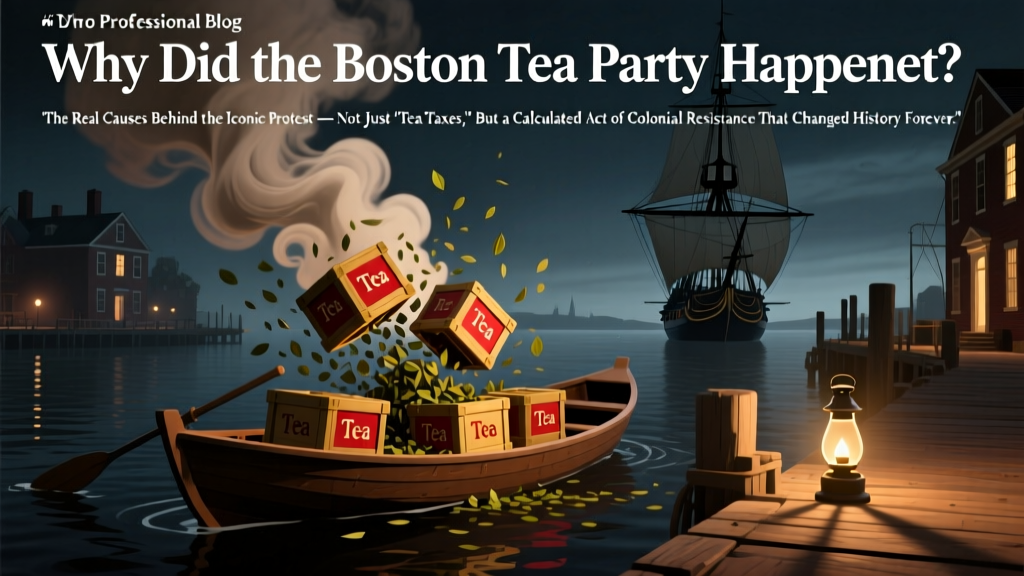
Why Did the Boston Tea Party Happen? The Real Causes Behind the Iconic Protest — Not Just 'Tea Taxes,' But a Calculated Act of Colonial Resistance That Changed History Forever
Why Did the Boston Tea Party Matter—Then and Now?
The question why did the Boston Tea Party happen is asked millions of times each year—not just by students cramming for U.S. history exams, but by museum educators designing immersive exhibits, civic leaders planning Constitution Day events, and historical reenactors refining their narratives for authenticity. Far from a spontaneous riot over tea prices, it was a meticulously coordinated act of political theater grounded in Enlightenment philosophy, colonial legal precedent, and economic strategy. In an era where public trust in institutions is at historic lows, understanding how ordinary citizens mobilized across class lines to defend self-governance offers urgent, actionable lessons for today’s community organizers, educators, and event planners.
The Three Real Catalysts—Not Just ‘Taxation Without Representation’
Most textbooks reduce the Boston Tea Party to a slogan—but that oversimplification erases its strategic sophistication. Let’s unpack what actually ignited the protest on December 16, 1773.
First, it wasn’t about the tax itself. The Townshend Duty on tea had been reduced to just 3 pence per pound in 1770—and all other Townshend duties had been repealed. Colonists weren’t protesting the *amount*; they were rejecting the *principle*: Parliament’s assertion of absolute authority to tax them without consent. As James Otis declared in 1764, “Taxation without representation is tyranny”—but more precisely, it was taxation without legislative consent that violated the English Bill of Rights (1689) and colonial charters.
Second, the East India Company’s monopoly was the true flashpoint. Through the Tea Act of May 1773, Parliament granted the near-bankrupt company exclusive rights to sell tea directly to American colonies—bypassing colonial merchants, undercutting local smugglers (like John Hancock), and flooding markets with cheap, duty-paid tea. This wasn’t free trade—it was state-sanctioned corporate privilege designed to make colonists *accept* the tax by making compliance profitable. As the Boston Gazette warned: “The fatal weed will be forced upon us… under the disguise of cheapness.”
Third, Boston’s unique civic infrastructure enabled coordinated resistance. Unlike Philadelphia or New York, Boston had a robust network of Committees of Correspondence (founded 1772), a highly literate populace (over 85% male literacy), and a tradition of town meetings where decisions carried legal weight. When three ships—the Dartmouth, Eleanor, and Beaver—arrived carrying 342 chests of tea, the Boston Committee of Correspondence didn’t wait for instructions from London. They convened daily at Faneuil Hall, issued public notices, held mass assemblies on the Old South Meeting House steps (attended by over 5,000 people), and deployed rotating watch groups to prevent unloading. This wasn’t chaos—it was disciplined civil disobedience.
What the Participants Actually Did—And Why Their Actions Were Deliberately Symbolic
Contrary to popular myth, the men who boarded the ships weren’t drunken ruffians. At least 111 participants have been identified—mostly artisans, shipwrights, merchants, and printers, many affiliated with the Sons of Liberty. Over 60% were under age 30. Crucially, they dressed as Mohawk warriors—not to ‘play Indian’ in a racist caricature, but to invoke the sovereignty of Indigenous nations who had long resisted British encroachment and to signal their rejection of British subjecthood. As historian Alfred Young notes, “They wore masks not to hide identity, but to assume a new one: that of natural, uncorrupted Americans standing outside imperial hierarchy.”
Every action was choreographed for maximum rhetorical impact:
- No private property was damaged—only the tea was destroyed. Axes broke open chests; no nails were pulled from decks. Even the ship’s rigging and cargo manifests remained untouched.
- Tea was dumped—not burned. Burning would’ve risked fire spreading to adjacent wharves and warehouses; dumping ensured visibility, minimized collateral damage, and created a visceral, unforgettable image: 90,000 pounds of tea—worth £9,659 (≈ $1.7M today)—turning the harbor water brown.
- Participants swore oaths of secrecy, and only began speaking publicly decades later—preserving unity during the critical months before the First Continental Congress.
This level of operational discipline mirrors modern event planning principles: clear roles, defined boundaries, stakeholder alignment, and intentional symbolism. Today’s civic festivals, protest marches, and living-history programs borrow these same frameworks—yet few acknowledge their revolutionary origins.
How British Response Turned Protest Into Revolution
If the Boston Tea Party was the spark, Parliament’s reaction was the accelerant. Rather than negotiating or repealing the Tea Act, Lord North’s ministry passed the Coercive Acts (called the Intolerable Acts in America) in spring 1774—a series of punitive measures designed to isolate Massachusetts and deter imitation:
- The Boston Port Act closed the harbor until restitution was paid—devastating the city’s economy overnight.
- The Massachusetts Government Act revoked the colony’s charter, replacing elected officials with Crown appointees and banning town meetings without royal approval.
- The Administration of Justice Act allowed royal officials accused of crimes to be tried in England—effectively granting impunity.
- The Quartering Act required colonists to house British troops in private buildings.
These laws backfired spectacularly. Instead of intimidating Boston, they unified the colonies. Within months, twelve colonies sent delegates to the First Continental Congress in Philadelphia—where they coordinated nonimportation agreements, established the Continental Association, and laid groundwork for the Continental Army. As John Adams wrote in his diary: “The Boston Port Bill… has wrought a greater change in the temper of the people than any other measure ever projected.”
For event planners and educators, this is a masterclass in consequence-aware design: every symbolic act must anticipate institutional response—and build resilience into the narrative arc. Modern commemorations that stop at ‘tea in the harbor’ miss the pivotal story: how repression catalyzed coalition-building across geographic, economic, and ideological lines.
Lessons for Today’s Civic Event Planners & Educators
The Boston Tea Party wasn’t a standalone event—it was Phase One of a multi-year campaign. Its success hinged on preparation, messaging discipline, coalition alignment, and responsive adaptation. Here’s how those principles translate to 2024:
- Anchor in shared values, not just grievances. The Sons of Liberty didn’t rally around ‘no tea tax’—they rallied around ‘no taxation without representation,’ ‘defense of charter rights,’ and ‘protection of colonial courts.’ Modern events should lead with positive, unifying ideals—not just opposition.
- Design for scalability and replication. Boston’s model was copied in Charleston, Annapolis, and New York within weeks. Successful civic campaigns today—like climate strike networks or voter registration coalitions—use modular toolkits, shared branding, and decentralized decision-making.
- Integrate primary sources authentically. Use actual letters (e.g., Abigail Adams’ December 1773 correspondence), shipping manifests, or merchant ledgers—not generic stock images—to deepen credibility and emotional resonance.
- Plan for ‘the aftermath’ phase. The Boston Committee anticipated retaliation and pre-drafted petitions, organized relief funds for affected dockworkers, and coordinated inter-colony communication channels. Every commemorative event should include a ‘what happens next?’ component—whether volunteer sign-ups, policy advocacy resources, or local partnership opportunities.
| Element | Boston Tea Party (1773) | Modern Civic Commemoration (Example) | Key Takeaway |
|---|---|---|---|
| Core Narrative | “Defense of constitutional rights against monopolistic overreach” | “Protecting voting access against gerrymandering and suppression” | Avoid reductionist slogans; root messaging in legal/historical precedent |
| Stakeholder Engagement | Town meetings, Committees of Correspondence, merchant alliances, press coordination | Coalition-building with NAACP, League of Women Voters, local libraries, high school civics departments | Success requires cross-sector buy-in—not just ‘interested parties’ but invested partners |
| Risk Mitigation | Oaths of secrecy; strict no-damage protocol; pre-arranged alibis | Permitting compliance; liability insurance; accessibility accommodations; digital security for participant data | Proactive safeguards build trust and ensure longevity |
| Legacy Infrastructure | First Continental Congress (1774); Committees of Safety; Provincial Congresses | Year-round voter education hubs; youth leadership pipelines; annual policy roundtables | Events should seed sustainable structures—not just one-day impact |
Frequently Asked Questions
Was the Boston Tea Party really about tea—or something deeper?
It was fundamentally about sovereignty and consent. Tea was the vehicle—not the destination. The protest targeted Parliament’s claim to legislate for the colonies without their consent, especially through monopolistic economic instruments like the Tea Act. As Samuel Adams stated, “This meeting can do nothing more to save the country.” The tea destruction was the final, irreversible declaration that colonial self-governance could not be bargained away.
Did colonists oppose all taxes—or just certain kinds?
Colonists accepted internal taxes levied by their own elected assemblies (e.g., property taxes, excise duties on alcohol). Their objection was to *external* taxes imposed by a distant Parliament in which they held zero representation—violating the English constitutional principle of “no taxation without representation,” affirmed in the Magna Carta and Bill of Rights. The distinction between internal/external taxation was central to colonial legal arguments.
Why didn’t Britain just lower the tax and avoid conflict?
Parliament viewed concession as existential weakness. After the Stamp Act repeal (1766), the Declaratory Act asserted Parliament’s “full power and authority to make laws… binding the colonies… in all cases whatsoever.” Lowering the tea tax would have undermined that doctrine—and emboldened challenges to parliamentary supremacy across the empire, including in Ireland and India. Fiscal pragmatism lost to constitutional dogma.
How did women contribute to the movement leading up to the Tea Party?
Women were indispensable organizers. The Edenton Tea Party (1774) saw 51 North Carolina women sign a pledge boycotting British tea and cloth. Groups like the Daughters of Liberty spun homespun cloth (“homespun frocks”), published anti-British poetry in newspapers, and hosted “liberty teas” using raspberry or sage instead of taxed tea. Their economic resistance pressured merchants and amplified moral authority—proving civic action wasn’t limited to waterfront protests.
Is the Boston Tea Party considered a terrorist act today?
No—historians and legal scholars distinguish it from modern terrorism. It targeted property (not people), followed strict ethical protocols, emerged from a recognized tradition of English civil disobedience (e.g., Wilkes riots), and sought redress within constitutional frameworks. Its legacy is enshrined in U.S. founding documents and civic pedagogy—not condemned as unlawful violence.
Common Myths
- Myth #1: “They threw the tea in because they hated tea.” — False. Colonists consumed more tea per capita than Britons. The protest was against the monopoly and principle—not the beverage. Many patriots continued drinking smuggled Dutch tea or domestic herbal infusions.
- Myth #2: “It was a wild, drunken mob.” — False. Contemporary accounts describe orderly conduct, assigned roles, and enforced discipline. No arrests were made that night because no laws were broken beyond the symbolic destruction of contraband goods.
Related Topics (Internal Link Suggestions)
- First Continental Congress outcomes — suggested anchor text: "what happened after the Boston Tea Party"
- Committees of Correspondence structure — suggested anchor text: "how colonists organized before the revolution"
- East India Company colonial influence — suggested anchor text: "corporate power in early America"
- Women in the American Revolution — suggested anchor text: "female patriots and boycotts"
- Living history event planning guide — suggested anchor text: "how to organize authentic colonial reenactments"
Your Next Step: Design With Purpose, Not Pageantry
Understanding why did the Boston Tea Party happen isn’t about memorizing dates—it’s about recognizing how principled, well-organized civic action reshapes power. Whether you’re planning a Constitution Day festival, developing a middle-school unit on colonial resistance, or launching a local democracy initiative, start with the same questions the Sons of Liberty asked: What right are we defending? Who must be included? What structures will outlive the event itself? Don’t just commemorate history—activate its logic. Download our free Civic Action Planning Toolkit, used by 240+ museums and school districts, to map your next initiative with historical fidelity and strategic rigor.
More Articles
 A Game Tournament Timeline Template
 What Was Free Soil Party? The Surprising Truth Behind America’s First Anti-Slavery Political Movement — And Why Its Legacy Still Shapes Elections Today
 How to Send Invitations for a Craft Fair
Who Do You Invite to the Engagement Party? The Real-World Guest List Framework That Prevents Awkwardness, Saves $1,200+ in Venue Costs, and Keeps Your Relationship Strong (No 'Just Add Family' Advice)
How to Send Invitations for a Craft Fair
Who Do You Invite to the Engagement Party? The Real-World Guest List Framework That Prevents Awkwardness, Saves $1,200+ in Venue Costs, and Keeps Your Relationship Strong (No 'Just Add Family' Advice)
 Don’t Stop the Party Lyrics: The Real Reason Your Playlist Fails (and Exactly How to Fix It with Science-Backed Energy Mapping)
Is the Democratic Party Losing Voters? 7 Data-Backed Reasons Why Support Is Eroding — And Exactly What Leaders Are Doing (or Not Doing) to Reverse the Trend Before 2024
What Are the Main Political Parties in Israel? A Clear, Up-to-Date Breakdown of All 12 Key Parties — Including Their Ideologies, Leaders, Electoral Thresholds, and Real-World Influence After the 2023 War and 2024 Coalition Shifts
Don’t Stop the Party Lyrics: The Real Reason Your Playlist Fails (and Exactly How to Fix It with Science-Backed Energy Mapping)
Is the Democratic Party Losing Voters? 7 Data-Backed Reasons Why Support Is Eroding — And Exactly What Leaders Are Doing (or Not Doing) to Reverse the Trend Before 2024
What Are the Main Political Parties in Israel? A Clear, Up-to-Date Breakdown of All 12 Key Parties — Including Their Ideologies, Leaders, Electoral Thresholds, and Real-World Influence After the 2023 War and 2024 Coalition Shifts
 How to Change Political Party Affiliation in Pennsylvania in 2024: A Step-by-Step Guide That Takes Less Than 10 Minutes (No Mail, No Wait, No Mistakes)
 Who Was the Leader of the Bolshevik Party? The Untold Story Behind Lenin’s Rise, His Rivals, and Why Stalin’s Takeover Wasn’t Inevitable — A Historian’s Breakdown of Power, Betrayal, and Ideological Warfare
When Do Pool Parties Close in Vegas? The Real Closing Dates (Not the Marketing Hype) — Plus Exact 2024 Closures, Rain-Date Policies, and How to Still Party After Labor Day
Who Was the Leader of the Bolshevik Party? The Untold Story Behind Lenin’s Rise, His Rivals, and Why Stalin’s Takeover Wasn’t Inevitable — A Historian’s Breakdown of Power, Betrayal, and Ideological Warfare
When Do Pool Parties Close in Vegas? The Real Closing Dates (Not the Marketing Hype) — Plus Exact 2024 Closures, Rain-Date Policies, and How to Still Party After Labor Day