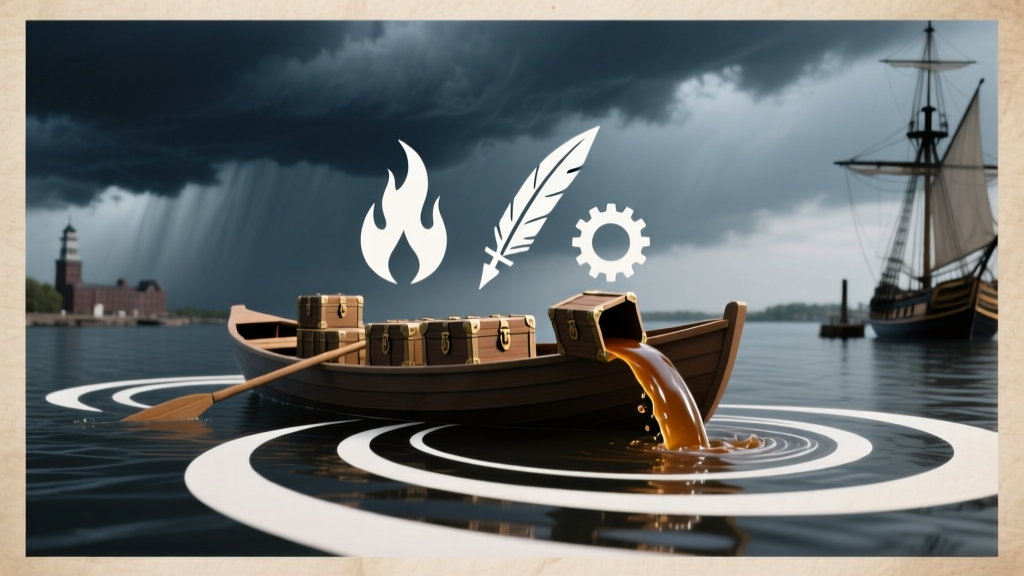
What Was the Impact of the Boston Tea Party? 7 Unexpected Consequences That Shaped America’s Path to Revolution (and Why Modern Event Planners Still Study Its Strategy)
Why This Isn’t Just History — It’s a Blueprint for Impactful Civic Engagement
What was the impact of the Boston Tea Party? Far more than a dramatic act of protest against tea taxes, it ignited a cascade of political, economic, and psychological consequences that reshaped colonial identity and forced Britain into a fatal miscalculation. Today, educators, living-history coordinators, museum exhibit designers, and municipal event planners studying revolutionary-era programming rely on this event not as a relic—but as a masterclass in symbolic action, coalition-building, and strategic escalation. If you’re planning a Constitution Day celebration, a school district’s Colonial Week, or a heritage tourism initiative, understanding these layered impacts isn’t optional—it’s essential.
The Immediate Political Fallout: From Tea Chests to Martial Law
Within weeks of December 16, 1773, Parliament responded—not with negotiation—but with punitive legislation collectively known as the Coercive Acts (or Intolerable Acts in the colonies). These weren’t abstract laws; they were surgical strikes designed to isolate and humiliate Massachusetts. The Boston Port Act closed the harbor until restitution was paid—effectively strangling the city’s economy. The Massachusetts Government Act revoked the colony’s charter, replacing elected officials with Crown appointees. The Administration of Justice Act allowed royal officials accused of crimes to be tried in England—removing local accountability. And the Quartering Act authorized housing troops in private homes.
Crucially, these measures backfired spectacularly. Rather than cowing Boston, they triggered unprecedented intercolonial solidarity. When Virginia’s House of Burgesses declared a day of fasting and prayer in support of Boston, Governor Dunmore dissolved the assembly—only for members to reconvene at Raleigh Tavern and pledge aid. Similar responses erupted from New York, Philadelphia, and Charleston. By September 1774, delegates from twelve colonies convened the First Continental Congress—not to petition, but to coordinate resistance. As John Adams wrote in his diary: “This meeting is the most important event that ever happened in America.”
Economic Ripple Effects: How One Night of Destruction Transformed Colonial Trade
The Boston Tea Party destroyed 342 chests—90,000 pounds—of East India Company tea valued at £9,659 (≈ $1.7 million today). But the financial impact extended far beyond that sum. British merchants who held tea consignments across the colonies canceled shipments preemptively. Colonial importers, fearing reprisals or boycotts, refused to accept new cargoes—even before formal non-importation agreements were ratified. By early 1774, over 80% of colonial ports had enacted coordinated commercial sanctions.
A lesser-known consequence was the rise of domestic alternatives. Women-led groups like the Daughters of Liberty organized ‘liberty teas’ using native herbs—spicebush, raspberry leaf, mint—and spun homespun cloth to replace British textiles. In Newport, Rhode Island, women held public spinning bees attracting hundreds; in Edenton, North Carolina, 51 women signed a declaration boycotting British goods—a document widely reprinted in London papers, shocking British elites who’d assumed colonial women were apolitical. These weren’t side effects—they were infrastructure. They created parallel supply chains, built leadership pipelines, and normalized collective economic discipline—practices modern event planners replicate when designing community-led sustainability fairs or local vendor co-ops.
The Propaganda Breakthrough: Turning Vandalism into Virtue
Colonial leaders knew perception would determine outcome. So they engineered narrative control with astonishing precision. Samuel Adams and the Sons of Liberty didn’t just dump tea—they dressed as Mohawk warriors, spoke in low voices, swept the decks clean afterward, and swore oaths of secrecy. Why? To signal this wasn’t lawless rioting, but disciplined, principled resistance rooted in Indigenous sovereignty symbolism (a deliberate contrast to British imperialism) and Enlightenment ideals of natural rights.
Newspapers like the Boston Gazette published eyewitness accounts emphasizing orderliness and restraint. Paul Revere carved and distributed engravings showing British soldiers firing on unarmed civilians (the Boston Massacre), then pivoted to illustrated broadsides depicting the Tea Party as solemn, almost ceremonial. Crucially, they avoided naming participants—protecting identities while amplifying moral authority. When British officials called it ‘vandalism,’ colonists reframed it as ‘constitutional defense.’ When Parliament labeled it treason, pamphleteers like Thomas Paine retorted: ‘Treason against tyranny is loyalty to liberty.’ This narrative architecture—clear framing, visual storytelling, anonymity-as-strategy—is why modern civic event planners study the Tea Party when launching advocacy campaigns or heritage festivals: it proves symbolism, consistency, and audience empathy matter more than scale.
Long-Term Institutional Legacies: From Committees of Correspondence to Modern Civic Infrastructure
The Tea Party catalyzed permanent organizational innovation. Before 1773, colonies communicated sporadically. Afterward, the Committee of Correspondence—first launched in Boston in 1772, then adopted by all thirteen colonies—became the first intercolonial information network. It shared intelligence, coordinated boycotts, standardized messaging, and even tracked British troop movements. Think of it as the 18th-century equivalent of a Slack workspace for revolutionaries.
This infrastructure directly enabled the First and Second Continental Congresses—and later, the Articles of Confederation. More tangibly, it birthed civic models still in use: town hall forums, citizen advisory boards, participatory budgeting pilots, and even modern open-data portals for municipal transparency. For example, when the City of Boston launched its 2023 ‘Revolutionary Legacy’ public history initiative, planners explicitly modeled their neighborhood storytelling hubs on the 1773 Committees—training local residents as ‘correspondents’ to collect oral histories, map historic sites, and co-design walking tours. That’s not nostalgia—that’s applied legacy.
| Impact Category | Short-Term Effect (1773–1775) | Medium-Term Effect (1776–1789) | Modern Event Planning Relevance |
|---|---|---|---|
| Political Unity | First Continental Congress convened; intercolonial alliances formed | Declaration of Independence drafted; Articles of Confederation ratified | Template for multi-stakeholder coalitions (e.g., city + schools + nonprofits co-hosting Juneteenth festivals) |
| Economic Strategy | Non-importation agreements enforced across 12 colonies | Continental currency issued; wartime procurement networks established | Framework for local vendor requirements, ‘buy-local’ festival mandates, and sustainable sourcing policies |
| Narrative Control | Coordinated press releases, engraved visuals, coded language (e.g., ‘Mohawk’ disguise) | Paine’s Common Sense sold 500,000 copies; state constitutions embedded revolutionary rhetoric | Best practices for branded storytelling, accessibility-first content design, and myth-busting exhibit labels |
| Civic Infrastructure | Committees of Correspondence operational in all colonies by 1774 | Post office system formalized; county courts reorganized under state authority | Blueprint for digital engagement platforms, volunteer ambassador programs, and participatory archiving projects |
Frequently Asked Questions
Was the Boston Tea Party really about tea—or was it symbolic?
It was overwhelmingly symbolic. Colonists could have bought cheaper smuggled Dutch tea—or even accepted the lower taxed East India Company tea. What they rejected was Parliament’s right to tax them without representation. As John Adams wrote in 1774: “The question was not whether we should pay the duty on tea… but whether we should consent to taxation without our consent.” The tea was merely the most visible, politically charged commodity available.
Did anyone die during the Boston Tea Party?
No. Not a single person was injured or killed. Participants took extraordinary care to avoid violence—damaging only the tea, not the ships or crew. One sailor reportedly offered the ‘Mohawks’ a cup of tea; they declined politely. This discipline was intentional: to distinguish constitutional protest from mob rule.
How did Britain respond—and why did it fail?
Britain imposed the Coercive (Intolerable) Acts—closing Boston Harbor, revoking self-government, and enabling military trials in England. It failed because it treated Massachusetts as an isolated problem, ignoring colonial interdependence. Instead of isolating Boston, it united the colonies. As George Washington observed: “The cause of Boston… now is and ever will be the cause of America.”
Were there other tea parties after Boston?
Yes—three documented ‘tea parties’ followed within months: in Charleston (December 1773), Annapolis (October 1774), and Greenwich, New Jersey (August 1774). Each adapted Boston’s model—targeting tea shipments, involving local elites and artisans, and issuing public declarations. None achieved Boston’s cultural resonance, but together they proved the tactic was replicable and scalable.
How do modern historians view the Tea Party’s legacy today?
Contemporary scholarship emphasizes its complexity: it was both a radical act of civil disobedience and a carefully managed performance of colonial masculinity and whiteness (Indigenous imagery was appropriated, enslaved people and women were excluded from leadership). Today’s best educational events acknowledge this duality—honoring its role in founding democracy while interrogating whose voices were amplified and silenced.
Common Myths
Myth #1: “The Boston Tea Party was a spontaneous riot led by angry mobs.”
Reality: It was meticulously planned over six weeks by the Boston Committee of Correspondence and Sons of Liberty. Participants were vetted, roles assigned (lookouts, hatchet men, sweepers), and strict rules enforced—including no damage beyond tea and no alcohol consumed on board.
Myth #2: “Colonists hated tea itself and wanted to ban it.”
Reality: Most colonists loved tea—and continued drinking it throughout the Revolution using smuggled or domestically grown alternatives. Their objection was solely to taxation without representation, not the beverage.
Related Topics (Internal Link Suggestions)
- First Continental Congress planning guide — suggested anchor text: "how to organize a multi-stakeholder civic summit"
- Colonial-era reenactment safety protocols — suggested anchor text: "authentic yet inclusive historical event guidelines"
- Teaching the American Revolution through primary sources — suggested anchor text: "engaging classroom activities for grades 5–12"
- Designing inclusive heritage tourism experiences — suggested anchor text: "moving beyond founding father narratives"
- Nonviolent protest tactics in U.S. history — suggested anchor text: "from Boston Tea Party to Selma"
Your Next Step: Turn Legacy Into Action
Understanding what was the impact of the Boston Tea Party isn’t about memorizing dates—it’s about recognizing how strategic symbolism, cross-sector coordination, and narrative discipline can transform a single act into lasting institutional change. Whether you’re drafting a grant proposal for a community history project, designing an interactive museum exhibit, or training high school students to lead oral history interviews, the Tea Party offers actionable lessons: start small but think systemically; protect your people while amplifying your message; and always ask—who benefits from this story, and who’s missing from it? Download our free Revolutionary Event Planning Toolkit—complete with timeline templates, stakeholder mapping worksheets, and inclusive framing language guides—to apply these principles to your next civic initiative.
More Articles
 How Do We Party Pop Singer? 7 Real-World Steps to Throw a Chart-Topping Pop Star-Themed Party (Without Hiring a PR Team or Going Over Budget)
 How to Gracefully Withdraw from an A-Rank Party Without Burning Bridges: A Step-by-Step Protocol Used by Top Executives, Diplomats, and Talent Agents (No Awkwardness, No Reputation Damage)
What to Wear on a Yacht Party: 7 Non-Negotiable Outfit Rules (That Prevent Wind-Blown Disasters, Sunburns, & Awkward Barefoot Moments)
How to Gracefully Withdraw from an A-Rank Party Without Burning Bridges: A Step-by-Step Protocol Used by Top Executives, Diplomats, and Talent Agents (No Awkwardness, No Reputation Damage)
What to Wear on a Yacht Party: 7 Non-Negotiable Outfit Rules (That Prevent Wind-Blown Disasters, Sunburns, & Awkward Barefoot Moments)
 What Political Party Was George Washington In? The Truth That Changes How You Understand America’s First President — And Why Every Civic Educator Gets This Wrong
What Is a Right Wing Party? 7 Myths You Still Believe (And Why They’re Costing You Political Clarity in 2024)
What Political Party Was George Washington In? The Truth That Changes How You Understand America’s First President — And Why Every Civic Educator Gets This Wrong
What Is a Right Wing Party? 7 Myths You Still Believe (And Why They’re Costing You Political Clarity in 2024)
 When Did the Great Party Switch Happen? The Real Answer (and How to Pivot Your Event Like a Pro—Without Chaos, Cost Overruns, or Guest Confusion)
How to Throw a Gender Reveal Party Without the Stress, Mess, or Misfires: A Realistic 7-Step Playbook That 92% of First-Time Planners Wish They’d Had From Day One
How to Make Pride Party Invitations That Actually Reflect Joy, Inclusion & Your Guest List—Not Just Rainbows and Fonts (A Step-by-Step Guide You Can Start Today)
When Did the Great Party Switch Happen? The Real Answer (and How to Pivot Your Event Like a Pro—Without Chaos, Cost Overruns, or Guest Confusion)
How to Throw a Gender Reveal Party Without the Stress, Mess, or Misfires: A Realistic 7-Step Playbook That 92% of First-Time Planners Wish They’d Had From Day One
How to Make Pride Party Invitations That Actually Reflect Joy, Inclusion & Your Guest List—Not Just Rainbows and Fonts (A Step-by-Step Guide You Can Start Today)
 What Does the Democratic Party Believe In? A Clear, Nonpartisan Breakdown of Core Values, Policy Priorities, and Real-World Impact—No Spin, No Jargon, Just Facts You Can Trust