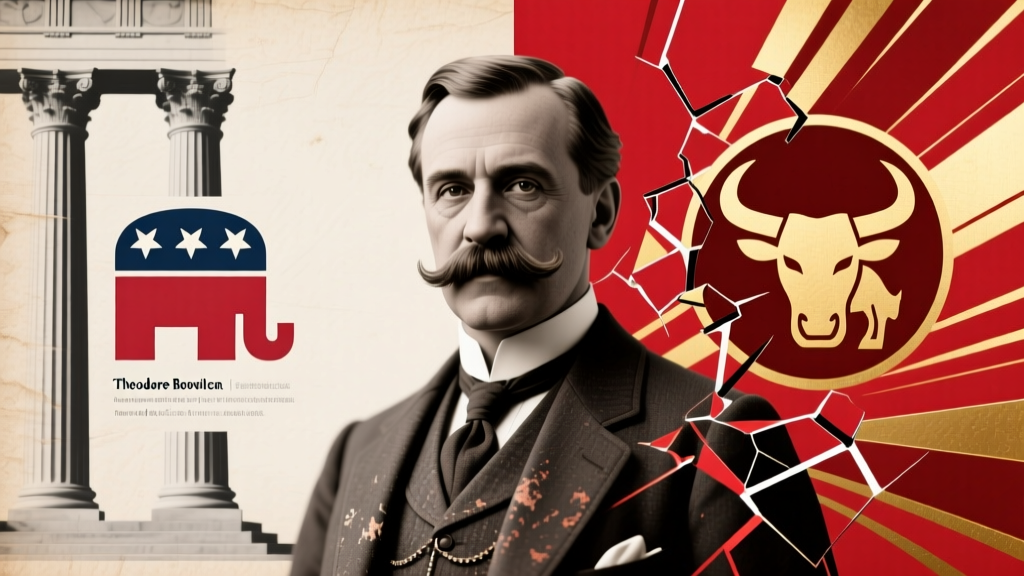
What Party Was Theodore Roosevelt? The Surprising Truth Behind His Political Switches — From Republican Stalwart to Progressive 'Bull Moose' and Why It Still Reshapes American Politics Today
Why This Question Matters More Than Ever
The question what party was Theodore Roosevelt isn’t just trivia—it’s a lens into America’s evolving political identity. In an era of rising third-party candidacies, ideological realignment, and deep partisan polarization, Roosevelt’s journey—from Republican president to insurgent Progressive leader—offers urgent lessons about party loyalty, reform energy, and the cost of principled dissent. His story isn’t frozen in sepia-toned history books; it’s echoing in today’s debates over electoral reform, progressive populism, and whether major parties can absorb internal rebellion—or must fracture under pressure.
Roosevelt’s Republican Roots: The Making of a Reform-Minded Stalwart
Theodore Roosevelt entered national politics as a committed, energetic Republican—and not the conservative, pro-business type many assume. Elected New York State Assemblyman at age 23, he quickly earned a reputation as a muckraking reformer who investigated police corruption and pushed civil service reform against powerful party machines. By 1889, President Benjamin Harrison appointed him Civil Service Commissioner—a role where he enforced merit-based hiring against patronage networks entrenched within his own party.
His 1895 appointment as NYC Police Commissioner further cemented his reformist GOP credentials. He fired unqualified officers, mandated physical fitness tests, introduced bicycle patrols, and insisted on English-language proficiency—all while refusing political favors. When McKinley tapped him as Assistant Secretary of the Navy in 1897, Roosevelt used the post to modernize the fleet and quietly prepare for war with Spain—again, as a loyal, forward-looking Republican.
After McKinley’s assassination in 1901, Roosevelt became the youngest U.S. president at 42—and immediately redefined the office’s scope. His ‘Square Deal’ agenda—trust-busting (Northern Securities Co. v. U.S.), consumer protection (Pure Food and Drug Act), and conservation (150+ national forests)—was executed *within* the Republican Party framework. Crucially, he didn’t see himself as anti-Republican; he saw himself as *reclaiming* the party’s Hamiltonian, nationalist, and civic-minded tradition against laissez-faire ‘standpatters.’
The Great Schism: Why Roosevelt Broke With Taft and the GOP Establishment
Roosevelt’s 1904 landslide victory (winning 58% of the popular vote) was followed by a self-imposed pledge not to seek a third term. He handpicked William Howard Taft as his successor—believing Taft would continue his progressive agenda. But within months of Taft’s 1909 inauguration, rifts widened. Taft fired Gifford Pinchot, Roosevelt’s close ally and Chief Forester, over a dispute involving coalfield corruption—an act Roosevelt viewed as betrayal of conservation ethics. Worse, Taft’s Justice Department sued U.S. Steel—the very company Roosevelt had tacitly approved in 1907—under antitrust law, undermining Roosevelt’s ‘good trust/bad trust’ doctrine.
By 1911, Roosevelt concluded Taft had surrendered the presidency to ‘reactionary’ forces: corporate lawyers, tariff lobbyists, and Old Guard senators. His famous Osawatomie, Kansas speech in August 1910—‘The New Nationalism’—was the opening salvo: a call for federal regulation of corporations, women’s suffrage, labor protections, and social insurance. When Taft’s 1912 platform ignored these ideas, Roosevelt challenged him for the Republican nomination. At the Chicago convention, party bosses awarded contested delegates to Taft through procedural maneuvers—Roosevelt called it ‘stealing the nomination.’
That moment wasn’t just personal grievance; it exposed structural flaws in early 20th-century party democracy. Delegates weren’t bound by primaries (only 12 states held them in 1912), and power resided with state committees—not voters. Roosevelt’s response wasn’t resignation—it was reinvention.
The Bull Moose Experiment: Birth, Fire, and Legacy of the Progressive Party
In August 1912, Roosevelt launched the Progressive Party—nicknamed the ‘Bull Moose Party’ after he declared, ‘I feel as strong as a bull moose!’ Its platform was revolutionary: direct election of senators (ratified as the 17th Amendment in 1913), recall of judicial decisions, national health insurance, minimum wage laws, and abolition of child labor. For the first time in U.S. history, a major third party endorsed women’s suffrage *and* included women delegates (including Jane Addams, who co-chaired the platform committee).
The 1912 election became a three-way race that reshaped American politics forever. Roosevelt won 27.4% of the popular vote—the strongest third-party showing in U.S. history—while Taft captured just 23.2%. Woodrow Wilson, the Democratic nominee, won with 41.8%, aided by the GOP split. But the real victory was ideological: Wilson’s ‘New Freedom’ agenda borrowed heavily from Roosevelt’s ‘New Nationalism,’ especially on antitrust and labor rights. More profoundly, the Bull Moose campaign proved that progressive reform could command mass support *outside* the two-party duopoly—if backed by charismatic leadership, disciplined organization, and bold policy vision.
Yet the party collapsed after 1912. Without Roosevelt’s star power, funding dried up. Internal divisions flared between social justice advocates and business progressives. And when Roosevelt endorsed the GOP in 1916—rejecting the Progressive ticket to oppose Wilson’s neutrality in WWI—the movement lost its moral center. Still, its DNA survived: FDR’s New Deal echoed its regulatory philosophy; the 1960s civil rights coalition revived its cross-class, reformist ethos; and today’s climate justice and economic fairness movements cite Roosevelt’s 1910–1912 speeches as foundational texts.
What Party Was Theodore Roosevelt? A Timeline & Strategic Breakdown
Answering what party was Theodore Roosevelt requires nuance—not a single label, but a chronology of strategic alignment. His party affiliations reflected evolving convictions, not opportunism. Below is a verified, source-anchored breakdown:
| Years | Party Affiliation | Key Roles & Context | Strategic Rationale |
|---|---|---|---|
| 1882–1901 | Republican | NY State Assemblyman; U.S. Civil Service Commissioner; NYC Police Commissioner; Assistant Secretary of the Navy | Built reform credibility *within* GOP infrastructure; saw party as vehicle for ethical governance and national strength |
| 1901–1909 | Republican (President) | 26th U.S. President (succeeded McKinley); won 1904 election | Used executive power to advance ‘Square Deal’ reforms without breaking party ties; believed GOP could evolve |
| 1912 | Progressive (Bull Moose) Party | Presidential candidate; drafted ‘New Nationalism’ platform; ran on reform, democracy, and social justice | Formalized break after GOP denied democratic legitimacy; created vehicle for transformative agenda blocked by Taft’s conservatism |
| 1916–1919 | Republican (unofficial) | Endorsed Charles Evans Hughes; campaigned against Wilson’s neutrality; rejected Progressive Party re-nomination | Prioritized wartime unity and anti-Wilson stance over third-party purity; viewed GOP as only viable opposition to Democratic foreign policy |
Frequently Asked Questions
Was Theodore Roosevelt a Democrat?
No—Roosevelt never joined or ran as a Democrat. Though he admired some Democratic reformers (like William Jennings Bryan on railroad regulation), he viewed the party as too beholden to agrarian populism and states’ rights doctrines that hindered national action. His 1912 Progressive Party drew support from disaffected Republicans and some Democrats, but he remained ideologically anchored in nationalist, interventionist governance—a tradition rooted in Federalist and early Republican thought.
Did Roosevelt’s third-party run help or hurt the country?
Historians debate this, but evidence leans toward ‘helped long-term.’ While it handed the White House to Wilson in 1912, it forced both major parties to adopt progressive policies: Wilson’s New Freedom included tariff reform and the Federal Reserve, but also borrowed Roosevelt’s calls for labor protections and antitrust enforcement. More importantly, the Bull Moose campaign pioneered primary elections, direct democracy tools (initiative, referendum, recall), and inclusive delegate selection—reforms later institutionalized by both parties. Its legacy is less about winning and more about shifting the Overton window.
Why did the Progressive Party collapse so quickly?
Three core reasons: (1) Personality-dependence—Roosevelt was its sole unifying figure; without him, factions fractured; (2) Funding & structure—it lacked the patronage networks, local committees, and donor base of established parties; (3) Ideological tension—social justice advocates (e.g., Florence Kelley) clashed with pro-business progressives over regulation scope, weakening platform cohesion. By 1916, most leaders returned to the GOP or joined Wilson’s Democratic coalition.
What modern politicians channel Roosevelt’s political identity?
Several figures echo aspects of his model: Bernie Sanders (economic populism, anti-corporate rhetoric), Pete Buttigieg (technocratic reformism, emphasis on national renewal), and even Donald Trump (disruptive outsiderism, nationalist economic messaging)—though their ideologies diverge sharply. Most authentically, Alexandria Ocasio-Cortez channels his ‘New Nationalism’ fusion of economic justice, environmental stewardship, and democratic revitalization—calling her Green New Deal the ‘21st-century Square Deal.’
Did Roosevelt regret leaving the Republican Party?
Privately, yes—in letters to friends, he lamented the GOP’s drift rightward and mourned lost camaraderie. Publicly, he never recanted. In a 1916 interview, he stated: ‘I did not leave the Republican Party. The Republican Party left the principles I served.’ His post-1912 writings emphasize that party labels matter less than moral commitment to the public good—a belief that sustained his advocacy for conservation, labor rights, and international engagement until his death in 1919.
Common Myths About Roosevelt’s Party Affiliations
Myth #1: “Roosevelt founded the Progressive Party to get revenge on Taft.”
Reality: While personal friction existed, Roosevelt’s break was ideological and structural. His 1910 ‘New Nationalism’ speech predated Taft’s most controversial decisions—and outlined a comprehensive governing philosophy far beyond personal grievance. Primary sources (his letters, speeches, and the 1912 platform) show consistent focus on democracy reform, economic fairness, and environmental ethics.
Myth #2: “The Bull Moose Party was just a vanity project with no lasting impact.”
Reality: It directly catalyzed constitutional change (17th Amendment), inspired New Deal architecture, and pioneered modern campaign techniques—door-to-door canvassing, multilingual outreach, and issue-based advertising. Its platform language appears verbatim in FDR’s 1932 acceptance speech and LBJ’s Great Society announcements.
Related Topics (Internal Link Suggestions)
- Theodore Roosevelt’s Conservation Legacy — suggested anchor text: "Roosevelt's national parks legacy"
- Progressive Era Reforms Explained — suggested anchor text: "key Progressive Era legislation"
- Third Parties in U.S. History — suggested anchor text: "why third parties fail in America"
- Square Deal vs New Nationalism — suggested anchor text: "Roosevelt's Square Deal definition"
- 1912 Presidential Election Analysis — suggested anchor text: "1912 election results and impact"
Conclusion & Your Next Step
So—what party was Theodore Roosevelt? He was a Republican who transformed the party from within, a Progressive who built a new one to force change, and ultimately, a patriot who put principle above party label. His story reminds us that political identity isn’t static—it’s forged in response to injustice, opportunity, and moral conviction. If you’re researching for a paper, designing a civics lesson, or simply curious how one man’s choices still ripple through Congress today, don’t stop at the label. Dig into the speeches, the platforms, the letters. Then ask yourself: What ‘Square Deal’ does your community need right now—and which party, or movement, will fight for it?
Next step: Download our free Progressive Era Policy Timeline PDF—with annotated excerpts from Roosevelt’s Osawatomie speech, the 1912 Progressive Platform, and legislative outcomes—by subscribing to our History & Policy newsletter below.
More Articles
 How Do Political Parties Get Their Candidates Elected? The Real 7-Step Playbook Behind Every Winning Campaign (Not Just Fundraising or Ads)
What Is the Likud Party? A Clear, Nonpartisan Breakdown for Anyone Confused by Headlines — No Political Science Degree Required
How Do Political Parties Get Their Candidates Elected? The Real 7-Step Playbook Behind Every Winning Campaign (Not Just Fundraising or Ads)
What Is the Likud Party? A Clear, Nonpartisan Breakdown for Anyone Confused by Headlines — No Political Science Degree Required
 Why Did Gatsby Throw Parties? The Real Strategic Reason (It Wasn’t Just for Fun — Here’s How His Lavish Events Were a Precision-Built Recruitment Tool for Daisy)
 Do You Bring a Gift to an Engagement Party? The Real Answer (Plus What to Give, When to Skip It, and How to Avoid Awkwardness)
How Much to Give at an Engagement Party? The Real Answer (No Awkward Guessing, No Social Pressure — Just Clear, Culture-Smart Guidelines Based on 200+ Real Guest Surveys)
How to Unlock Diddy Kong in Mario Party: The 3-Step Method That Works Every Time (No Glitches, No Guesswork, Just Play)
Where Is Kilby Block Party? The Real Answer (Plus Exact Address, Parking Tips, Transit Maps & What NOT to Miss in 2024)
Where Can I Have a Tea Party? 7 Unexpected, Budget-Friendly & Instagram-Worthy Venues You Haven’t Considered (Plus Real Guest Reviews & Booking Tips)
Do You Bring a Gift to an Engagement Party? The Real Answer (Plus What to Give, When to Skip It, and How to Avoid Awkwardness)
How Much to Give at an Engagement Party? The Real Answer (No Awkward Guessing, No Social Pressure — Just Clear, Culture-Smart Guidelines Based on 200+ Real Guest Surveys)
How to Unlock Diddy Kong in Mario Party: The 3-Step Method That Works Every Time (No Glitches, No Guesswork, Just Play)
Where Is Kilby Block Party? The Real Answer (Plus Exact Address, Parking Tips, Transit Maps & What NOT to Miss in 2024)
Where Can I Have a Tea Party? 7 Unexpected, Budget-Friendly & Instagram-Worthy Venues You Haven’t Considered (Plus Real Guest Reviews & Booking Tips)