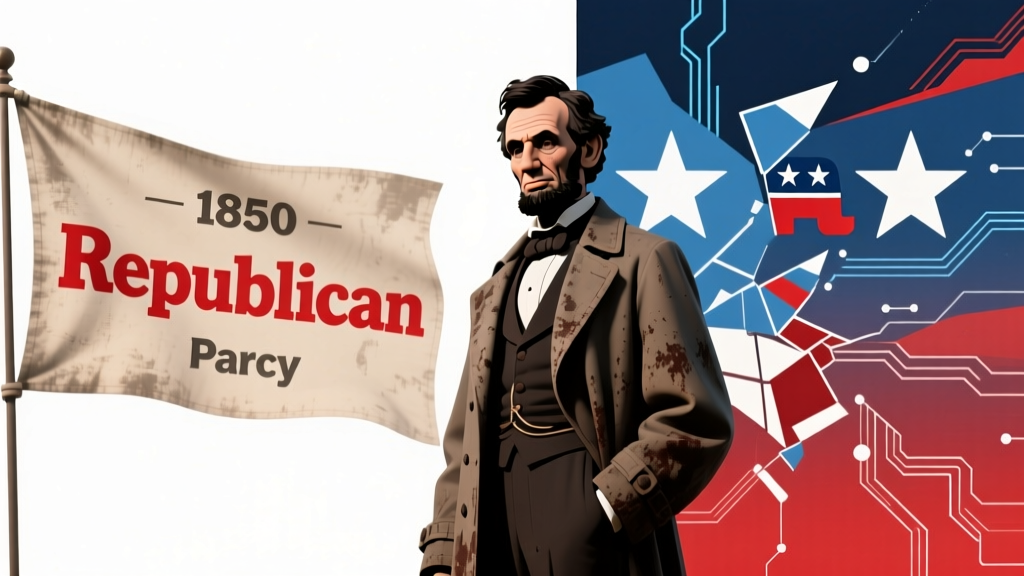
What Party Did Abraham Lincoln Belong To? The Surprising Truth Behind His Political Switch — And Why Most Textbooks Get It Wrong (Plus How His Party’s Evolution Shapes Today’s Politics)
Why This Question Matters More Than Ever
What party did Abraham Lincoln belong to? That simple question opens a door to understanding America’s deepest political fault lines — not just in 1860, but right now. As voters navigate record polarization, resurgent third-party movements, and debates over party loyalty versus principle, Lincoln’s journey from Whig congressman to Republican president offers urgent lessons in moral courage, strategic coalition-building, and ideological reinvention. His story isn’t dusty history — it’s a living playbook for anyone trying to lead change within broken systems.
From Kentucky Roots to Whig Convictions
Abraham Lincoln didn’t begin as a Republican — he began as a devoted Whig. Born in 1809 in a log cabin near Hodgenville, Kentucky, Lincoln absorbed early political values from frontier newspapers, self-education, and mentors like John Todd Stuart, who introduced him to Henry Clay’s ‘American System.’ That vision — federally funded infrastructure, a national bank, protective tariffs, and internal improvements — defined Whig identity in the 1830s and 1840s. Lincoln served four terms in the Illinois General Assembly (1834–1842) and one term in the U.S. House of Representatives (1847–1849) as a Whig. He championed railroads, river navigation projects, and public education — all hallmarks of Whig economic nationalism.
But cracks appeared early. The Whig Party fractured over slavery. While northern Whigs increasingly opposed its expansion, southern Whigs defended it as a constitutional right. Lincoln himself avoided abolitionist rhetoric but drew a firm line: he called slavery ‘a monstrous injustice’ and declared in 1854 that he could not ‘rest’ while the nation allowed its spread into new territories. When Congress passed the Kansas-Nebraska Act — repealing the Missouri Compromise and enabling popular sovereignty — Lincoln saw it as the death knell for principled conservatism. His famous ‘Peoria Speech’ that October wasn’t just opposition; it was a full-throated philosophical indictment of slavery’s moral and democratic corrosion.
The Birth of the Republican Party: A Coalition Forged in Crisis
By late 1854, Whig chapters across the Midwest were collapsing. In Ripon, Wisconsin, anti-Nebraska activists met in a schoolhouse and proposed a new party — one explicitly dedicated to halting slavery’s expansion. Similar gatherings erupted in Michigan, Iowa, and Illinois. Lincoln attended the first official Illinois Republican convention in Bloomington on May 29, 1856 — not as a founder, but as a respected elder statesman whose credibility bridged former Whigs, Free Soilers, and disaffected Democrats. He delivered the ‘Lost Speech,’ so named because no transcript survived — but eyewitnesses recalled its fiery moral clarity and unifying force.
Crucially, the Republican Party wasn’t born as an abolitionist party. Its 1856 platform demanded only that slavery be excluded from federal territories — a position Lincoln called ‘the very soul of the organization.’ He rejected radicalism but refused compromise: ‘A house divided against itself cannot stand,’ he declared in his 1858 Senate race against Stephen Douglas. That speech shocked many — not for calling for emancipation, but for framing slavery as an existential threat to democracy itself. Republicans weren’t just opposing a policy; they were defending the foundational premise that liberty required active institutional defense.
Lincoln’s nomination at the 1860 Chicago Convention was a masterclass in coalition politics. Delegates included former Know-Nothings (anti-immigrant), ex-Free Soilers (anti-slavery expansion), and ex-Whigs (pro-business, pro-union). Lincoln won on the third ballot — not because he was the most famous, but because he was the most ‘available’: untainted by recent controversial votes, geographically balanced (from swing-state Illinois), and ideologically precise. His acceptance letter emphasized unity: ‘The struggle of today is not altogether for today — it is for a vast future also.’
Lincoln’s Presidency: Governing Across Party Lines
Once elected, Lincoln didn’t govern as a partisan ideologue — he governed as a wartime constitutional steward. His cabinet famously included rivals: William Seward (ex-Whig, anti-Lincoln frontrunner), Salmon Chase (radical Republican, later Chief Justice), and Edward Bates (ex-Whig conservative, Attorney General). This ‘Team of Rivals’ model wasn’t symbolic — it was operational. Lincoln held weekly cabinet meetings where dissent was not just tolerated but invited. When Seward drafted a condescending memo urging Lincoln to defer major decisions, Lincoln responded with quiet authority — then kept Seward as Secretary of State.
He also appointed Democrats to key posts: Montgomery Blair as Postmaster General, Andrew Johnson (a Tennessee Democrat) as military governor of Tennessee — and later, his own Vice President. Lincoln understood that preserving the Union required legitimacy beyond Republican ranks. His 1863 Emancipation Proclamation was framed legally — as a war measure under presidential commander-in-chief powers — precisely to insulate it from judicial or partisan challenge. And when the 13th Amendment came before Congress in 1865, Lincoln personally lobbied lame-duck Democrats, offering patronage jobs and appeals to legacy. The final vote passed by just two votes — a triumph of cross-party persuasion, not party discipline.
A lesser-known fact: Lincoln quietly supported the formation of the National Union Party in 1864 — a temporary rebranding of the Republican ticket designed to attract War Democrats and border-state Unionists. His running mate wasn’t another Republican, but Johnson — a slaveholding Southern Democrat who’d remained loyal to the Union. The National Union banner signaled that this election wasn’t about party purity, but national survival.
How Lincoln’s Party Identity Shapes Modern Politics
Today’s Republican Party bears little resemblance to Lincoln’s. In 1860, the GOP was the party of federal investment, immigrant rights (it opposed the nativist Know-Nothings), progressive taxation (the first federal income tax was signed by Lincoln in 1861), and civil rights leadership (the Civil Rights Act of 1866 and 14th Amendment passed under Republican supermajorities). By contrast, modern GOP platforms emphasize deregulation, restrictive immigration policies, and states’ rights — positions often aligned with pre–Civil War Democrats.
This isn’t coincidence — it’s the result of the ‘Southern Strategy’ beginning in the 1960s, when Republican operatives deliberately courted white segregationist voters alienated by the Democratic Party’s embrace of civil rights. Political scientist Larry Bartels documented that between 1960 and 2000, the ideological positions of the two major parties effectively swapped on racial issues, economic intervention, and federal power. Lincoln’s original Republican vision — pro-Union, pro-opportunity, pro-federal responsibility — now finds stronger resonance in certain progressive and centrist Democratic platforms than in today’s GOP.
That reality creates profound tension for historians, educators, and civic leaders. When schools teach ‘Lincoln was a Republican,’ without context, students absorb an incomplete truth — one that can mislead them into assuming modern party labels carry stable meaning across centuries. The deeper lesson isn’t party affiliation — it’s how principles migrate, coalitions dissolve and reform, and leadership requires both fidelity to core values and flexibility in strategy.
| Dimension | Lincoln-Era Republican Party (1854–1865) | Modern Republican Party (Post-1964) | Key Shift Catalyst |
|---|---|---|---|
| Economic Policy | Strong federal role: national bank, tariffs, infrastructure spending, first income tax | Emphasis on deregulation, tax cuts, limited federal economic intervention | Reagan Revolution (1980s); rise of supply-side economics |
| Race & Civil Rights | Founded on anti-slavery expansion; passed 13th, 14th, 15th Amendments; created Freedmen’s Bureau | Opposed 1964 Civil Rights Act (61% of GOP Senators voted nay); shifted toward ‘law and order’ rhetoric | Nixon’s Southern Strategy (1968); Goldwater’s 1964 campaign opposition to Civil Rights Act |
| Immigration Stance | Pro-immigrant: welcomed Germans, Irish; opposed nativist Know-Nothings; supported naturalization rights | Generally restrictive: supports border walls, limits on asylum, reduced legal immigration | 1990s–2000s anti-illegal immigration activism; post-9/11 security framing |
| Federal vs. State Power | Asserted strong federal supremacy to preserve Union and enforce Reconstruction | Emphasizes states’ rights, particularly on social issues (abortion, gun control, education) | Reaction to New Deal expansion; rise of conservative legal movement (Federalist Society) |
Frequently Asked Questions
Was Abraham Lincoln ever a member of the Democratic Party?
No — Lincoln never joined the Democratic Party. Though he debated Democrat Stephen Douglas and worked alongside War Democrats during the Civil War, he consistently opposed the party’s pro-slavery expansion stance. His earliest political writings criticized Democrats for enabling ‘the extension of slavery,’ and he declined multiple overtures to run as a Democrat in the 1840s and 1850s.
Did Lincoln help found the Republican Party?
Not as a formal founder — the first Republican organizing meetings occurred in 1854 in Wisconsin and Michigan before Lincoln joined. But he was instrumental in shaping its ideology and credibility. His 1854 Peoria Speech laid the intellectual groundwork; his 1858 ‘House Divided’ speech crystallized its moral urgency; and his 1860 nomination gave it national legitimacy. Historians widely credit him as the party’s ‘founding standard-bearer.’
Why did the Whig Party collapse?
The Whig Party collapsed primarily due to irreconcilable divisions over slavery. Northern Whigs increasingly embraced anti-expansionism, while Southern Whigs prioritized protecting slavery and states’ rights. The 1852 presidential election — where the Whig nominee, Winfield Scott, lost badly and failed to carry a single Southern state — exposed fatal fractures. Without a unifying issue beyond opposition to Andrew Jackson’s legacy, the party had no anchor once slavery consumed national politics.
What happened to Lincoln’s Republican Party after his death?
After Lincoln’s assassination, the party split between Radical Republicans (led by Thaddeus Stevens and Charles Sumner), who pushed aggressive Reconstruction and Black suffrage, and Moderate Republicans (like Lincoln’s successor Andrew Johnson, ironically a Democrat), who favored quicker restoration of Southern states. The Radicals prevailed temporarily, passing landmark civil rights legislation — but by the 1870s, Northern fatigue, economic depression, and violent white supremacist backlash (e.g., Ku Klux Klan) led to the abandonment of Reconstruction. The party gradually shifted focus toward industrial growth, gold-standard monetary policy, and civil service reform — setting the stage for its 20th-century evolution.
Is there a modern political party that aligns with Lincoln’s beliefs?
No party maps perfectly onto Lincoln’s worldview — but elements resonate across today’s spectrum. His support for infrastructure investment, worker protections (he signed the Homestead Act and Pacific Railway Act), and federal enforcement of civil rights align more closely with progressive Democrats. His fiscal conservatism (balanced budgets, suspicion of debt), emphasis on meritocracy, and belief in self-reliance find echoes among centrist or reform-minded independents. Ultimately, Lincoln defies easy categorization — which is why studying him remains essential for diagnosing our own political moment.
Common Myths
Myth #1: Lincoln was the first Republican president, so the GOP has always stood for racial equality.
Reality: While Lincoln’s Republicans passed transformative civil rights laws, the party’s commitment eroded rapidly after 1877. Federal troops withdrew from the South, Jim Crow laws proliferated, and the GOP largely abandoned Black voters for decades — turning the party into a bastion of Northern business interests rather than racial justice.
Myth #2: Lincoln left the Whig Party because he disagreed with its economics.
Reality: Lincoln remained deeply committed to Whig economic principles — internal improvements, national banking, protective tariffs — throughout his life. His break was exclusively over slavery and the party’s inability to take a unified moral stand. He carried Whig economic policy directly into the Republican platform.
Related Topics (Internal Link Suggestions)
- Lincoln’s views on slavery — suggested anchor text: "Lincoln's evolving stance on slavery"
- History of the Whig Party — suggested anchor text: "rise and fall of the Whig Party"
- Republican Party platform 1860 — suggested anchor text: "1860 Republican Party platform explained"
- Abraham Lincoln and the Emancipation Proclamation — suggested anchor text: "how the Emancipation Proclamation changed the Civil War"
- Political realignment in U.S. history — suggested anchor text: "major U.S. political realignments timeline"
Your Turn: Reclaim Historical Literacy
Understanding what party Abraham Lincoln belonged to isn’t about nostalgia — it’s about reclaiming analytical tools. When you see politicians invoke Lincoln’s name, ask: Which Lincoln? The Whig legislator who built railroads? The Republican candidate who warned of a house divided? The wartime president who appointed Democrats to his cabinet? Context transforms slogans into substance. So go deeper: read his Peoria Speech, compare the 1856 and 2024 GOP platforms side-by-side, or visit Springfield’s Lincoln Home National Historic Site — where his law office still holds copies of Whig newspapers and Republican convention tickets. History doesn’t repeat — but it does rhyme. And Lincoln’s rhyme is still echoing.
More Articles
 A Little Party Never Killed Nobody — But Poor Planning *Can*: The 7-Minute Event Planner’s Framework to Host Stress-Free Micro-Parties That Actually Strengthen Relationships (No Budget Blowouts, No Guest Ghosting, No Regrets)
How We Do Party Singer Crossword: The Exact 7-Step System Top Event Planners Use to Seamlessly Blend Live Singing & Interactive Wordplay (Without Overwhelming Guests or Breaking Budget)
A Little Party Never Killed Nobody — But Poor Planning *Can*: The 7-Minute Event Planner’s Framework to Host Stress-Free Micro-Parties That Actually Strengthen Relationships (No Budget Blowouts, No Guest Ghosting, No Regrets)
How We Do Party Singer Crossword: The Exact 7-Step System Top Event Planners Use to Seamlessly Blend Live Singing & Interactive Wordplay (Without Overwhelming Guests or Breaking Budget)
 ‘A Little Party Never Killed Nobody Trump’: Why This Viral Meme Is Reshaping Modern Event Planning (And How to Host One Without the Cringe)
What Is Labour Party UK? The Truth Behind Its History, Values, Leadership, and Real Impact on Your Taxes, NHS, and Jobs — No Political Spin, Just Facts You Can Actually Use
Is the Hunting Party Good? 7 Real-World Reasons Why It’s Surging in Popularity (and 3 Critical Pitfalls Most Hosts Overlook)
‘A Little Party Never Killed Nobody Trump’: Why This Viral Meme Is Reshaping Modern Event Planning (And How to Host One Without the Cringe)
What Is Labour Party UK? The Truth Behind Its History, Values, Leadership, and Real Impact on Your Taxes, NHS, and Jobs — No Political Spin, Just Facts You Can Actually Use
Is the Hunting Party Good? 7 Real-World Reasons Why It’s Surging in Popularity (and 3 Critical Pitfalls Most Hosts Overlook)
 What Is Single Party System? The Truth Behind Its Stability, Risks, and Real-World Impact — Debunking 5 Myths That Still Shape Global Politics Today
 What to Wear to a Grad Party in 2024: The Stress-Free Style Guide That Saves You 3 Hours (and 2 Awkward Outfit Changes)
 Can I Join PlayStation Party on PC? The Truth About Cross-Platform Voice Chat in 2024 (Spoiler: It’s Possible—But Not Native)
 Networking Mixer Seating Arrangement Ideas
Who Is a Third Party Under CCPA? The 5-Second Rule That Just Saved Your Business $2.3M in Fines (and Why 87% of Marketers Still Get It Wrong)
Networking Mixer Seating Arrangement Ideas
Who Is a Third Party Under CCPA? The 5-Second Rule That Just Saved Your Business $2.3M in Fines (and Why 87% of Marketers Still Get It Wrong)