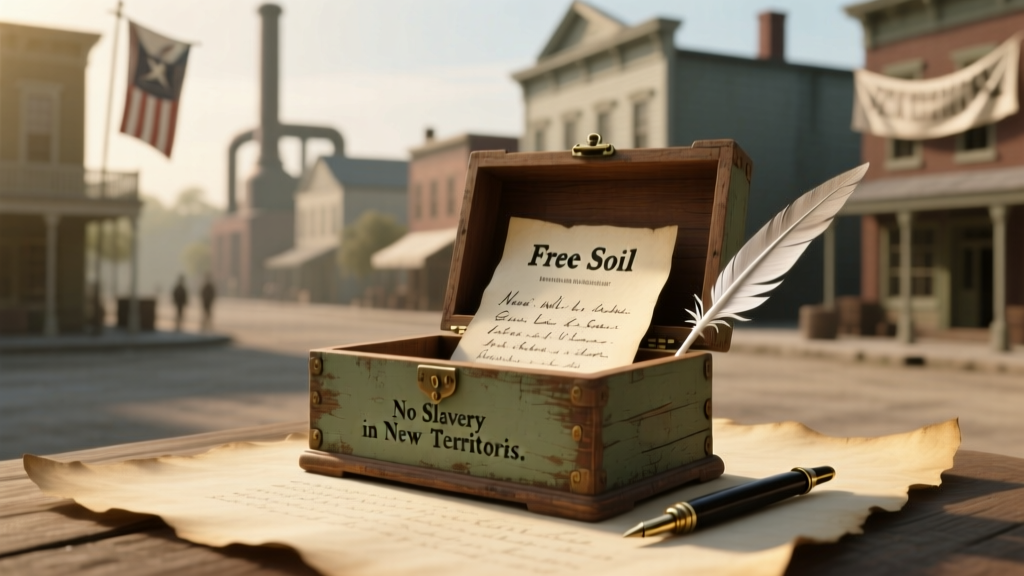
What Is the Free Soil Party? The Surprising Truth Behind America’s First Anti-Slavery Political Movement — And Why It Changed Presidential Elections Forever
Why This Obscure 19th-Century Party Still Matters Today
So — what is the Free Soil Party? At first glance, it sounds like a modern environmental coalition or perhaps a grassroots land-rights group. In reality, it was one of the most consequential third parties in American history — a bold, morally urgent political force that emerged in 1848 to oppose the expansion of slavery into newly acquired western territories. Though it lasted only five years and never won a presidential election, the Free Soil Party reshaped national politics, split the Democratic Party, forced the Whigs into irrelevance, and laid the indispensable ideological and organizational groundwork for the Republican Party — which would elect Abraham Lincoln just 12 years later. Understanding what the Free Soil Party was isn’t just academic nostalgia; it’s essential context for grasping how moral conviction, coalition-building, and strategic electoral disruption can alter the course of democracy.
The Birth of a Radical Coalition: How Four Factions Forged One Party
The Free Soil Party didn’t spring from a single ideology or leader — it was forged in crisis. In 1846, after the U.S. victory in the Mexican-American War, Congress faced a volatile question: Would slavery be permitted in California, New Mexico, and other vast new territories? The Wilmot Proviso — a proposed amendment banning slavery in any land acquired from Mexico — passed the House multiple times but died in the Senate, blocked by Southern Democrats and conservative Whigs.
That deadlock catalyzed an unprecedented alliance. In August 1848, at Buffalo, New York, over 15,000 delegates gathered — former anti-slavery Democrats (‘Barnburners’), conscience-stricken Whigs (‘Conscience Whigs’), members of the abolitionist Liberty Party, and independent reformers — all united under one banner: "Free Soil, Free Speech, Free Labor, and Free Men."
This wasn’t just rhetoric. Each phrase carried precise political weight:
- Free Soil meant no extension of slavery into federal territories — not necessarily abolition where it already existed;
- Free Speech defended the right to denounce slavery without censorship or mob violence;
- Free Labor championed the dignity of wage-earning white workers, warning that slave labor depressed wages and degraded opportunity;
- Free Men affirmed the rights of Black Americans to liberty and legal personhood — though the party stopped short of demanding immediate emancipation or full civil equality.
Crucially, this coalition was pragmatic, not purist. While abolitionists like Frederick Douglass criticized the party’s refusal to call for nationwide emancipation, Free Soilers argued that halting slavery’s growth was the most achievable, constitutionally defensible, and politically potent first step. Their slogan wasn’t “Abolish Slavery Now” — it was “Stop Its Spread.” And that restraint gave them broad appeal across the North.
Van Buren’s Run: The 1848 Election That Broke the Mold
The Free Soil Party’s first and most impactful test came in the 1848 presidential election. They nominated former Democratic president Martin Van Buren — a stunning choice. Once the architect of the Jacksonian Democratic machine, Van Buren had been sidelined after opposing the annexation of Texas and the war with Mexico. His candidacy signaled a dramatic realignment: a sitting establishment figure rejecting his own party’s pro-slavery drift.
Van Buren didn’t win — he earned just 10.1% of the popular vote (291,501 votes) and zero electoral votes. But the impact was seismic. In New York — a critical swing state — Van Buren siphoned 120,510 votes from Democrat Lewis Cass, handing the state’s 36 electoral votes to Whig Zachary Taylor. Without Free Soil interference, Cass likely wins New York and the presidency. As historian Eric Foner notes, “The Free Soil vote in New York was the margin of Taylor’s victory — and thus the margin that kept slavery’s expansion temporarily unchecked.”
More importantly, Van Buren’s campaign proved third parties could mobilize mass support, dominate local elections, and shift national discourse. Free Soil candidates won 12 seats in the U.S. House of Representatives — more than any third party had ever secured — and dominated state legislatures in Vermont, Massachusetts, and Wisconsin. Their platform became the default position of Northern voters: slavery must not spread.
From Free Soil to Republican: The Strategic Evolution of Anti-Slavery Politics
The Free Soil Party dissolved after the 1852 election, when its nominee John P. Hale won only 5% of the vote. But its legacy didn’t vanish — it metastasized. Between 1852 and 1854, three events accelerated its transformation: the passage of the Kansas-Nebraska Act (which repealed the Missouri Compromise and opened western territories to slavery via ‘popular sovereignty’), the violent chaos of ‘Bleeding Kansas,’ and the Supreme Court’s Dred Scott decision (1857), which declared Black people had no rights citizens could respect).
In response, former Free Soilers joined forces with anti-Nebraska Whigs, disaffected Know-Nothings, and radical abolitionists to form the Republican Party in 1854. The new party adopted the Free Soil core: opposition to slavery’s expansion, defense of free labor, and belief in federal authority to restrict slavery in territories. Its first presidential candidate, John C. Frémont, ran in 1856 on a platform nearly identical to the 1848 Free Soil platform — even using the same slogan.
By 1860, the Republican platform was a direct descendant: 11 of its 17 planks echoed Free Soil positions. Lincoln himself had been a Conscience Whig who supported Van Buren in 1848. When he declared in 1858, “A house divided against itself cannot stand,” he was channeling the Free Soil conviction that slavery and freedom could not coexist in the same nation — especially not in its expanding borders.
Free Soil’s Enduring Impact: Beyond the Ballot Box
The Free Soil Party’s influence extended far beyond electoral math. It pioneered tactics later perfected by reform movements: coordinated state-level organizing, issue-focused voter education (not personality-driven campaigns), and leveraging newspapers like The National Era and Freeman’s Journal to build a shared narrative.
It also redefined political morality. Before Free Soil, mainstream parties treated slavery as a sectional compromise. Free Soilers insisted it was a national sin requiring national action — and they made that argument accessible to farmers, shopkeepers, and mechanics, not just ministers and intellectuals. Their emphasis on free labor resonated with working-class whites who feared competition from enslaved labor — proving that moral arguments gain traction when tied to tangible self-interest.
Even their limitations tell a story. The party excluded Black delegates from its founding convention and avoided endorsing suffrage or integration. Yet Black activists like Charles Lenox Remond and Sojourner Truth spoke at Free Soil rallies, pushing the movement leftward. That tension — between pragmatic coalition-building and uncompromising justice — remains central to progressive politics today.
| Feature | Free Soil Party (1848–1854) | Liberty Party (1840–1848) | Republican Party (founded 1854) |
|---|---|---|---|
| Core Goal | Prevent slavery’s expansion into federal territories | Immediate abolition of slavery nationwide | Prevent slavery’s expansion; contain & ultimately eliminate it |
| Electoral Strategy | Win swing states (NY, OH, PA) by appealing to white labor & moderates | Build moral witness; rarely prioritized winning | Build broad Northern coalition; target electoral college math |
| Key Leaders | Martin Van Buren, Salmon P. Chase, Charles Sumner | James G. Birney, Gerrit Smith | Abraham Lincoln, William Seward, Thaddeus Stevens |
| Peak Vote Share | 10.1% (1848) | 2.3% (1844) | 39.8% (1860) |
| Legacy Outcome | Direct precursor to Republican Party; reshaped national debate | Paved ideological path; influenced Free Soil’s moral framing | Won presidency; led nation through Civil War & abolition |
Frequently Asked Questions
Was the Free Soil Party abolitionist?
No — not in the strict sense. While many Free Soilers were personally opposed to slavery, the party’s official platform focused exclusively on preventing slavery’s expansion into new territories. It explicitly avoided calling for emancipation in slave states, arguing that the Constitution protected slavery where it already existed. This distinction separated them from abolitionists like William Lloyd Garrison, who demanded immediate, universal emancipation.
Why did the Free Soil Party collapse so quickly?
The party declined after 1848 due to internal divisions (especially between radical abolitionists and pragmatic anti-expansionists), the rise of the nativist Know-Nothing Party diverting anti-Democratic votes, and the failure of its 1852 candidate John P. Hale to replicate Van Buren’s appeal. Crucially, its mission was largely absorbed by the new Republican Party after 1854 — making continued existence redundant.
Did the Free Soil Party have any Black members or leaders?
While the party’s 1848 convention excluded Black delegates and its leadership was overwhelmingly white, prominent Black abolitionists like Frederick Douglass, Charles Lenox Remond, and Sojourner Truth actively collaborated with Free Soil chapters, spoke at rallies, and urged support. Their influence pushed the party toward stronger anti-racist stances — though formal inclusion remained limited.
How did the Free Soil Party influence the Civil War?
Indirectly but decisively. By making anti-expansion the dominant Northern political position, Free Soilers ensured that when Southern states seceded in 1861, they cited the Republican Party’s commitment to containing slavery — a principle inherited directly from Free Soil — as their primary grievance. Lincoln’s election was the culmination of the Free Soil strategy: contain slavery, let it die out, and preserve the Union on free-labor principles.
What does "Free Soil" actually mean?
"Free Soil" referred specifically to federal territories — lands owned by the U.S. government, like those acquired from Mexico or Native nations — that would remain free from slavery. It was a legal and geographic concept, not a moral abstraction. Advocates argued Congress had clear constitutional authority (under the Territory Clause, Art. IV, Sec. 3) to ban slavery in these areas — unlike in states, where the Constitution protected the institution.
Common Myths About the Free Soil Party
Myth #1: The Free Soil Party wanted to abolish slavery everywhere. False. Its platform deliberately avoided challenging slavery in existing states — focusing solely on territorial restriction. This was a strategic concession to win broader Northern support.
Myth #2: It was a fringe, ineffective protest movement. False. It won 12 House seats in 1848, dominated legislatures in several Northern states, and altered the outcome of the 1848 presidential election. Its ideas became national policy within 12 years.
Related Topics (Internal Link Suggestions)
- Wilmot Proviso — suggested anchor text: "what was the Wilmot Proviso and why did it ignite sectional conflict"
- Kansas-Nebraska Act — suggested anchor text: "how the Kansas-Nebraska Act destroyed the Whig Party"
- Conscience Whigs — suggested anchor text: "who were the Conscience Whigs and what did they believe"
- Barnburner Democrats — suggested anchor text: "Barnburner Democrats vs Hunkers: the Democratic civil war"
- Origins of the Republican Party — suggested anchor text: "how the Republican Party was born from anti-slavery coalitions"
Conclusion & Your Next Step
So — what is the Free Soil Party? It was far more than a footnote. It was the first successful political effort to treat slavery not as an inevitable fact, but as a preventable policy — one that could be halted, contained, and ultimately overcome through democratic means. Its story teaches us that transformative change often begins not with sweeping revolution, but with disciplined, values-driven coalition-building around a single, winnable goal. If you’re researching antebellum politics, teaching U.S. history, or drawing parallels to modern movements, don’t skip the Free Soilers. Dive deeper: read Van Buren’s 1848 acceptance letter, explore digitized issues of The National Era, or compare Free Soil platforms across states. History doesn’t repeat — but it rhymes. And the rhyme of 1848 echoes in every campaign that dares to say, “This injustice stops here.”
More Articles
 Where to Have a First Birthday Party: 7 Stress-Free Venue Options (That Won’t Break the Bank or Your Sanity) — Real Parents’ Tested Picks for Babies Under 12 Months
What Political Party Does Kroger Support Reddit? The Truth Behind Corporate Donations, PAC Activity, and Why Users Keep Asking (Spoiler: It’s Not That Simple)
Where to Have a First Birthday Party: 7 Stress-Free Venue Options (That Won’t Break the Bank or Your Sanity) — Real Parents’ Tested Picks for Babies Under 12 Months
What Political Party Does Kroger Support Reddit? The Truth Behind Corporate Donations, PAC Activity, and Why Users Keep Asking (Spoiler: It’s Not That Simple)