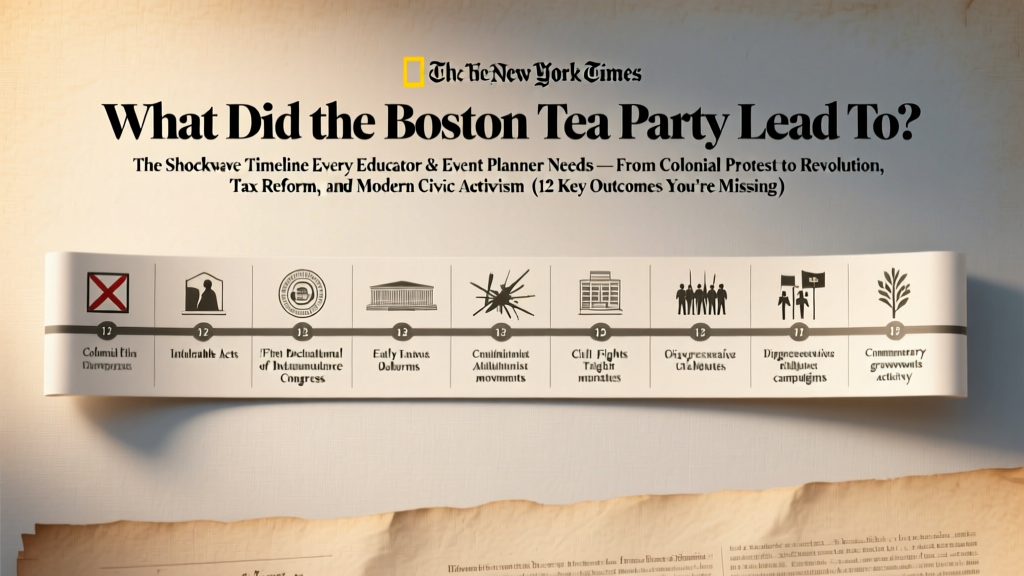
What Did the Boston Tea Party Lead To? The Shockwave Timeline Every Educator & Event Planner Needs — From Colonial Protest to Revolution, Tax Reform, and Modern Civic Activism (12 Key Outcomes You’re Missing)
Why This Isn’t Just History — It’s Your Next Commemoration Blueprint
What did the Boston Tea Party lead to? That question powers lesson plans, living history festivals, museum exhibits, and even corporate social responsibility campaigns — because this 1773 act of defiance didn’t end at Griffin’s Wharf. It ignited a cascade of political, legal, economic, and cultural consequences that reshaped governance, inspired global movements, and still inform how we plan and frame civic engagement today. If you’re designing a colonial-era reenactment, developing a civics curriculum, or producing a public history event, understanding these outcomes isn’t academic trivia — it’s operational intelligence.
The Immediate Fallout: Coercion, Not Compromise
Within weeks of December 16, 1773, British Parliament responded not with negotiation, but with punitive legislation known collectively as the Coercive Acts — dubbed the Intolerable Acts by colonists. These weren’t isolated laws; they were a coordinated strategy to isolate Massachusetts and deter further resistance. The Boston Port Act closed the harbor until restitution was paid for the destroyed tea — effectively starving the city’s economy. The Massachusetts Government Act revoked the colony’s charter, replacing elected officials with Crown appointees. The Administration of Justice Act allowed royal officials accused of crimes to be tried in Britain — removing local accountability. And the Quartering Act expanded military housing rights, embedding soldiers directly into civilian life.
This wasn’t overreaction — it was escalation designed to fracture colonial unity. Yet it backfired spectacularly. In response, delegates from 12 colonies convened the First Continental Congress in Philadelphia in September 1774 — the first truly intercolonial governing body. They drafted the Declaration of Rights and Grievances, organized a continent-wide boycott of British goods (the Continental Association), and agreed to reconvene if grievances remained unaddressed. For event planners staging ‘First Continental Congress’ simulations, this moment is critical: it shows how crisis catalyzes coalition-building — a narrative arc your attendees can embody through role-play, delegate badges, and embargo-themed interactive stations.
The Revolutionary Ignition: From Protest to War
What did the Boston Tea Party lead to on the battlefield? Directly: Lexington and Concord. Indirectly: the full-scale American Revolution. By spring 1775, tensions had metastasized. The British attempt to seize colonial arms stores in Concord triggered armed conflict — and the ‘shot heard round the world.’ Crucially, the Tea Party had already established precedent: nonviolent civil disobedience *could* escalate to armed defense when met with systemic coercion. Historians like T.H. Breen emphasize that the Tea Party normalized collective action — turning abstract rights into tangible, communal stakes. When minutemen assembled on April 19, 1775, they weren’t reacting to a single incident; they were defending a political identity forged in the months after the Tea Party.
For educators, this means framing the Tea Party not as an isolated ‘prank,’ but as Phase One of a three-act revolution: Symbolic Resistance (1773), Institutional Response (1774), Military Mobilization (1775–1783). A classroom timeline activity using primary sources — shipping manifests, Parliament debates, Paul Revere’s engraving of the ‘Boston Massacre’ (a precursor), and the Suffolk Resolves — makes this progression visceral. Event planners can replicate this arc across festival zones: ‘Wharf Zone’ (tea dumping), ‘Congress Hall’ (First Continental Congress replica), and ‘Lexington Green’ (militia muster station).
The Legal & Constitutional Legacy: Tea, Taxes, and the 16th Amendment
What did the Boston Tea Party lead to in constitutional law? Far more than independence — it seeded foundational principles about taxation, representation, and federal authority. The rallying cry ‘No taxation without representation’ became enshrined not just in revolutionary rhetoric, but in the U.S. Constitution’s structure: Article I, Section 8 grants Congress sole power to levy taxes, while the 16th Amendment (1913) clarified federal income tax authority — a direct evolution of the debate over parliamentary vs. colonial legislative sovereignty.
But the deeper legacy lies in protest jurisprudence. Courts have repeatedly cited the Tea Party in rulings on civil disobedience, notably in United States v. Schoon (1991), where judges acknowledged its moral legitimacy while distinguishing lawful protest from unlawful property destruction. Modern activists — from climate demonstrators halting pipeline construction to voting rights advocates occupying state capitols — invoke its symbolic grammar: targeted, theatrical, economically disruptive, yet nonviolent toward people. When planning a ‘Civic Action Expo,’ include a ‘Protest Tactics Through Time’ exhibit comparing 1773 tea dumping with 1960 Greensboro sit-ins and 2020 Black Lives Matter supply-chain disruptions — highlighting continuity in strategy, not just cause.
Modern Event Planning Lessons: What Today’s Organizers Can Steal
Here’s what contemporary event planners consistently overlook: the Boston Tea Party succeeded because it was logistically flawless, symbolically resonant, and media-savvy. Organizers (including Samuel Adams and the Sons of Liberty) rehearsed for weeks. Participants disguised themselves as Mohawk warriors — not to deceive, but to signal pan-tribal solidarity against imperial overreach (a nuance often lost in modern portrayals). They dumped 342 chests — precisely enough to bankrupt the East India Company’s local shipment — and cleaned the ship decks afterward, avoiding collateral damage. Newspapers like the Boston Gazette amplified the event within days, circulating eyewitness accounts and editorials that framed it as principled resistance, not vandalism.
That’s a masterclass in experiential design. Today’s history festivals fail when they prioritize spectacle over substance — think ‘tea-throwing contests’ devoid of context. Instead, borrow the Tea Party’s precision: assign roles (harbor master, customs inspector, tea merchant), use period-accurate crates with QR codes linking to digitized shipping records, and host a ‘Representation Negotiation’ simulation where delegates debate alternatives to taxation — mirroring the actual 1774 Suffolk Resolves. As Dr. Jane Kamensky, Harvard historian and consultant for the Museum of the American Revolution, notes: ‘The most powerful historical events aren’t remembered for what happened — but for what they made possible. Your job isn’t to reenact 1773. It’s to recreate its catalytic energy.’
| Timeline Stage | Key Outcome | Event Planning Application | Educational Hook |
|---|---|---|---|
| 0–3 Months | Intolerable Acts passed; First Continental Congress convened | Create ‘Crisis Response’ breakout sessions: small groups draft colonial petitions using authentic grievance language | Compare Parliament’s justification vs. colonial rebuttals using primary source excerpts |
| 6–12 Months | Armed conflict begins at Lexington & Concord; Second Continental Congress forms Continental Army | Design a ‘Mobilization Challenge’ where teams allocate limited resources (gunpowder, muskets, food) based on 1775 logistics constraints | Analyze casualty reports and supply logs to discuss war readiness vs. revolutionary idealism |
| 5–10 Years | Treaty of Paris (1783); U.S. Constitution ratified (1788); Bill of Rights adopted (1791) | Host a ‘Constitutional Convention Simulation’ with rotating delegates debating federalism, taxation, and representation | Map how specific grievances (e.g., quartering, jury trials) became constitutional amendments |
| 200+ Years | Global influence on anti-colonial movements (India’s Salt March), labor strikes, digital activism | Curate a ‘Legacy Wall’ featuring photos/videos of Gandhi’s Dandi March, WTO protests in Seattle, and #FridaysForFuture actions | Students interview local activists about how they adapt historical protest frameworks to modern issues |
Frequently Asked Questions
Did the Boston Tea Party directly cause the American Revolution?
No — but it was the decisive catalyst. While tensions had simmered since the 1765 Stamp Act, the Tea Party transformed resistance from petition-driven grievance into irreversible institutional rupture. The British response (Intolerable Acts) united previously divided colonies, created the First Continental Congress, and established the precedent that colonial self-governance was non-negotiable. Historians estimate that without the Tea Party’s escalation, armed conflict might have been delayed by years — or taken a different, less unified form.
Was the Boston Tea Party violent?
No physical violence occurred. While participants disguised themselves and destroyed £9,659 worth of tea (≈ $1.7M today), they deliberately avoided harming people or damaging the ships. Crew members were unharmed, and dockworkers were paid for their labor. This disciplined restraint was strategic — it distinguished the protest from rioting and bolstered its moral legitimacy in colonial and international opinion.
How did the Boston Tea Party affect the East India Company?
It devastated the company financially and politically. The destroyed tea represented 46 tons of inventory — roughly 5% of its annual American sales. More critically, the incident exposed the company’s dependence on parliamentary bailouts and monopolistic privileges, accelerating its decline. By 1858, the British government dissolved the company entirely, absorbing its territories into the British Raj. For educators, this is a powerful case study in corporate-state entanglement.
Why did colonists dump tea instead of boycotting it?
They’d already boycotted tea for years — but the 1773 Tea Act undercut that effort by allowing the East India Company to sell directly to colonists at lower prices, bypassing colonial merchants. Colonists saw this not as a bargain, but as a trap: accepting cheap tea meant accepting Parliament’s right to tax them. Dumping it was a performative refusal — saying ‘We won’t consume your product, even if it’s free, because doing so validates your authority.’
Are there modern reenactments of the Boston Tea Party?
Yes — most notably the annual Boston Tea Party Ships & Museum reenactment in Boston Harbor, which draws 150,000+ visitors. But best practices now emphasize contextual accuracy: actors explain Mohawk disguises as symbolic (not appropriative), highlight the role of free Black men like Prince Hall in the protest, and discuss how women like Abigail Adams shaped the political discourse around it. Planners should consult Indigenous advisors and Black historians when designing such programming.
Common Myths
Myth #1: ‘The Boston Tea Party was a spontaneous riot by angry mobs.’
Reality: It was meticulously planned over weeks by the Sons of Liberty, with assigned roles, signals, and strict nonviolence protocols. Over 100 participants were identified by historians — many prominent merchants and lawyers.
Myth #2: ‘Colonists opposed tea itself — they hated the beverage.’
Reality: Colonists loved tea. Their objection was exclusively to the tax and the monopoly granted to the East India Company. In fact, smuggling Dutch tea (untaxed) surged before 1773 — proving demand was high, but principle mattered more than convenience.
Related Topics (Internal Link Suggestions)
- First Continental Congress activities for students — suggested anchor text: "interactive First Continental Congress lesson plans"
- Colonial protest symbolism in modern events — suggested anchor text: "how to ethically use historical protest symbols in events"
- Living history festival safety and authenticity guidelines — suggested anchor text: "best practices for historically accurate reenactments"
- Teaching taxation without representation in middle school — suggested anchor text: "No taxation without representation classroom activities"
- Intolerable Acts primary source analysis — suggested anchor text: "Intolerable Acts document-based questions"
Your Next Step: Turn History Into Impact
What did the Boston Tea Party lead to? A cascade of consequences — political, legal, cultural — that continue to shape how we gather, protest, legislate, and commemorate. But its greatest lesson for today’s educators and event planners isn’t in the past; it’s in the method. Precision. Purpose. Partnership. If you’re finalizing plans for a Patriot Day festival, revising a civics unit, or advising a museum exhibit, don’t just recount the dumping — engineer the conditions that make its legacy feel urgent, actionable, and alive. Download our free Revolutionary Event Planning Toolkit — complete with role-play scripts, sourcing guides for period-accurate materials, and a checklist for inclusive historical framing — and start building your next catalytic moment.
More Articles
 What Happened to the Federalist Party? The Shocking Collapse No Textbook Explains Clearly — From Dominance in 1796 to Total Disappearance by 1820 (Here’s Exactly How & Why)
 A Cooking Class on a Budget: How to Plan a Fun, Organized, Low-Cost Culinary Event
How to Celebrate Retirement Without a Party: 7 Quietly Powerful Ways That Honor Your Journey (No Cake, Noise, or Pressure Required)
Is NJ a one party consent state for recording? The truth about New Jersey’s wiretapping law—and what you *must* know before hitting record at your next event, meeting, or family gathering.
When Do You Have a Gender Reveal Party? The Truth About Timing—Most Parents Wait Too Long (and Risk Major Stress, Disappointment, or Even Medical Complications)
Who Led the Whig Party? The Surprising Truth Behind America’s Forgotten Political Powerhouse — And Why Its Leadership Collapse Still Shapes Our Elections Today
Will there be another season of The Hunting Party? Here’s exactly what we know — including official network statements, production timelines, cast contract clues, and why Season 3 is statistically likely (but not guaranteed) based on global streaming data and renewal patterns for similar reality thrillers.
A Cooking Class on a Budget: How to Plan a Fun, Organized, Low-Cost Culinary Event
How to Celebrate Retirement Without a Party: 7 Quietly Powerful Ways That Honor Your Journey (No Cake, Noise, or Pressure Required)
Is NJ a one party consent state for recording? The truth about New Jersey’s wiretapping law—and what you *must* know before hitting record at your next event, meeting, or family gathering.
When Do You Have a Gender Reveal Party? The Truth About Timing—Most Parents Wait Too Long (and Risk Major Stress, Disappointment, or Even Medical Complications)
Who Led the Whig Party? The Surprising Truth Behind America’s Forgotten Political Powerhouse — And Why Its Leadership Collapse Still Shapes Our Elections Today
Will there be another season of The Hunting Party? Here’s exactly what we know — including official network statements, production timelines, cast contract clues, and why Season 3 is statistically likely (but not guaranteed) based on global streaming data and renewal patterns for similar reality thrillers.