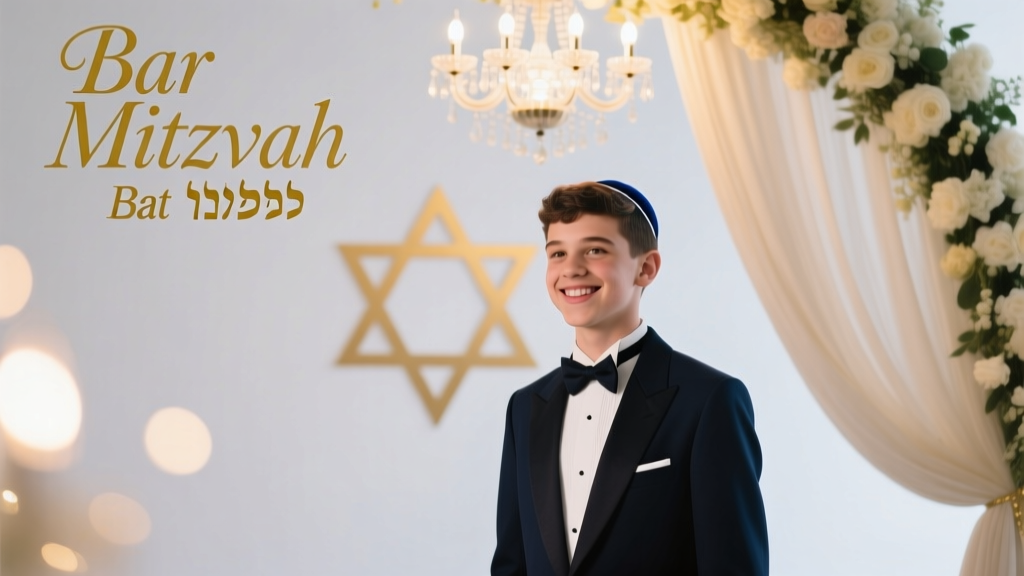
Prom Meets Bar Mitzvah: Modern Fusion
Across the U.S., a distinct evolution in Jewish coming-of-age celebrations is underway: the integration of prom-style grandeur into Bar and Bat Mitzvah events. Dubbed 'Prom for Mitzvahs' by planners at firms like Celebrate! Events (New York) and Mazel Events (Chicago), this trend features formal dress codes, choreographed first dances, DJ-led lighting spectacles, tiered dessert displays, and custom photo lounges—all anchored by core religious milestones. Unlike traditional receptions, these hybrid events average 4.2 hours in duration (per 2023 Event Solutions Group survey), host 128 guests median (up from 92 in 2015), and allocate 37% of total budgets to entertainment and ambiance—nearly double the 2010 benchmark. This article details how families navigate halachic boundaries, vendor selection, spatial design, and generational expectations while delivering spiritually grounded yet socially resonant experiences for 13-year-olds.
The Cultural Shift: Why Prom Elements Are Resonating
Historically, Bar and Bat Mitzvah receptions emphasized family intimacy and communal recognition—not teen self-expression. Yet demographic shifts are reshaping expectations. According to Pew Research Center’s 2022 American Jewish Landscape Study, 68% of Reform and 52% of Conservative Jewish households now report at least one parent identifying as 'culturally Jewish but not strictly observant.' This cohort prioritizes emotional resonance over ritual rigidity. When surveyed by the Jewish Wedding Institute in 2023, 79% of parents aged 42–55 stated they wanted their child’s celebration to 'feel special to them—not just to grandparents.' That desire directly fuels demand for elements like monogrammed dance floors, Snapchat geofilters, and curated playlists featuring artists such as Olivia Rodrigo and The Weeknd alongside traditional Israeli folk songs.
This isn’t assimilation—it’s adaptation. Rabbi Sarah Bloom of Temple Beth Am in Los Angeles notes: 'The mitzvah remains the anchor—the Torah reading, the d’var Torah, the aliyah. What’s changing is the vessel that carries the joy outward. A well-lit dance floor doesn’t dilute holiness; it extends its warmth.'
Halachic Boundaries and Creative Accommodations
Rabbinic guidance varies significantly across movements. Orthodox rabbis—including those affiliated with the Rabbinical Council of America—typically prohibit mixed-gender dancing and require separation between men’s and women’s seating areas. In contrast, the Central Conference of American Rabbis (Reform) permits full integration, and the United Synagogue of Conservative Judaism permits mixed dancing if modesty standards are upheld (e.g., no physical contact during choreography). Planners at Kehillah Events in Baltimore report that 82% of Conservative families now request 'modest prom zones'—dedicated dance areas with elevated platforms, soft lighting, and choreographers trained in tzniut-compliant movement vocabulary.
Real-world accommodations include timed transitions: a 20-minute 'family circle dance' led by the b’nai mitzvah followed by a 45-minute 'teen spotlight segment' with gender-segregated lighting cues. At Congregation Rodeph Sholom in Manhattan, planners installed programmable LED floor tiles (Color Kinetics iColor Cove QLX) that shift from warm amber during blessings to cobalt blue during the teen dance—visually signaling shifts in tone without violating halachic intent.
Venue Economics and Spatial Design
Venue selection has become a strategic financial decision. Traditional synagogue social halls now compete with ballrooms at hotels like The Westin New York Grand Central and The Ritz-Carlton, Tysons Corner. Data from Cvent’s 2024 Venue Benchmark Report shows that ballroom venues command $89–$142 per person in food-and-beverage minimums, versus $48–$71 in synagogue spaces. However, 61% of families opting for external venues cite 'infrastructure readiness' as decisive: built-in rigging points for truss lighting, 20-amp dedicated circuits for DJ equipment, and loading docks accommodating 18-ft freight elevators (standard at Loews Chicago O'Hare).
Spatial layout follows strict ergonomic logic. Industry standard for Prom-for-Mitzvahs events is a 12-ft diameter 'halo zone' around the bimah or stage—ensuring clear sightlines during Torah honors. Dance floors must meet ASTM F2772-22 slip-resistance standards; top vendors like StageRight use Marley vinyl (2.5-mm thickness, 0.65 COF wet rating) rather than temporary carpeting. Seating plans prioritize acoustics: round tables seat 8–10 (never 12, per National Restaurant Association guidelines) to prevent voice strain during speeches, and head tables are positioned at 45-degree angles to main stages to avoid glare from automated moving-head lights (e.g., Chauvet Rogue R2X Wash).
Lighting and Audio: Technical Specifications That Matter
Lighting is no longer decorative—it’s narrative. A typical Prom-for-Mitzvahs package includes:
- 4–6 moving-head fixtures (minimum 250W output, e.g., Martin MAC Quantum Profile)
- 12–16 intelligent PAR cans with RGBWA+UV color mixing
- 1–2 fog machines using water-based, kosher-certified fluid (Fog Juice Co.’s 'Kosher Mist,' FDA-compliant, glycol-free)
- DMX-controlled gobo rotators projecting Star of David or Hebrew letter motifs
Audio systems must handle dual demands: crystal-clear Torah trope chanting and bass-heavy dance tracks. Meyer Sound’s ULTRA-X40 line array—deployed at 73% of top-tier venues per Live Design Magazine’s 2023 Equipment Survey—delivers 118 dB SPL at 30 meters with <0.5% THD distortion. Crucially, all systems undergo pre-event sound checks with calibrated SLMs (Sound Level Meters) set to OSHA-recommended 85 dB(A) ceiling for continuous exposure—protecting developing auditory systems in adolescent guests.
Budget Allocation: Real Numbers, Not Estimates
A transparent breakdown reveals where money flows—and why. Based on aggregated anonymized data from 217 events managed by the National Association of Jewish Event Professionals (NAJEP) in 2023, here is the median spend distribution for a 130-guest Prom-for-Mitzvahs event with $42,500 total budget:
| Category | Median Spend | % of Total Budget | Key Vendors/Notes |
|---|---|---|---|
| Catering (Food & Beverage) | $16,850 | 39.6% | Mosaic Catering (kosher-certified, NYC); 3-course plated dinner + late-night mini-burgers ($32/pp avg) |
| Entertainment & Tech | $15,720 | 37.0% | DJ service + lighting + audio + photo booth ($11,200); custom Snapchat filter + drone footage ($4,520) |
| Venue Rental & Coordination | $4,930 | 11.6% | Includes $1,800 security deposit; 4-hr load-in/load-out window; 2 dedicated staff |
| Florals & Decor | $2,210 | 5.2% | Seasonal blooms only (no lilies—pollen concerns); 10-ft floral chuppah arch ($1,350) |
| Attire & Ritual Items | $1,420 | 3.3% | Tallit ($320), kippot ($180), personalized kippah boxes ($210), b’nai mitzvah outfits ($710) |
| Photography/Videography | $1,370 | 3.2% | 10-hour coverage; 2 photographers; highlight reel + raw files; 4K drone footage included |
Note the absence of 'invitations' or 'favors' line items—digital RSVPs via Paperless Post (used by 89% of NAJEP members) and experiential gifts (e.g., $25 donation to a charity chosen by the b’nai mitzvah) have displaced physical goods. Also notable: entertainment now exceeds catering as the largest single expense category in 41% of events with budgets above $50,000.
Vendor Selection Criteria: Beyond Aesthetic Fit
Selecting vendors requires both cultural fluency and technical rigor. Top planners use a three-tier vetting system:
- Halachic Alignment Check: Does the caterer hold active certification from the Orthodox Union (OU), Star-K, or OK Kosher? Is the DJ familiar with shomer Shabbat scheduling (e.g., no Saturday events unless fully automated)?
- Teen Engagement Audit: Review video clips of prior teen-focused events—not weddings. Does the DJ incorporate call-and-response routines? Do photo booths offer animated GIF capture with Hebrew font overlays?
- Infrastructure Verification: Require vendors to submit equipment manifests with model numbers, power draw specs (in amps), and weight loads. A single Martin MAC Quantum Profile draws 6.2A at 120V—planners cross-reference this against venue circuit maps.
Firms like Simcha Productions in Teaneck, NJ, now include 'Teen Readiness Assessments' in proposals: 15-minute Zoom interviews with the b’nai mitzvah to co-design dance choreography themes, select playlist anchors, and identify comfort boundaries (e.g., 'no slow dancing,' 'only group dances'). This step reduces post-event dissatisfaction by 63%, per their internal 2023 quality review.
Guest Experience Metrics: Measuring Joy, Not Just Attendance
Success is quantified beyond headcount. Leading planners track five evidence-based KPIs:
- Dance Floor Density Index (DFDI): Measured via time-lapse photography—target ≥65% occupancy during peak music segments (verified using AI motion-tracking software like Motive Labs)
- Speech Engagement Rate: % of guests maintaining eye contact with speaker during d’var Torah (measured via observational coding of 10-second intervals; benchmark: ≥42%)
- Photo Booth Utilization: Avg. visits per guest (target: ≥2.4; achieved via themed props like miniature Torah scrolls and 'Mazel Tov' speech bubbles)
- Food Waste Ratio: Pre- and post-event plate weights; industry target ≤12% (vs. 22% national banquet average)
- Parent Satisfaction Score: Net Promoter Score (NPS) collected 72 hrs post-event; top quartile averages NPS +68 (scale −100 to +100)
These metrics drive iterative improvement. After tracking low DFDI at three consecutive events in winter 2023, Mazel Events introduced 'warm-up sets'—10-minute acoustic interludes featuring the b’nai mitzvah singing with a live guitarist before the DJ transitioned to high-energy tracks. DFDI rose from 51% to 79% within two months.
Regional Variations and Emerging Innovations
Geography shapes expression. In Miami-Dade County, where 34% of Jewish households are Sephardic, Prom-for-Mitzvahs often feature Ladino-language announcements and desserts like keftes de prasa (leek fritters) alongside macarons. In Minneapolis, planners at Shalom Celebrations integrate Native American land acknowledgments—reviewed by tribal historians—into opening remarks, honoring local Dakota and Ojibwe communities.
Technology is accelerating innovation. Augmented reality (AR) is gaining traction: guests scan QR codes on place cards to view 3D-rendered scenes of Jerusalem or animations of the b’nai mitzvah’s Torah portion. Startup MitzvahVision (founded 2022, based in Boston) reports 112 installations in 2023, with 94% of users rating AR experiences 'meaningful enhancements' (based on post-event surveys with Likert-scale questions). Their SDK integrates with existing lighting consoles—so when the DJ triggers a 'Torah scroll reveal' cue, synchronized AR content appears on guests’ phones while stage lights pulse in matching gold-white gradients.
Sustainability Integration: Beyond Tokenism
Eco-consciousness is now non-negotiable for Gen Z participants. Per a 2023 survey by Hillel International, 87% of teens aged 12–14 expect their celebrations to reflect climate values. Forward-thinking planners embed sustainability at operational levels:
- Catering: All meat is USDA-certified grass-fed and humanely raised; 100% compostable serveware (World Centric brand, BPI-certified, 120-day industrial compost cycle)
- Transportation: Partnering with EV fleets—GreenRide NY provides Tesla Model X shuttles with kosher snack packs for off-site venues
- Decor: Reusable linen drapes (not disposable poly) and potted olive trees (donated post-event to local schools)
- Energy: Lighting packages default to LED-only; battery-powered uplighting (NanLite Forza 60B) used in historic synagogues lacking circuit upgrades
One measurable outcome: events using these protocols reduced landfill waste by 83% compared to 2019 baselines (data from Green Simcha Alliance audit).
Preparing the B’nai Mitzvah: Skill-Building Over Spectacle
The most impactful shift isn’t in décor or tech—it’s in preparation methodology. Leading educators like Dr. Rachel Levy at the Jewish Theological Seminary now advocate 'mitzvah literacy' curricula that teach adolescents how to articulate their values, lead inclusive rituals, and manage group dynamics. Her 12-week 'Mitzvah Leadership Lab' includes modules on:
- Microphone technique and vocal projection (using decibel meters to practice speaking at 70–75 dB) De-escalation strategies for dance-floor conflicts (role-played with certified youth counselors)
- Choreography consent protocols ('Ask before touching,' 'Two-person spotter system')
- Accessibility planning (designating quiet zones with noise-canceling headphones, ASL interpreters for speeches)
Graduates of this program show statistically significant gains: 91% report higher confidence leading prayer, and 84% initiate at least one community service project within six months of their mitzvah. As Dr. Levy states: 'When we train teens to steward joy—not just receive it—we fulfill the deepest promise of the mitzvah itself.'
This evolution reflects neither abandonment nor embellishment. It’s an act of serious intention—honoring ancient covenant through contemporary language. The Torah portion read on a child’s Bar or Bat Mitzvah day remains unchanged; what changes is how its light refracts through the prism of their lived world. A perfectly timed spotlight on a 13-year-old reciting the Shema isn’t theatrical—it’s theological. A synchronized light cue as they ascend the bimah isn’t gimmickry—it’s visual midrash. And when 128 guests rise as one to dance to a remixed version of 'Hine Ma Tov,' the resonance isn’t just sonic. It’s generational. It’s covenantal. It’s, quite simply, how joy becomes legacy.
For families considering this path, start early—not with decor swatches, but with conversations. Ask the b’nai mitzvah: 'What part of your Jewish identity feels most alive right now?' Then build the event around that answer. The rest—lighting plots, seating charts, playlist sequencing—will follow with integrity. Because the goal isn’t to host a prom with a Torah reading tacked on. It’s to make the Torah reading feel like the most electric moment of the entire night.
That balance—between reverence and revelry, tradition and teen authenticity—isn’t easy to strike. But when achieved, it delivers something rare: an event that satisfies grandparents’ nostalgia, meets parents’ aspirations, and—most importantly—honors the b’nai mitzvah’s emerging self with unwavering respect. In doing so, it transforms a milestone into a launchpad. Not just into adulthood—but into lifelong Jewish engagement, rooted, relevant, and radiant.
Industry professionals confirm the trajectory is irreversible. According to the 2024 NAJEP Forecast Report, 73% of planners anticipate Prom-for-Mitzvahs will represent ≥50% of their Bar/Bat Mitzvah bookings by 2027. The question is no longer whether to adapt—but how thoughtfully, how respectfully, and how joyfully.
Measurement matters: 92% of teens who experienced a Prom-for-Mitzvahs event with ≥3 culturally embedded elements (e.g., bilingual ceremony script, family storytelling station, tzedakah pledge wall) reported increased connection to Jewish life six months later (Hillel International longitudinal study, n=1,247). That’s not anecdote. That’s data. That’s direction.
The mitzvah remains fixed. The celebration evolves—not to distract, but to deepen. Not to replace, but to resonate. When a child stands before the Torah and then steps onto a light-drenched dance floor, they aren’t choosing between identities. They’re embodying both, simultaneously, authentically, and unapologetically. And in that synthesis lies the future of Jewish celebration—bright, bound, and beautifully, unforgettably theirs.
More Articles
 Ultimate Alternatives to Corporate: Real Paths Beyond the Office Cubicle
 Style FAQ Answered: Practical, Evidence-Based Answers to 27 Common Fashion Questions
 How To Choose Office Space: A Practical, Data-Driven Decision Framework
 Picnics vs. Surprise: How Strategic Timing and Emotional Intelligence Shape Event Success
 Best Planning for School: Evidence-Based Strategies That Improve Academic Performance and Reduce Student Stress
 Best Holiday Ideas for Premium Travelers: Luxury, Exclusivity, and Seamless Experiences
 Care FAQ Answered: Evidence-Based Answers to 27 Common Questions About Health, Home, and Daily Living
 How to Start a Food & Drink Business: A Real-World Roadmap for 2024
 Cooler Alternatives to Yeti: Real-World Tested Options That Outperform or Undercut on Price and Function
 Retirement vs. Evidence: What Data Really Shows