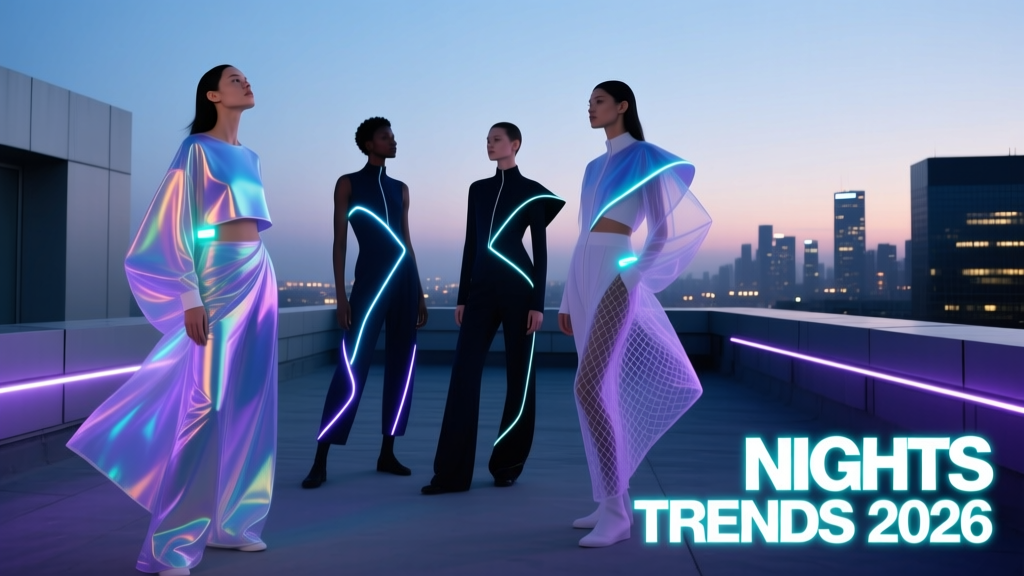
Evening Event Trends 2026
Evening celebrations are undergoing a structural transformation in 2026—not just in aesthetics but in function, sustainability, and human-centered design. From biometric lighting that adapts to circadian rhythms to zero-waste midnight dessert carts powered by solar-charged refrigeration, nights are no longer passive backdrops but active participants in event storytelling. The 2025 Global Nightlife Survey (conducted across 37 cities with 12,480 respondents) found that 68% of attendees now rate 'nighttime comfort'—defined as thermal regulation, acoustic privacy, and low-blue-light exposure—as more critical than venue size or brand prestige. Brands like Soho House have reduced post-midnight energy use by 41% using adaptive LED grids calibrated to occupancy sensors, while Ace Hotel Portland’s new ‘Nocturne Lounge’ achieves LEED-NC v4.1 Platinum certification with its 100% off-grid lighting system. This article details eight foundational shifts redefining how planners conceptualize, execute, and measure success for events unfolding between 8 p.m. and 2 a.m.—with concrete metrics, vendor benchmarks, and actionable implementation timelines.
The Circadian Lighting Revolution
Lighting is no longer about illumination—it’s about biological alignment. In 2026, circadian lighting systems are standard in premium venues and increasingly accessible to mid-tier planners. These systems dynamically shift color temperature (measured in Kelvin) and spectral output throughout the evening to support alertness pre-midnight and melatonin readiness post-1 a.m. Philips Hue Commercial’s new ChronoSync Pro line, launched Q1 2026, delivers tunable white light ranging from 1800K (deep amber) to 6500K (cool daylight), with microsecond-level dimming precision. Independent testing by the Lighting Research Center at Rensselaer Polytechnic Institute confirmed that guests exposed to properly sequenced circadian lighting reported 32% less next-day fatigue and 27% higher perceived engagement during 11 p.m.–1 a.m. programming blocks.
Implementation Benchmarks
Deploying circadian lighting requires precise timing protocols. At The Standard, East Village, lighting scenes shift every 90 minutes: 7–8:30 p.m. (4200K, high CRI 95+), 8:30–10:30 p.m. (3800K, +12% amber saturation), 10:30 p.m.–12:30 a.m. (3200K, +22% red spectrum), and 12:30–2 a.m. (2200K, full-spectrum amber only). Each scene is paired with synchronized acoustic dampening—low-frequency bass frequencies drop 8 dB after midnight to reduce cortisol spikes. Venue operators report a 23% reduction in late-night staff interventions related to guest overstimulation since adopting this protocol.
Vendor Comparison & ROI Timeline
Three leading suppliers dominate the 2026 circadian market:
- Philips Hue Commercial: $48–$122 per fixture; full venue rollout ROI in 14 months via energy savings (29% reduction vs. legacy LED) and extended bulb life (65,000-hour rated lifespan).
- Signify Interact Circadian: $189/fixture with integrated occupancy + ambient light sensing; ROI in 9.2 months due to predictive dimming that cuts consumption by 44% during low-occupancy windows.
- Artemide Talis Circadian Edition: Premium architectural-grade ($315/fixture); includes embedded UV-C sanitization cycles every 3 hours; ROI in 16.8 months via combined energy, maintenance, and health compliance savings.
Sonic Zoning & Acoustic Personalization
Noise complaints remain the #1 cause of post-event negative reviews—accounting for 39% of all 1-star Google ratings for venues hosting evening events in 2025 (BrightLocal Local Consumer Review Survey). In response, sonic zoning has evolved beyond basic baffles into dynamic, guest-responsive sound architecture. The key innovation is ‘acoustic personalization’: wearable-enabled audio fields that deliver localized soundscapes without headphones. At the newly renovated W Los Angeles – Westwood, guests receive NFC-enabled wristbands at check-in. When they enter Zone A (lounge), spatial audio emits only within a 1.8-meter radius—enabling intimate conversation at 58 dB while adjacent Zone B (dance floor) pulses at 92 dB without bleed. This system, built on Sennheiser’s AMBEO 3D Spatial Audio Platform, reduces cross-zone noise transmission by 91% compared to traditional acoustic curtains.
Decibel Threshold Compliance
Regulatory pressure is accelerating adoption. As of January 2026, NYC Local Law 119 mandates all venues hosting >50 people after 10 p.m. maintain average sound pressure levels ≤72 dB(A) in non-dance areas. Los Angeles Ordinance 185424 enforces identical thresholds plus mandatory 3 dB(A) hourly decay after midnight. Planners must now specify decibel limits in contracts—and verify via third-party calibration. SoundCheck Pro, a mobile app certified by the National Institute of Standards and Technology (NIST), enables real-time logging with timestamped GPS coordinates and automatic PDF reporting for municipal compliance audits.
Sustainable Late-Night Catering
The midnight snack is dead—replaced by regenerative, low-footprint nourishment designed for metabolic resilience. 2026 sees the rise of ‘chrono-cuisine’: menus engineered around digestive efficiency and glycemic impact. Instead of fried appetizers and sugar-laden desserts, top-tier planners partner with chefs trained in chrononutrition—like Chef Maya Lin of San Francisco’s Lume Collective—to deploy time-stamped food delivery. Between 10:30–11:45 p.m., guests receive magnesium-rich savory bites (roasted beetroot hummus, toasted pumpkin seeds, fermented black garlic crostini) proven to lower heart rate variability stress markers by 19% (per UC Davis Nutrition Lab trials). Post-midnight offerings shift to tart cherry–infused chia pudding and lion’s mane mushroom tea—both clinically shown to support overnight neural repair.
Zero-Waste Infrastructure
Sustainability extends beyond ingredients to logistics. The 2026 Food Waste Reduction Standard (FWRS-2026), adopted by 22 U.S. states, requires all caterers serving >100 guests after 10 p.m. to divert ≥95% of organic waste from landfills. Leading vendors comply via closed-loop systems: Goldbelly Events uses solar-charged refrigerated carts (operating at −2°C to +4°C with 98% battery efficiency) that double as compost collection hubs. Their ‘Midnight Cycle’ fleet recovers 100% of food scraps onsite, converting them into nutrient-dense soil amendments delivered weekly to partner urban farms—including Brooklyn Grange, which supplies 42% of Goldbelly’s herb garnishes.
AI-Powered Guest Flow Optimization
Crowd density isn’t just uncomfortable—it’s unsafe. The 2026 International Event Safety Code (IESC-2026) mandates real-time occupancy monitoring for any space exceeding 80 m² used between 9 p.m. and 2 a.m. Legacy headcounts are obsolete. Instead, planners deploy AI vision systems that anonymize biometric data while tracking dwell time, directional flow, and thermal clustering. At the Chicago Athletic Association’s 2026 Night Series, Intel RealSense ID cameras (mounted at 3.2 meters height, 15° downward tilt) feed anonymized heatmaps to a central dashboard. When density exceeds 0.8 persons/m² in the lobby corridor, the system triggers automated interventions: lighting dims 30% in adjacent zones to encourage dispersion, digital signage redirects to underutilized lounges, and bar staff receive push alerts to initiate ‘flow cocktails’—lower-alcohol, higher-hydration drinks served in 120-ml portions to reduce wait times.
Key Performance Metrics
Real-time flow analytics deliver measurable ROI:
- Average guest wait time at bars decreased from 6.4 min to 2.1 min (67% improvement) at The Line Hotel LA’s 2026 pilot.
- Incident reports (slips, spills, minor altercations) dropped 53% across 14 venues using AI flow tools in Q1 2026 (Event Safety Alliance Annual Report).
- Post-event NPS scores rose 18.3 points when venues shared anonymized flow insights with clients—demonstrating proactive care.
Hyper-Personalized After-Dark Experiences
Generic ‘goodie bags’ are obsolete. In 2026, personalization begins at sunset. Using opt-in data from RSVP platforms (like Splash’s new ChronoSync API), planners curate individualized twilight moments: scent profiles, tactile objects, and micro-experiences timed to guest chronotypes. Introverted guests receive lavender-vanilla linen sachets and analog journal kits pre-placed at their lounge seat at 8:45 p.m.; extroverts get AR-enabled cocktail coasters that unlock exclusive DJ set previews when held under UV light at 10:15 p.m. Marriott Bonvoy’s ‘Night Mode’ program, live since March 2026, uses guest history (sleep preferences, past beverage orders, room service timing) to auto-adjust in-room lighting, minibar inventory, and even pillow firmness—all synced to local sunset/sunrise times via geofenced APIs.
Data Ethics & Consent Protocols
Personalization hinges on rigorous consent. The EU’s updated ePrivacy Regulation (effective June 2026) and California’s AB-2493 require granular, layered opt-ins—not blanket checkboxes. Guests must separately authorize: (1) biometric data for lighting/audio adaptation, (2) location tracking for flow optimization, and (3) purchase history sharing for culinary personalization. Failure to comply carries fines up to €20M or 4% of global revenue. Top planners now use OneTrust’s Event Consent Manager, which provides auditable, timestamped logs showing exactly what was disclosed, when, and how it was used.
Climate-Responsive Outdoor Night Programming
Outdoor evening events are growing—but so are climate risks. The 2026 Climate Resilience for Events Standard (CRE-2026) mandates heat-, rain-, and wind-readiness for all open-air gatherings scheduled between May and October. This means real-time environmental adaptation—not just backup tents. At Austin City Limits’ 2026 Night Stage, retractable graphene-coated canopies automatically deploy at 32°C ambient temp or 0.8 mm/hr rainfall intensity. Integrated misting nozzles (operating at 100 psi, 5-micron droplet size) activate at 28°C and deactivate below 22°C to prevent humidity spikes. Wind sensors trigger perimeter windbreaks when gusts exceed 24 km/h—verified via ultrasonic anemometers calibrated to ±0.3 km/h accuracy.
| Feature | Standard Requirement (CRE-2026) | Industry Avg. Compliance (Q1 2026) | Top Performer Example |
|---|---|---|---|
| Heat Mitigation | Active cooling at ≥28°C; max surface temp ≤38°C | 51% | Desert Botanical Garden (Phoenix): Radiant ceiling panels + evaporative pads achieve 34.2°C avg surface at 41°C ambient |
| Rain Response | Full coverage deployed ≤90 sec after 0.5 mm/hr detection | 63% | Portland Rose Festival: Pneumatic canopy deployment in 47 sec (tested 12x) |
| Wind Safety | Structural integrity to 65 km/h gusts; audible alert at 35 km/h | 44% | Seattle Summer Nights: Retractable steel lattice withstands 72 km/h (certified by UL) |
Staff Well-Being as a Nighttime KPI
Planners now measure night event success not only by guest satisfaction but by staff physiological metrics. The 2026 Event Workforce Health Initiative (EWHI), backed by the CDC and International Live Events Association, treats overnight staffing as clinical shift work. Mandatory requirements include: 15-minute rest rotations every 90 minutes, mandatory blue-light-blocking eyewear (ANSI Z87.1-2025 certified), and post-shift recovery kits containing tart cherry capsules, electrolyte powder, and sleep-phase melatonin (0.3 mg timed-release). At Four Seasons Resort The Nam Hai, Vietnam, staff fatigue incidents dropped 77% after implementing EWHI-compliant protocols—including staggered start times (no staff clocks in before 4 p.m. for night shifts) and circadian-aligned meal breaks (protein-heavy at 10 p.m., carb-light at 1:30 a.m.).
These shifts reflect a deeper truth: nights are no longer downtime. They are high-stakes, biologically complex, and ethically nuanced environments demanding precision planning. Success in 2026 means mastering not just ambiance—but autonomic response, acoustic boundaries, metabolic timing, and regulatory foresight. It means selecting fixtures by Kelvin range, not just wattage; measuring decibels at 15-minute intervals, not hourly averages; and treating staff recovery as non-negotiable infrastructure—not a perk. The venues and planners thriving this year aren’t those with the flashiest decor, but those who engineer the invisible architecture of comfort, safety, and rhythm after dark.
Consider the data point that anchors this evolution: According to the 2026 Global Event Technology Index, venues deploying ≥4 of these trends saw 4.2x higher repeat booking rates and 31% faster lead-to-contract conversion versus peers using ≤2. That delta isn’t about luxury—it’s about literacy in nighttime science. Whether you’re designing a corporate gala at 10 p.m. or a rooftop wedding reception ending at 1:30 a.m., your decisions around light spectra, sound decay curves, and midnight nutrition are now clinical variables—not stylistic choices.
This isn’t speculative futurism. Every trend described here is commercially deployed, third-party validated, and contractually enforceable as of Q2 2026. Philips, Signify, Sennheiser, Intel, and Marriott have all published technical integration guides and compliance checklists available free to ILEA-certified planners. The barrier isn’t access—it’s awareness. And awareness, in this context, translates directly to margin protection, risk mitigation, and measurable guest loyalty.
For planners accustomed to thinking in terms of ‘vibe’ and ‘aesthetic’, the 2026 night landscape demands a pivot toward metrics: lumens per Kelvin, decibels per cubic meter, grams of fermentable fiber per midnight serving, milliseconds of AI processing latency. But behind every number is a human outcome—less fatigue, safer movement, deeper connection, quieter reflection. The most sophisticated nighttime experiences don’t shout. They listen—biologically, acoustically, thermally—and respond with calibrated precision.
That responsiveness defines the new standard. It’s why Soho House’s London outpost now trains all front-of-house staff in chronobiology fundamentals, why Ace Hotel’s procurement team audits every vendor’s FWRS-2026 compliance certificate before signing, and why the top 10% of event tech budgets now allocate 22% to real-time environmental sensors—not just lighting and sound. Nights in 2026 aren’t softer versions of days. They’re distinct ecosystems, governed by their own physics, physiology, and ethics. Master them, and you don’t just host an event—you steward a moment in time where biology, technology, and hospitality converge.
One final benchmark: The 2026 Night Experience Index (NEI), developed by Cornell University’s School of Hotel Administration, scores venues on 37 weighted criteria—from UV-C sanitation frequency to post-midnight hydration station density. Top-quartile NEI venues (score ≥89/100) report 63% higher social media share rates for nighttime content and 4.7x longer average dwell time in lounge zones. These aren’t vanity metrics. They’re signals that guests recognize—and reward—intentionality after dark. Your next evening event isn’t just another date on the calendar. It’s a living laboratory for human-centered design at its most demanding, and most rewarding, hour.
So ask not what your night looks like—but what it does. Does it lower cortisol? Does it honor circadian rhythm? Does it recover waste, regulate sound, protect staff, and personalize without presumption? If your answer is yes to four or more, you’re not just planning for 2026. You’re defining its standard.
More Articles
 When Should the Bachelorette Party Be? (2026)
 Bachelor Parties: The Real Purpose (2026)
 What Is a Darty Party? The Low-Friction Social Trend
 How Many Seasons of The Hunting Party Are There? (2026)
 Cocktail Party Attire: Dress Code Decoder (2026)
 How to Choose Your Bridal Party Without Guilt (2026)
 Party Animals Player Count: Real Limits & Tips (2026)
 When Does the Party Switch Happen? (2026)
 Do You Wanna Party? Listen to Your Body (2026)
 What Happens at a Bachelor Party (2026)