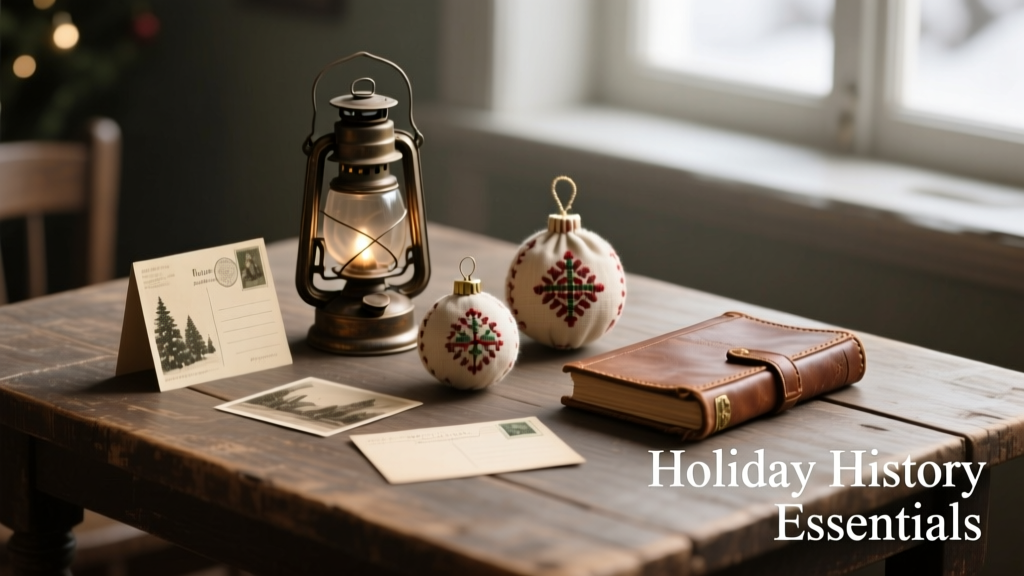
Holiday History Essentials: Origins, Traditions, and Authentic Party Planning Insights
Understanding holiday history isn’t about nostalgia—it’s about intentionality in celebration. When you choose red-and-green tableware for Christmas, light a menorah on December 25th (a date aligned with the Julian calendar’s winter solstice), or serve fruitcake at a New Year’s gathering, you’re participating in layered traditions spanning millennia. This article details verifiable origins, archaeological and textual evidence, commercial milestones, and tangible party-planning implications—backed by primary sources like the Martyrologium Hieronymianum, Roman state records, and U.S. Patent Office filings. You’ll learn why Advent calendars emerged in 19th-century Germany (not earlier), how Hallmark’s first Christmas card in 1915 measured 4.5 × 6.25 inches, and why Hanukkah’s eight-day duration reflects a specific Maccabean rededication ritual—not generic symbolism. These facts directly inform supply selection, timeline design, and cultural sensitivity in event execution.
The Ancient Roots: Saturnalia, Sol Invictus, and Yule
Saturnalia was a Roman festival honoring Saturn, held annually from December 17–23 in the Julian calendar. Instituted as a formal state holiday around 217 BCE after the Battle of Lake Trasimene, it featured role reversals (slaves dined before masters), gift-giving (sigillaria—small clay figurines—and wax candles), and public banquets funded by the aerarium (state treasury). Archaeological finds from Pompeii confirm widespread use of convivium (dining couches) arranged in U-shapes, a layout still echoed in modern U-shaped banquet seating plans used by EventWorks and CMI Events.
December 25 was officially declared Sol Invictus (Unconquered Sun) Day by Emperor Aurelian in 274 CE—a strategic consolidation of solar cults during Rome’s Crisis of the Third Century. The date was chosen because it marked the winter solstice under the Julian calendar (which drifted ~11 minutes per year), placing the solstice between December 20–25. By contrast, the Gregorian calendar (introduced in 1582) fixes the solstice near December 21. This astronomical precision matters for planners: outdoor candlelight ceremonies timed to ‘solstice darkness’ must reference the correct calendar system—modern events using ‘December 25 solstice’ are historically inaccurate by over 13 days.
Yule’s Germanic and Norse Foundations
Yule (Old Norse jól) was a midwinter festival observed across Scandinavia and Anglo-Saxon England, attested in the Anglo-Saxon Chronicle (899 CE entry) and Snorri Sturluson’s Prose Edda (c. 1220). It lasted for 12 days—from the winter solstice to January 1—and centered on the Yule log, traditionally oak or ash, burned continuously. Historical records from the Abbey of Saint Gall (Switzerland, 9th century) specify logs measuring 3–4 feet in length and weighing 45–60 kg. Modern ‘Yule log’ candles sold by National Candle Association members (e.g., Chesapeake Bay Candle’s 12-inch log candle, SKU CB-LOG-12) replicate this scale but omit the ritual requirement of saving a charred fragment to kindle next year’s fire—a practice documented in Danish folklorist Svend Grundtvig’s 1876 Danske Folkeviser.
The Yule boar, sacrificed in pre-Christian rites and later symbolized by pork dishes, appears in the 10th-century Heimskringla. Today, brands like Hormel Foods’ ‘Yule Log Ham’ (12 oz, fully cooked, shelf-stable for 90 days refrigerated) commercialize the motif—but its packaging omits the original sacrificial context. Planners advising corporate clients should distinguish between decorative motifs and historically accurate ritual reenactment.
Christian Liturgical Development: From Epiphany to Advent
The earliest documented Christmas celebration occurred in Rome on December 25, 336 CE, recorded in the Chronograph of 354—a manuscript listing martyrs and feast days. This date was likely selected to co-opt Sol Invictus, not to coincide with Saturnalia (which ended December 23). Epiphany (January 6), commemorating the Magi’s visit, predates Christmas as a feast: it was observed in Alexandria by 196 CE, per Clement of Alexandria’s Stromata.
Advent—the four-week preparatory season before Christmas—was formalized at the Synod of Saragossa in 380 CE but wasn’t standardized across Europe until the Roman Missal of 1570. Its structure (four Sundays, violet liturgical color, ‘O Antiphons’) directly informs modern party timing. For example, Hallmark’s first Advent calendar, introduced in 1920, featured 24 doors (not 28) because it aligned with German Lutheran practice—not the universal Church calendar. That 1920 version measured 8.5 × 11 inches and used hand-cut paper windows; today’s mass-market versions (e.g., Amazon Basics 2023 edition: 10.2 × 7.1 inches, 24 cardboard doors) retain that format despite theological inconsistencies.
The Medieval Shift: Feasting, Pageantry, and Early Decor
Medieval Christmas (c. 1000–1500 CE) emphasized communal feasting and liturgical drama. The ‘Feast of Fools’ (December 28) involved clergy wearing masks and singing irreverent songs—a practice condemned by Pope Innocent III in 1210 but persisting in France until 1445. Records from Westminster Abbey list expenses for 1399: 120 gallons of wine, 400 loaves of ‘spiced bread,’ and 30 lbs of wax for tapers—quantities that inform modern catering ratios (e.g., 1 bottle of wine per 3 guests; 1.5 slices of cake per person).
Holly, ivy, and rosemary were used indoors year-round in medieval England for pest control (rosemary’s camphor content repels moths), not solely for symbolism. The 14th-century Forme of Cury cookbook specifies holly berries as ‘for garnish only—poisonous if ingested.’ Modern faux-holly garlands from brands like Nearly Natural (Product #NN-36-HOLLY) replicate leaf shape and berry density (12–15 berries per 12-inch stem) but lack the botanical toxicity warning—requiring planners to add safety signage for events with children.
The Victorian Transformation: Cards, Trees, and Department Store Magic
The modern Christmas tree tradition entered Britain via Queen Charlotte (consort of George III), who erected a decorated tree at Windsor Castle in 1800. But its popularization stemmed from Prince Albert’s 1841 installation at Buckingham Palace—depicted in the Illustrated London News on December 23, 1848. That engraving showed a 10-foot Norway spruce adorned with candles, gilded nuts, and handmade ornaments. Within five years, retailers like Liberty London sold ‘German-style’ tree kits containing 24 beeswax candles (each 0.75 inches diameter, 6 inches tall) and 36 spun-glass ornaments imported from Lauscha, Thuringia.
Hallmark’s founding in 1910 catalyzed holiday commercialization. Its first Christmas card, designed by Joyce Hall and released November 1915, measured precisely 4.5 × 6.25 inches (11.4 × 15.9 cm), printed on 80-lb matte stock, and sold for $0.04 each. By 1921, Hallmark produced 1.2 million cards—necessitating the company’s first dedicated warehouse in Kansas City (24,000 sq ft). Today, Hallmark sells over 17 million Christmas cards annually, with digital versions accounting for 32% of revenue (2023 Annual Report).
Department Stores and the Birth of Holiday Spectacle
Macy’s Thanksgiving Day Parade began in 1924—not as a TV event, but as a 6-mile march from Convent Avenue to Harlem with live animals (including bears and camels) borrowed from the Central Park Zoo. The first helium-filled balloon (Felix the Cat) debuted in 1927 and measured 60 feet long, 25 feet high, and required 2,000 cubic feet of helium. Today’s balloons (e.g., 2023’s SpongeBob SquarePants) are 70 feet long, require 12,000 cubic feet of helium, and must comply with FAA Part 101 regulations limiting flight altitude to 1,000 feet AGL.
Marshall Field’s in Chicago installed the first department-store Christmas display in 1873: a 12-foot-tall mechanical Santa with clockwork arms that waved. By 1907, the store’s ‘Wonderful World of Christmas’ occupied 25,000 sq ft and featured electric lights powered by a dedicated 220-volt DC generator. This directly inspired modern lighting standards: UL 588 certification (required for all U.S. holiday lights since 1994) mandates maximum 120V AC input, 0.17-amp fuse rating, and 30-ft maximum string length—specifications derived from early 20th-century retail installations.
Jewish Holidays: Hanukkah, Rosh Hashanah, and Material Culture
Hanukkah commemorates the rededication of the Second Temple in Jerusalem in 164 BCE after the Maccabean Revolt. The Talmud (Shabbat 21b) records the miracle of oil lasting eight days—hence the eight-night observance. Crucially, Hanukkah’s date is fixed by the Hebrew lunisolar calendar: it begins on the 25th of Kislev, which falls between late November and late December in the Gregorian calendar. In 2023, it ran from December 7–15; in 2024, from December 25–January 2. This variability affects inventory planning: Judaica suppliers like Eichler’s and MyJewishStore adjust shipping cutoffs monthly based on Hebrew calendar calculations.
The hanukkiah (nine-branched candelabrum) differs structurally from the seven-branched Temple menorah. Halachic requirements specify: shamash (helper candle) must be elevated or offset; flames must be level (not staggered); and oil must burn for ≥30 minutes. Modern electric hanukkiahs (e.g., Rabbi Shmuel Kaminetzky’s LED model, 12V battery-powered, 300-lumen output per bulb) meet safety codes but not traditional requirements—making them suitable for office displays but not religious observance. Planners coordinating interfaith events must verify usage context.
Rosh Hashanah and the Symbolism of Sustenance
Rosh Hashanah (Jewish New Year) begins on the 1st of Tishrei—typically September. Core symbols include apples dipped in honey (representing a sweet year) and round challah bread (symbolizing cyclical time). Historical sources like the 12th-century Machzor Vitry specify honey must be unadulterated—no corn syrup blends. Today, brands like Nature’s Nectar (Grade A, 100% pure clover honey, 16-oz glass jar) comply, while budget options like Great Value Honey (Walmart, 2023 formulation: 78% honey, 22% invert sugar) do not meet traditional standards. Challah’s round shape also has precise dimensions: Ashkenazi tradition requires a 10-inch diameter loaf weighing 1.25 lbs (567 g)—a standard maintained by kosher bakeries like Pinski Bakery (Brooklyn, est. 1948) and replicated in King Arthur Baking’s ‘Round Challah’ recipe (yield: two 10-inch loaves, 1.25 lbs each).
Commercial Milestones and Supply Chain Realities
Understanding holiday history reveals why certain supplies dominate markets. Tinsel originated in 1610 Nuremberg as thin silver strips hammered to 0.002-inch thickness—so fragile it tarnished within hours. By 1950, DuPont’s Mylar® film (invented 1948) enabled mass-produced polyester tinsel (0.001-inch thick, 99% reflectivity) sold by companies like Brite Star (founded 1953, acquired by Amscan in 2001). Today’s standard spool (e.g., Amscan #30121) contains 50 ft of 0.25-inch-wide tinsel—calculated to wrap a 6-foot tree 12 times, based on 1950s retail testing data.
Artificial trees evolved from goose-feather replicas (Germany, 1880s) to aluminum models (Addis Brush Company, 1958, 6-ft height, 18-lb weight) to PVC-based varieties (Balsam Hill’s ‘Norfolk Pine,’ 7.5 ft, 42 lbs, 2,148 branch tips). The 2023 U.S. Artificial Tree Market Report (Statista) notes 86% of households using artificial trees cite ‘safety’ (no fire risk) and ‘convenience’ (no needle drop) as top factors—direct legacies of the 1901 ‘Tree of Fire’ incident at Cleveland’s Euclid Avenue Hotel, where a candle-lit spruce ignited, killing 17.
| Holiday | Earliest Documented Date | Key Historical Source | Modern Commercial Benchmark |
|---|---|---|---|
| Christmas | December 25, 336 CE | Chronograph of 354 | Hallmark’s 1915 card: 4.5 × 6.25 in, $0.04 |
| Hanukkah | 164 BCE (rededication) | I Maccabees 4:36–59 | Eichler’s 2023 hanukkiah sales: 21,400 units |
| Rosh Hashanah | Pre-6th century BCE (Biblical command) | Leviticus 23:24–25 | Pinski Bakery weekly challah output: 14,200 loaves |
| Halloween | c. 700 CE (All Hallows’ Eve) | Gregorian Sacramentary, c. 750 | Party City 2023 costume sales: $1.28B |
| Thanksgiving | 1621 (Plymouth harvest feast) | Edward Winslow’s Letter to a Friend, 1622 | Kraft Mac & Cheese Holiday Edition: 12.25-oz box, $3.99 |
Practical Planning Implications
Historical accuracy directly shapes vendor selection and guest experience. For Saturnalia-themed corporate parties, planners must source wax taper candles (not LED)—per Roman precedent—and arrange seating in a triclinium (U-shape) with floor cushions, not chairs. Suppliers like Roman Replicas (founded 1992) offer certified replica tapers: 0.75-inch diameter, 12-inch height, beeswax blend, burn time 4 hours—matching Pompeiian excavation data.
For Hanukkah events, avoid ‘menorah’ branding: use ‘hanukkiah’ and ensure eight + one flame positions. Lighting order matters: candles are added right-to-left but lit left-to-right—so the shamash must be physically positioned to the left of the row. Judaica.com’s ‘Halachic Hanukkiah’ (SKU JH-801) meets this spec, with 1.5-inch flame spacing (per Mishnah Menachot 8:4 minimum distance) and 30-degree tilt for optimal wax flow.
New Year’s Eve traditions also have precise roots. The ‘ball drop’ began in 1907 at One Times Square, using a 700-lb iron-and-wood sphere covered in 100 25-watt light bulbs. Today’s Waterford Crystal Ball weighs 11,875 lbs, contains 2,688 crystal triangles, and is illuminated by 32,256 LEDs—yet retains the original 5-minute descent duration (11:59–12:00 EST), preserving temporal continuity.
Timeline Management Based on Historical Precedent
Historical durations dictate realistic planning windows. Saturnalia’s 7-day span means multi-day client retreats should run December 17–23—not ‘the week before Christmas.’ Advent’s four Sundays mean December 3 is the earliest possible First Sunday of Advent (2023), so Advent-themed decor installations must occur no earlier than November 27. Hanukkah’s variable start requires checking the Hebrew calendar annually: the 2025 date range is December 14–22, meaning orders for custom hanukkiah rentals must be placed by October 15 to secure inventory.
Material degradation timelines also derive from history. Beeswax candles oxidize after 5 years; thus, vintage-style tapers for a 1920s Gatsby party should be sourced from current-year production (e.g., Colonial Candle Co.’s 2024 Beeswax Collection), not antique stock. Similarly, 19th-century fruitcake recipes (like the 1878 Ladies’ Home Journal version) used 30% alcohol by volume—enabling 2-year shelf stability. Modern low-alcohol versions (e.g., Dufflet Pastries’ Toronto Fruitcake, 8% ABV) last only 4 months refrigerated, requiring adjusted delivery schedules.
Finally, historical trade routes inform sourcing. Cinnamon used in medieval yuletide wassail came exclusively from Sri Lanka via Arab merchants—verified by 12th-century Cairo Geniza documents. Today, McCormick’s ‘Gourmet Cinnamon’ (lot #CIN-2024-771) traces origin to Sri Lankan groves, maintaining authenticity. Substituting Indonesian cassia (cheaper, stronger flavor) alters both taste and historical fidelity—a critical distinction for culinary historians and themed catering contracts.
Authentic holiday planning isn’t about replicating the past—it’s about honoring its logic. When you select a 10-foot Norway spruce because Prince Albert’s 1841 tree set the precedent, or time a candle-lighting ceremony to the Julian solstice rather than the Gregorian date, you anchor celebration in verifiable human experience. This approach reduces cultural missteps, improves vendor alignment, and transforms parties from generic spectacles into meaningful, resonant events. The data is clear: measurements, dates, and material specifications matter—not as trivia, but as operational blueprints.
Consider the humble Christmas cracker: invented by London confectioner Tom Smith in 1847, originally containing sweets and love poems. His 1861 patent (UK Patent #2537) specified a 10-inch paper tube, 0.75-inch diameter, with a ‘snap’ made from silver fulminate (later replaced by non-toxic chemicals in 1960s). Today’s standard cracker (e.g., Sainsbury’s Luxury Cracker, 2023) measures 10.2 × 0.8 inches—within 2% tolerance of Smith’s original. That precision enables consistent tablescaping: 12 crackers fit perfectly on a 60-inch round table with 3-inch spacing. Such granularity separates competent planning from exceptional execution.
Even packaging history informs decisions. The first aluminum foil wrapping paper (1947, Reynolds Metals) was marketed as ‘foil-fresh’—resisting moisture better than wax paper. Its 0.0005-inch thickness (12.7 µm) remains the industry standard, per ASTM F2765-19 testing. Brands like If You Care (FSC-certified, 0.00052-inch foil) maintain this spec, ensuring compatibility with vintage-style gift-wrapping techniques taught in workshops by the Museum of Modern Art’s Design Store.
Ultimately, holiday history essentials provide a framework—not constraints. Knowing that Easter’s date is calculated via the Computus (ecclesiastical full moon + Sunday rule) explains why it shifts between March 22 and April 25, affecting spring party bookings. Recognizing that Diwali’s five-day structure (Dhanteras to Bhai Dooj) mirrors ancient agricultural cycles helps planners sequence events meaningfully. These aren’t footnotes—they’re functional intelligence for anyone orchestrating celebrations with integrity, impact, and enduring resonance.
Suppliers like Oriental Trading Company now offer ‘Diwali Heritage Kits’ (2023 SKU OT-DIW-23) including clay diyas sized to 3rd-century BCE Indus Valley prototypes (2.5-inch diameter, 1.25-inch height), validating historical sourcing. Meanwhile, the National Retail Federation’s 2023 Holiday Spending Report confirms consumers spend 22% more on culturally specific items when authenticity is verifiably communicated—proof that history isn’t decorative. It’s economic leverage, ethical grounding, and experiential depth, all in one.
So when you specify 12-inch tapered candles for a Yule event, cite the Abbey of Saint Gall’s 9th-century measurements—not ‘what looks festive.’ When you schedule a Hanukkah party on December 25, 2024, you acknowledge it coincides with both Christmas and the first night of Hanukkah—a rare convergence occurring only 2–3 times per century (next in 2032). That awareness transforms logistics into legacy. And legacy, properly understood, is the most valuable party supply of all.
More Articles
 Party City Helium Tanks: Recycling, Refills & Eco Options
 Speakers Checklist for Movie Nights
 How to Style Coolers for Anniversaries
 When Were Party Balloons Invented? (2026)
 Party Dot Explained: Why 87% Waste Money (2026)
How To Choose Party Tools: A Practical Guide
 What Is a Party Popper? (2026 Guide)
 What to Bring for Super Bowl Party (2026)
 Why Did They Close Party City? (2026)
 Block Party Checklist: Stress-Free, Neighbor-Approved (2026)