Photography Guide: Capturing Ascension Day Processions and Celebrations
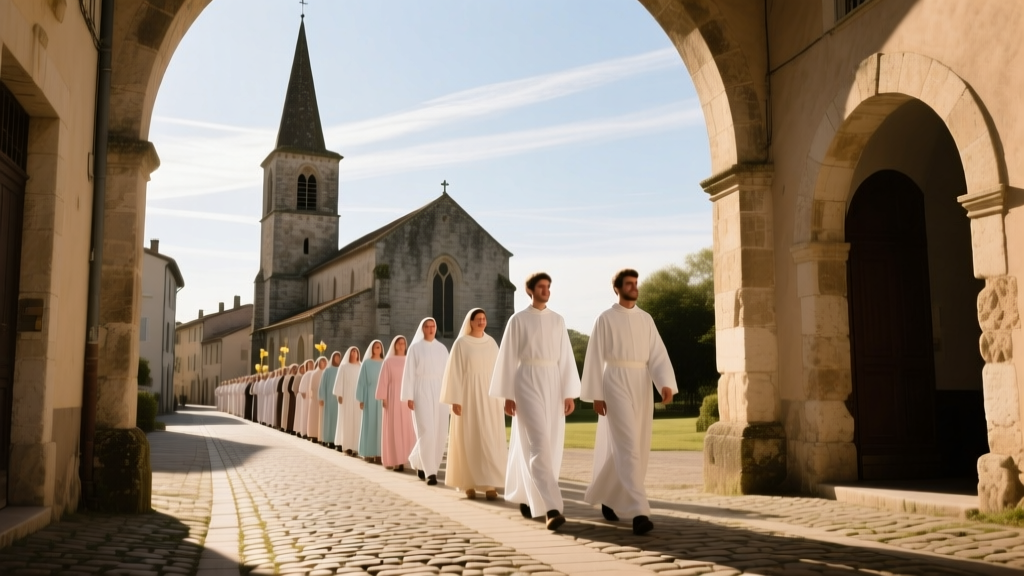
At 6:15 AM on May 14, 2026, the cobblestones of Strasbourg's Place de la Cathédral are still damp from a light spring drizzle. A procession of white-robed altar servers files through the arched doorway, carrying brass candlesticks that catch the first pale light filtering through the cathedral's rose window. You have maybe four seconds before they step into full shadow. Your camera needs to be ready.
Ascension Day is one of Europe's most photogenic religious holidays, yet most travel photographers arrive unprepared. The mix of slow-moving processions, candlelit interiors, and crowded public squares demands a specific approach to gear, settings, and technique. This guide walks you through everything you need to capture compelling images across three distinct European settings.
Understanding the Light on Ascension Day
Ascension Day falls 39 days after Easter Sunday, which in 2026 places it on May 14. At mid-May, European latitudes offer an unusually generous shooting window. In Paris, sunrise occurs at approximately 5:30 AM and sunset stretches to 9:15 PM, giving you nearly 16 hours of usable daylight. The golden hour ? that coveted stretch of warm, directional light ? begins roughly 70 minutes before sunset, putting you around 8:00 PM for evening shots.
Here's the thing most photographers miss: the morning golden hour matters just as much. Between 5:30 and 6:45 AM, the light in European cities has a soft, bluish quality that pairs beautifully with warm candlelight from church interiors. In Strasbourg, where processions often begin before 8 AM, this early window is your best friend.
Bruges presents a different challenge. Sitting at 51.2°N latitude, the city experiences a steeper sun angle in May. Sunrise runs about 5:45 AM, but the narrow canal-side streets stay in shadow until 7:00 AM or later. Plan your wide-angle architecture shots for that transition period when the first direct sunlight hits the gabled facades.
Camera Settings for Outdoor Processions
Processions move at roughly walking pace ? about 3 to 4 km/h ? which sounds slow but creates motion blur at anything below 1/125 second when you're shooting at 200mm. Here's a practical settings framework that works across most scenarios:
Shutter Speed Priorities
For walking processions, set your shutter speed to a minimum of 1/250 second. This freezes the movement of robes, banners, and handheld candles without requiring excessive ISO. If you're panning with the procession ? tracking the movement horizontally ? you can drop to 1/60 or 1/80 second to create that cinematic motion blur in the background while keeping the main subject sharp.
When photographing stationary moments ? a priest's blessing, a choir in formation, candles being lit ? you can safely work at 1/125 second. Inside dimly lit churches, however, you may need to accept 1/60 second and rely on image stabilization.
Aperture and ISO Ranges
Outdoor processions in May typically call for f/5.6 to f/8. This range gives you enough depth of field to keep multiple rows of participants in focus while still separating the subject from the background. For detail shots ? the embroidered edge of a banner, the texture of a processional cross ? open up to f/2.8 or f/4.
ISO depends entirely on where you're standing. In full daylight on a clear May morning, ISO 200-400 keeps noise negligible. Under the partial shade of cathedral arcades, push to ISO 800-1600. Inside churches during candlelit services, don't be afraid to hit ISO 3200 or even 6400 on modern full-frame bodies ? a noisy sharp image beats a clean blurry one every time.
| Scenario | Shutter Speed | Aperture | ISO Range | Autofocus Mode |
|---|---|---|---|---|
| Outdoor walking procession | 1/250s minimum | f/5.6 ? f/8 | 200?800 | AF-C (continuous) |
| Candlelit church interior | 1/60s ? 1/125s | f/2.8 ? f/4 | 1600?6400 | AF-S (single point) |
| Detail shots (banners, ornaments) | 1/200s | f/2.8 ? f/4 | 400?1600 | AF-S with eye detection |
| Panning with movement | 1/60s ? 1/80s | f/8 ? f/11 | 100?400 | AF-C with zone |
| Crowd-wide establishing shots | 1/125s | f/8 ? f/11 | 200?800 | AF-S or manual |
Lens Selection: What to Pack and Why
The 24-70mm f/2.8 zoom is your workhorse for Ascension Day photography. At 24mm you capture the full sweep of a procession winding through a medieval street. At 70mm you isolate individual faces in the crowd. The f/2.8 maximum aperture throughout the range handles those sudden transitions from bright square to shaded arcade.
Pair it with a 70-200mm f/2.8 for detail work. This lens compresses perspective, making crowded processions feel denser and more dramatic. It also lets you photograph from the edge of the crowd without intruding on the ceremony ? a critical consideration we'll return to shortly.
If you're working with a cropped-sensor body (APS-C), remember the 1.5x or 1.6x crop factor. Your 24-70mm effectively becomes a 36-105mm, which is still versatile but loses the wide end. Compensate by adding a 10-18mm or 16mm prime for those tight architectural interiors.
Budget Lens Alternatives
Not everyone can carry a €2,500 lens kit. Here's how to adapt at different price points:
- Under €500: A 50mm f/1.8 prime (often called the "nifty fifty") costs around €120-200 and delivers surprisingly sharp results. Pair it with a used 55-200mm f/4-5.6 telephoto for €150-250. You'll miss the wide end, but you can work around it by stepping back.
- €500?€1,200: Third-party zooms from Sigma and Tamron offer excellent value. The Sigma 24-70mm f/2.8 DG DN Art runs around €800 new and performs within 5% of first-party equivalents in blind sharpness tests published in the European Photography Equipment Review (2024).
- €1,200?€2,500: First-party professional zooms from Canon, Nikon, and Sony. The investment buys you faster autofocus, better weather sealing, and marginally sharper edge performance.
Composition Strategies for Crowded Scenes
Ascension Day processions draw crowds ? often 2,000 to 5,000 spectators in mid-sized cities like Bruges. The density creates both opportunity and frustration. Here's how to turn chaos into compelling frames.
Layer Your Frames
Position yourself so the image has three distinct planes: foreground, midground, and background. In Strasbourg's Petite France district, this might mean framing a procession through a half-timbered archway (foreground), with participants in embroidered vestments (midground) and the cathedral's spire visible beyond (background). Three layers of visual information create depth that a flat crowd shot simply cannot match.
Shoot from Elevated Positions
A cafe terrace on the second floor, a low stone wall, or even standing on a bollard (if it's safe and legal) gives you a cleaner sightline over the crowd. In Bruges, the steps of the Basilica of the Holy Blood offer a vantage point about 1.5 meters above street level ? enough to see over most heads while remaining at a respectful distance.
Use Leading Lines from Architecture
European towns were not built for photographers, but their street layouts work in your favor. The radial pattern of streets converging on a central square ? common in French bastide towns ? creates natural leading lines. Position yourself at the convergence point and shoot outward as the procession approaches. The converging architecture pulls the viewer's eye directly to your subject.
Photographing Religious Ceremonies Respectfully
This matters more than any technical tip. You are a guest at someone's act of worship.
Always check with the church or parish office before the event. In rural French villages, the priest or sacristan usually welcomes visitors with cameras, provided you agree to a few basic ground rules: no flash during the service, remain seated or stand in designated areas, and avoid photographing during moments of prayer or communion unless you have explicit permission.
"The best religious photography comes from patience and respect, not proximity. Stand back, observe the rhythm of the ceremony, and wait for moments that express devotion naturally ? a hand raised in blessing, the focused gaze of a choir member, the quiet exchange between a priest and an elderly parishioner. These images carry more weight than a close-up taken from the front row."
Turn off your shutter sound if your camera offers silent mode. The mechanical click of a mirror or shutter can be startling in a quiet church. Keep your movements slow and deliberate. If someone asks you to stop photographing, comply immediately and without argument.
Location Spotlight: Three Distinct Settings
Strasbourg ? The Grand Scale
Strasbourg's Ascension Day celebration centers on the Cathédrale Notre-Dame, a Gothic structure whose interior stretches 32 meters to the vaulted ceiling and 142 meters to the top of the spire. The procession typically departs from the cathedral's western portal at 9:30 AM, winding through the Rue des Grandes Arcades before reaching the Place Kléber ? roughly a 600-meter route that takes 25 minutes to complete.
The visual drama here comes from scale. The cathedral's pink Vosges sandstone facade, combined with the formal vestments of clergy and the density of the crowd, creates images with gravitas. Position yourself on the steps of the Aubette building (a historic structure on Place Kléber) for an elevated vantage point that captures the full breadth of the procession as it enters the square.
Bruges ? Intimate and Atmospheric
Bruges is smaller and denser. The procession from the Basilica of the Holy Blood to the Markt square covers approximately 400 meters through narrow medieval streets. The advantage: you can move quickly between positions on foot. Walk ahead of the procession, find your frame, and wait.
Early morning is magical here. At 6:30 AM, the canals reflect the first light on the gabled houses, and the streets are nearly empty. By 9 AM, when the procession begins, the city fills with spectators. The contrast between the quiet morning and the bustling mid-morning gives you two entirely different photographic moods from the same location.
Rural French Villages ? Authenticity and Access
In villages like Saint-Guilhem-le-Désert in the Hérault department, Ascension Day is a community event rather than a tourist spectacle. The entire village of roughly 200 residents participates. The procession leaves the 12th-century abbey church at 10 AM, follows a 300-meter path along the Hérault River, and concludes with a communal meal on the Place de l'Église.
The advantage of small villages: access. In a community this size, you'll be invited to join the meal, photograph inside the church without restriction, and capture candid moments that would be impossible in a city of 50,000. The trade-off is unpredictability ? schedules shift, events start late, and the light may not cooperate. Bring patience.
Post-Processing Workflow for Travel Photography
After a full day shooting an Ascension Day event, you'll likely return with 800 to 2,000 raw files. Here's a workflow that balances speed with quality:
Step One: Culling
Use a rating system in Lightroom or Capture One. On the first pass, mark anything technically usable with one star. On the second pass, promote the best of those to three stars. On the final pass, pick five stars for editing. Expect to keep roughly 10-15% of your total shots ? that's 80 to 300 images from a full day.
Step Two: Base Corrections
Apply lens profile corrections first ? this fixes distortion and vignetting specific to your lens. Then adjust white balance. Processions shot in mixed lighting (candlelight plus daylight through stained glass) often need a manual white balance adjustment. Set it to 4,800-5,200K as a starting point, then fine-tune to taste.
Step Three: Selective Adjustments
Use graduated filters to recover blown skies in wide-angle shots. Use radial filters to subtly brighten faces that fall in shadow during outdoor processions. Keep saturation adjustments conservative ? aim for a natural look that preserves the warm tones of stone architecture and the rich colors of liturgical vestments.
For black-and-white conversions ? particularly effective for candlelit interiors and portraits of elderly congregants ? try a high-contrast monochrome profile with the red channel pushed +20 to brighten skin tones and the blue channel pulled -15 to deepen shadows. This creates the kind of dramatic, timeless quality that works well in portfolios and exhibitions.
Gear Checklist for Ascension Day Shoots
May weather in Western Europe is unpredictable. Average temperatures range from 12°C to 22°C, with a 30-40% chance of light rain on any given day. Pack accordingly:
- Two camera bodies (one as backup, or mount the wide lens on one and the telephoto on the other)
- 24-70mm f/2.8 and 70-200mm f/2.8 lenses (or budget equivalents)
- Extra batteries ? cold mornings drain power 20-30% faster than rated capacity
- At least two 64GB SD cards
- Rain cover for your camera bag (a simple plastic poncho works in a pinch)
- Small tripod or monopod for low-light church interiors
- Lens cleaning kit ? dust and pollen are prevalent in May
The golden rule of event photography: the best camera is the one you know well. Spend time with your gear before the event. Practice the settings. Know where every button lives. When the procession steps out of the cathedral and into the light, you won't have time to figure out your menu system.