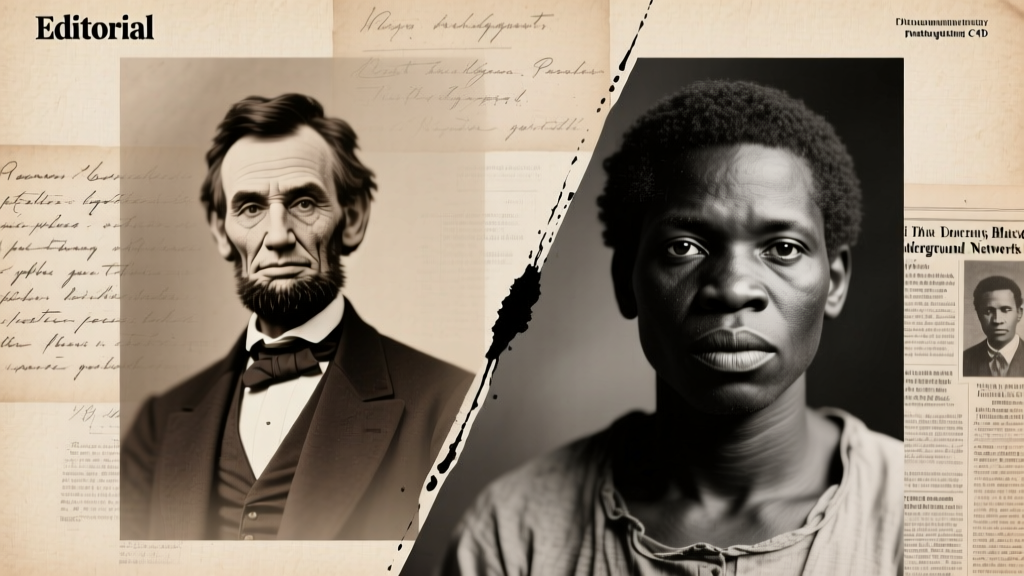
Which political party ended slavery? The truth behind Lincoln, the Republican Party, and the complex, bipartisan reality of emancipation — no oversimplifications, just documented facts and overlooked contributions from Democrats, abolitionists, and enslaved people themselves.
Why This Question Matters More Than Ever
The question which political party ended slavery surfaces constantly in classrooms, political debates, and social media — often weaponized with incomplete narratives. Yet the real story isn’t about party branding; it’s about constitutional crisis, moral courage, wartime strategy, and the relentless agency of enslaved Black Americans who forced emancipation onto the national agenda. Understanding this history isn’t academic nostalgia — it’s essential context for today’s conversations about racial justice, voting rights, and how political power actually shifts in America.
The Republican Party and the Emancipation Moment
Yes — the Republican Party was the vehicle through which President Abraham Lincoln issued the Emancipation Proclamation on January 1, 1863, and later championed the 13th Amendment. But that’s only the headline, not the full story. Founded in 1854 explicitly in opposition to the expansion of slavery into western territories, the early Republican Party united anti-slavery Whigs, Free Soilers, and disaffected Northern Democrats. Its 1860 platform called slavery ‘a relic of barbarism’ and demanded its containment — not immediate abolition. Lincoln himself repeatedly stated he had ‘no purpose to interfere with the institution of slavery in the States where it exists.’ His priority was preserving the Union.
What changed was war — and resistance. As enslaved people fled plantations en masse to Union lines (self-emancipating at scale), they transformed the Civil War’s moral and strategic calculus. Over 180,000 Black men enlisted in the U.S. Colored Troops — fighting not just for freedom, but for citizenship and dignity. Their valor made emancipation politically unavoidable. By 1864, even conservative Republicans conceded: ending slavery wasn’t just moral — it was militarily necessary and constitutionally inevitable.
Crucially, the 13th Amendment didn’t pass on party-line votes. It required two-thirds support in both chambers — and in the House vote of January 31, 1865, 16 Democratic representatives joined 93 Republicans to secure passage. That’s right: 17% of the yes votes came from Democrats — including border-state representatives like Rep. James Ashley (OH) and, critically, pro-Union Democrats from Kentucky and Tennessee who prioritized national unity over party orthodoxy.
Democrats: Opposition, Evolution, and Unexpected Alliances
To claim ‘the Democratic Party ended slavery’ would be false — but to say ‘Democrats universally opposed emancipation’ is equally misleading. In 1860, the Democratic Party fractured along sectional lines: Northern Democrats (led by Stephen Douglas) supported popular sovereignty; Southern Democrats (led by John C. Breckinridge) demanded federal protection of slavery. After secession, most Southern Democrats became Confederates — and actively fought to preserve slavery.
Yet Northern ‘War Democrats’ remained loyal to the Union. Figures like Governor Andrew Curtin of Pennsylvania and General George B. McClellan (though politically cautious) upheld the war effort. Some, like Congressman Samuel S. Cox of Ohio, opposed emancipation on racist or states’ rights grounds — but others, like Representative James R. Doolittle of Wisconsin (a Democrat who later switched parties), co-sponsored early anti-slavery legislation. More significantly, after the war, Reconstruction-era Democrats in Congress fiercely resisted civil rights laws — yet in the 20th century, the party’s ideological realignment meant many Southern Democrats became segregationists, while Northern liberals (including future Democratic presidents like Truman and JFK) advanced civil rights.
This evolution matters: party platforms shift. The Democrats of 1865 bear little resemblance ideologically or demographically to today’s Democratic Party — just as the Republican Party of Lincoln differs sharply from its 21st-century iteration. Reducing emancipation to a ‘party win’ flattens history and misleads modern political analysis.
The Real Architects: Enslaved People, Abolitionists, and Constitutional Mechanics
If we ask which political party ended slavery, we’re asking the wrong question — because slavery wasn’t ended by a party. It was dismantled through layered action:
- Enslaved resistance: From Gabriel Prosser’s 1800 rebellion to Nat Turner’s 1831 uprising, and especially the mass escapes during the Civil War (‘contraband camps’), Black people refused to be passive victims — they seized freedom, pressured commanders, and reshaped public opinion.
- Moral abolitionists: William Lloyd Garrison, Frederick Douglass, Harriet Tubman, and Sojourner Truth built movements outside formal politics — publishing newspapers, lobbying Congress, and organizing the Underground Railroad. Douglass famously challenged Lincoln: ‘When I do not see the commitment to universal liberty, I will not call you friend.’
- Radical Republicans: A faction within the GOP — led by Thaddeus Stevens and Charles Sumner — pushed Lincoln leftward, demanding immediate abolition and Black suffrage. They drafted the 13th, 14th, and 15th Amendments and enforced Reconstruction — often over Democratic and even moderate Republican objections.
- Constitutional process: The 13th Amendment succeeded not because of party loyalty, but because of extraordinary coalition-building, lobbying (Lincoln personally negotiated with swing-vote Democrats), and procedural mastery — including delaying the vote until lame-duck members (who’d lost re-election) could be replaced.
A lesser-known fact: the 13th Amendment was nearly derailed by a single Democratic representative — Fernando Wood of New York — who introduced a competing ‘compromise amendment’ protecting slavery in states where it existed. Only intense behind-the-scenes negotiation and appeals to patriotism secured his abstention.
What the Data Shows: Voting Records and Regional Realities
Let’s move beyond slogans and examine the actual legislative record. The final House vote on the 13th Amendment (January 31, 1865) reveals far more nuance than partisan mythology allows. Below is a breakdown of voting behavior by party and region — based on the Congressional Globe and modern scholarship (e.g., Foner’s The Fiery Trial and Egerton’s Year of Meteors):
| Group | Total Votes | Yea Votes | Nay Votes | Yea % | Key Context |
|---|---|---|---|---|---|
| Republican Party (House) | 110 | 93 | 17 | 84.5% | Includes 3 moderate Republicans who voted nay, fearing backlash in border states. |
| Democratic Party (House) | 77 | 16 | 61 | 20.8% | All 16 yea votes came from Unionist Democrats in KY, TN, MO, and OH — none from seceded states. |
| Unaffiliated / Independent | 2 | 2 | 0 | 100% | Representatives from newly admitted West Virginia and Nevada. |
| Total House | 189 | 111 | 78 | 58.7% | Required threshold: 126 (2/3 of 189). Passage achieved only after 3 Democrats changed votes post-lunch — reportedly influenced by Lincoln’s direct outreach and promises of patronage. |
This table underscores a critical point: emancipation required cross-party cooperation — not party purity. It also highlights regional fracture: Democratic support came exclusively from slaveholding border states that remained in the Union, where economic and political survival depended on balancing loyalty to Washington with local racial hierarchies. Meanwhile, every Republican senator voted yea — but Senate passage relied on the absence of Southern senators (who’d seceded), artificially inflating GOP unanimity.
Frequently Asked Questions
Did Abraham Lincoln free all enslaved people with the Emancipation Proclamation?
No — the Emancipation Proclamation applied only to Confederate states ‘in rebellion,’ exempting border slave states loyal to the Union (Delaware, Kentucky, Maryland, Missouri) and areas already under Union control. It was a wartime measure using presidential war powers, not a universal abolition decree. Full legal abolition required the 13th Amendment, ratified December 6, 1865.
Why didn’t the Constitution ban slavery in 1787?
The framers compromised to secure ratification: Southern states refused to join the Union without protections for slavery. The Constitution included the Three-Fifths Clause (counting enslaved people as 3/5 of a person for representation), the Fugitive Slave Clause (requiring return of escaped enslaved people), and a 20-year ban on banning the international slave trade. These provisions entrenched slavery in the nation’s founding document — making its eventual abolition a constitutional revolution, not a simple policy change.
Were there Black elected officials during Reconstruction?
Yes — over 2,000 Black men held public office between 1865–1877, including 16 U.S. Representatives and 2 Senators (Hiram Revels and Blanche K. Bruce of Mississippi). Most were Republicans — the party of Lincoln and emancipation — but their elections depended on biracial coalitions, federal enforcement, and Black voter mobilization. Their removal after 1877 marked the end of Reconstruction and the rise of Jim Crow.
Is the modern Republican Party the ‘party of Lincoln’ on racial issues?
Historically, yes — but the party’s racial politics evolved dramatically. From 1865–1930, Republicans dominated Black voting. The New Deal shifted many Black voters to the Democratic Party due to economic relief programs. The Civil Rights Act of 1964 and Voting Rights Act of 1965 saw most Republican senators vote yea — but Southern Democrats filibustered them. Today’s partisan alignment on race reflects decades of realignment, not static ideology.
How did enslaved people contribute to their own liberation?
Mass self-emancipation was decisive. Between 1861–1865, an estimated 500,000+ enslaved people escaped to Union lines — transforming Union logistics, undermining the Confederacy’s labor force, and forcing generals like Benjamin Butler to declare them ‘contraband of war.’ Their presence compelled the federal government to act — turning military necessity into moral imperative. As Frederick Douglass declared: ‘The arm of the slave is the best defense against the arm of the slaveholder.’
Common Myths
Myth #1: ‘The Republican Party abolished slavery single-handedly.’
Reality: While Republicans led the charge, emancipation required Democratic votes in the House, abolitionist pressure, enslaved resistance, and Lincoln’s political maneuvering. The 13th Amendment passed with bipartisan support — not party-line unity.
Myth #2: ‘Democrats have always been the party of racism, Republicans always the party of civil rights.’
Reality: Party ideologies and coalitions reversed dramatically between 1865 and 1965. Southern Democrats enforced segregation for a century; Northern Republicans led Reconstruction. Modern alignments reflect migration, civil rights legislation, and the Southern Strategy — not unbroken lineage.
Related Topics (Internal Link Suggestions)
- Emancipation Proclamation facts — suggested anchor text: "what the Emancipation Proclamation actually did"
- 13th Amendment ratification timeline — suggested anchor text: "how the 13th Amendment passed step by step"
- Reconstruction era policies — suggested anchor text: "Reconstruction successes and failures"
- Frederick Douglass speeches on Lincoln — suggested anchor text: "Douglass on Lincoln's true commitment to freedom"
- Black soldiers in the Civil War — suggested anchor text: "USCT troops who won their own freedom"
Conclusion & Your Next Step
So — which political party ended slavery? The answer isn’t a slogan. It’s a story of coalition, contradiction, and courage: the Republican Party provided the leadership and legislative vehicle, but emancipation succeeded only because of enslaved people’s resistance, abolitionist moral pressure, War Democrats’ pragmatic Unionism, and constitutional ingenuity. Reducing this complexity to partisan credit misses the deeper truth — that freedom is never granted; it’s taken, defended, and renegotiated across generations.
Your next step? Go beyond party labels. Read primary sources — Douglass’s 1852 speech ‘What to the Slave Is the Fourth of July?’; Lincoln’s August 1862 letter to Horace Greeley; or the firsthand accounts in Ira Berlin’s Freedom’s Soldiers. Then, visit your local historical society or support preservation of contraband camp sites — because honoring this history means honoring the people who lived it, not just the politicians who legislated it.