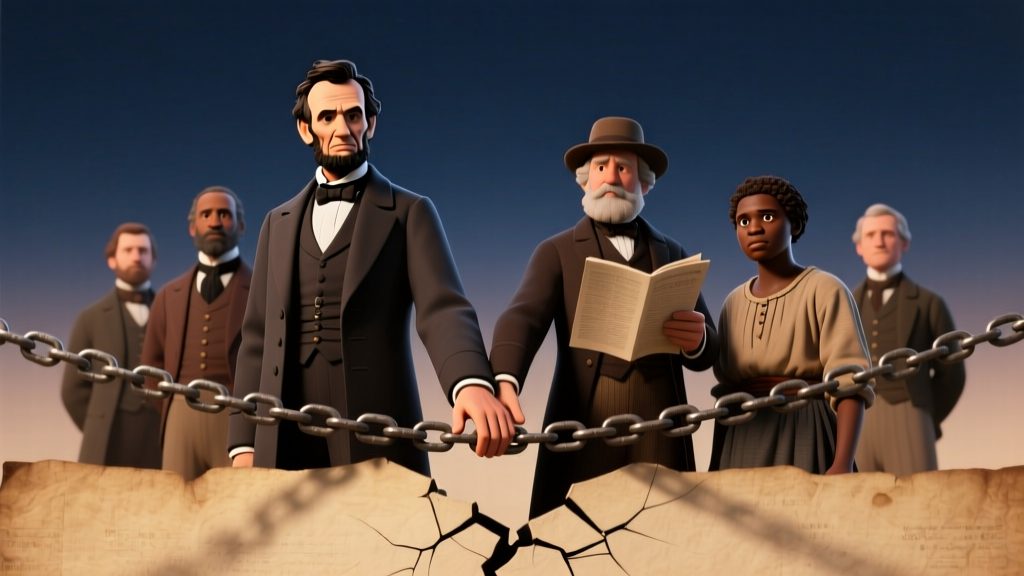
Which Party Abolished Slavery? The Truth Behind the Myth: It Wasn’t Just One Party — Here’s How Lincoln, Radical Republicans, Abolitionists, and Enslaved People Themselves Forged Emancipation Together
Why This Question Matters More Than Ever Today
The question which party abolished slavery isn’t just a trivia prompt—it’s a flashpoint in how we understand American democracy, accountability, and historical memory. In an era where school curricula are contested, monuments debated, and political rhetoric weaponizes history, getting this right shapes civic literacy, informs voting behavior, and exposes how myths calcify into dogma. And yet, most answers oversimplify—or worse, distort—the complex, contested, and deeply collaborative reality behind emancipation.
The Real Story Isn’t About a Single ‘Hero Party’—It’s About a Coalition Under Fire
Let’s start with precision: no political party *alone* abolished slavery. The U.S. Constitution gave Congress no explicit power to end slavery in states where it existed—only to ban the international slave trade (1808) and regulate slavery in federal territories. Abolition required unprecedented legal, military, moral, and grassroots convergence. That said, the Republican Party, founded in 1854 explicitly in opposition to the expansion of slavery, became the indispensable vehicle for emancipation. But calling it a ‘Republican achievement’ without naming its collaborators erases critical agency—and risks replicating the very erasure that sustained slavery itself.
Consider this: When Abraham Lincoln issued the Emancipation Proclamation on January 1, 1863, he did so as a wartime measure under his authority as Commander-in-Chief—not as a law passed by Congress. It applied only to Confederate-held territory (where the federal government had no enforcement power), exempted border states loyal to the Union (Kentucky, Missouri, Maryland, Delaware), and left slavery untouched in Union-occupied areas like parts of Louisiana and Tennessee. Its power was symbolic *and* strategic—but its legal teeth came later, via constitutional amendment.
That’s where the 38th U.S. Congress entered the story. Of its 180 House members, 106 were Republicans, 42 Democrats, and 32 Unionists (a pro-Union coalition including ex-Whigs and anti-secession Democrats). When the 13th Amendment passed the House on January 31, 1865—by a vote of 119–56—it succeeded only because 16 Democrats crossed party lines and voted yes, alongside every Republican present. Without those Democratic defectors—and intense lobbying by abolitionist groups like the American Anti-Slavery Society, relentless pressure from Black leaders like Frederick Douglass and Sojourner Truth, and the battlefield courage of nearly 200,000 Black Union soldiers—the amendment would have failed.
How Enslaved People Forced Emancipation—Long Before Any Party Acted
Here’s what standard narratives often omit: enslaved people didn’t wait for politicians to ‘abolish’ slavery. They self-emancipated—by the tens of thousands—fleeing plantations as Union armies advanced, crowding into contraband camps, enlisting as spies, laborers, and soldiers. Historian Ira Berlin called this the ‘revolutionary self-emancipation’—a mass uprising conducted under extreme duress, with profound strategic impact.
In 1861, three enslaved men—Frank Baker, Shepard Mallory, and James Townsend—escaped to Fort Monroe in Virginia and refused to be returned under the Fugitive Slave Act. Their commander, General Benjamin Butler, declared them ‘contraband of war’—a legal fiction that opened the floodgates. By war’s end, over 500,000 people had seized freedom this way. Their actions transformed Union policy: the Confiscation Acts (1861, 1862) and ultimately the Emancipation Proclamation were direct responses to this groundswell.
Black regiments like the 54th Massachusetts Infantry didn’t just fight bravely—they reshaped public opinion. After their assault on Fort Wagner in July 1863, Northern newspapers ran editorials demanding full citizenship. Their valor made emancipation politically irreversible. As Douglass wrote in 1863: ‘Once let the black man get upon his person the brass letters, U.S.; let him get an eagle on his button, and a musket on his shoulder and bullets in his pocket, and there is no power on earth which can deny that he has earned the right to citizenship.’
The Role of Abolitionists, Women, and Religious Networks
Long before the Republican Party existed, organized abolitionism laid the moral and tactical groundwork. Beginning in the 1830s, figures like William Lloyd Garrison (who declared the Constitution ‘a covenant with death’), Harriet Tubman (who led 13 missions rescuing ~70 people), and Lucretia Mott built networks that funneled escaped people north, published incendiary literature, lobbied legislatures, and staged protests—including the 1838 Pennsylvania Hall riot, where abolitionist women were attacked for advocating racial equality.
Women’s antislavery societies—often barred from speaking at mixed-gender events—published petitions signed by hundreds of thousands. In 1837 alone, over 130,000 women petitioned Congress to abolish slavery in D.C. Though ignored, these campaigns trained a generation of organizers who’d later lead suffrage and civil rights movements. Quakers, Methodists, and Congregationalists provided meeting spaces, funding, and theological justification—turning scripture against the ‘curse of Ham’ myth used to defend bondage.
Crucially, abolition wasn’t monolithic. ‘Moral suasion’ advocates like Garrison rejected politics; ‘political abolitionists’ like Gerrit Smith and Frederick Douglass (who shifted from anti-government to pro-constitutional activism after 1848) pushed for electoral engagement. That ideological evolution helped birth the Free Soil Party (1848), then the Republican Party (1854)—proving that movement energy *enabled* party formation, not vice versa.
What the Data Shows: Voting Records, Regional Shifts, and Lasting Consequences
Let’s move beyond anecdotes to hard evidence. The table below breaks down congressional votes on emancipation-related measures between 1861 and 1865—revealing partisan alignment, regional fractures, and pivotal defections.
| Measure | Date Passed | House Vote (Y-N) | Republican Support | Democratic Support | Key Defectors/Notes |
|---|---|---|---|---|---|
| Second Confiscation Act | July 17, 1862 | 94–34 | 92 Y, 2 N | 2 Y, 32 N | 2 Democrats (John Hickman, PA; Samuel S. Cox, OH) voted yes; both later opposed 13th Amendment |
| Emancipation Proclamation (executive order) | Jan 1, 1863 | N/A (Presidential act) | N/A | N/A | Lincoln consulted cabinet; no vote, but 4 of 10 cabinet members were Democrats (Seward, Welles, Blair, Smith)—all supported it |
| 13th Amendment (House passage) | Jan 31, 1865 | 119–56 | 100% of 106 GOP reps voted Y | 16 of 42 Democrats voted Y (38%) | Defectors included Reps. James Garfield (OH), George Yeaman (KY), and Daniel Voorhees (IN); all cited ‘national unity’ and ‘moral duty’ |
| 13th Amendment (Senate passage) | April 8, 1864 | 38–6 | 32 Y, 0 N | 6 Y, 0 N | All 6 Democratic Y votes came from border states (KY, MO, TN, WV); zero from Deep South or Northern Democrats |
Frequently Asked Questions
Did the Democratic Party support slavery?
Yes—dominantly so, especially from the 1830s through 1865. The party’s national platform defended slavery as a ‘positive good,’ enforced the Fugitive Slave Act, and nominated pro-slavery candidates like John C. Breckinridge (1860). However, a minority faction—the ‘War Democrats’—broke with the party to support the Union war effort and, in some cases, emancipation. Post-war, the party largely resisted Reconstruction and embraced Jim Crow—making its pre-war stance part of a longer continuum of racial hierarchy.
Was Lincoln a Republican—and did he personally abolish slavery?
Yes, Lincoln was the first Republican president, elected in 1860 on a platform opposing slavery’s expansion. But he did not ‘abolish slavery’ unilaterally. His Emancipation Proclamation freed enslaved people only in rebellious states (as a war measure), and its enforcement relied entirely on Union military victory. Permanent, universal abolition required the 13th Amendment—a constitutional change ratified by three-fourths of states in December 1865, months after Lincoln’s assassination.
Why didn’t the Republican Party immediately secure civil rights after abolition?
Because political will fractured. While Radical Republicans (e.g., Thaddeus Stevens, Charles Sumner) pushed for Black suffrage and land redistribution (‘40 acres and a mule’), moderate Republicans prioritized rapid Southern reintegration. The 1866 Civil Rights Act and 14th/15th Amendments were hard-won compromises—and enforcement collapsed after 1877, when federal troops withdrew from the South in the Compromise of 1877. The party’s retreat paved the way for disenfranchisement and segregation.
Were there any Black elected officials in the Republican Party during Reconstruction?
Absolutely—and they were foundational. Between 1869 and 1901, over 2,000 Black men held office in the South, mostly as Republicans: 2 U.S. Senators (Hiram Revels and Blanche K. Bruce, both MS), 20 U.S. Representatives (including Robert Smalls, SC, who commandeered a Confederate ship to escape slavery), and hundreds of state legislators. Their leadership produced public schools, anti-discrimination laws, and infrastructure investment—until white supremacist terror (Klan violence, ballot box stuffing) and federal abandonment ended Reconstruction.
Is it accurate to say ‘the GOP abolished slavery’ today?
As shorthand, it’s common—but historically incomplete and potentially misleading. The modern Republican Party shares a name with the 1860s party, but its ideology, coalition, and policy priorities have transformed dramatically (especially post-1960s realignment). Attributing 1865 achievements to today’s GOP risks ahistorical conflation—like crediting today’s Democratic Party for Woodrow Wilson’s segregationist policies. Historical accuracy demands specificity: the Republican Party of the 1860s, in coalition with Black freedom fighters, abolitionists, and dissident Democrats, secured constitutional abolition.
Common Myths
Myth #1: ‘The Republican Party single-handedly abolished slavery.’
Reality: While Republicans led Congress and the White House, emancipation required cross-party votes, enslaved resistance, abolitionist pressure, and military force. Reducing it to one party erases the agency of Black Americans and misrepresents legislative reality.
Myth #2: ‘Abraham Lincoln freed the slaves with the stroke of a pen.’
Reality: The Emancipation Proclamation was a limited, conditional, wartime order. It took the 13th Amendment—ratified by states, not presidents—to constitutionally abolish slavery everywhere. And even then, loopholes like prison labor (allowed under the Amendment’s ‘except as punishment’ clause) enabled new forms of coerced labor.
Related Topics (Internal Link Suggestions)
- 13th Amendment ratification process — suggested anchor text: "how the 13th Amendment was ratified"
- Black soldiers in the Civil War — suggested anchor text: "Black Union soldiers and emancipation"
- Reconstruction Era policies — suggested anchor text: "what happened after slavery ended"
- Abolitionist movement timeline — suggested anchor text: "key events in the abolitionist movement"
- Political realignment of the parties — suggested anchor text: "how the parties switched on race"
Your Next Step: Go Beyond the Soundbite
Now that you know which party abolished slavery wasn’t a solo act—but a fragile, contested, multi-racial coalition—you’re equipped to read history critically. Don’t settle for slogans. Visit the Library of Congress’s digitized 13th Amendment ratification documents, explore the contraband camp diaries at the Smithsonian, or host a community screening of Freedom’s Path, a documentary on Black lawmakers during Reconstruction. History isn’t inherited—it’s investigated. Start yours today.
More Articles
 How Long to Air Fry Party Wings? The Exact Timing Guide That Prevents Dry, Burnt, or Soggy Wings Every Time — Even With 50 Guests and Zero Oven Space
What Should I Wear to a Graduation Party? 7 Stress-Free Outfit Rules (Backed by Real Guest Surveys + Stylist Interviews) That Actually Prevent Awkward Outfit Regret
How Long to Air Fry Party Wings? The Exact Timing Guide That Prevents Dry, Burnt, or Soggy Wings Every Time — Even With 50 Guests and Zero Oven Space
What Should I Wear to a Graduation Party? 7 Stress-Free Outfit Rules (Backed by Real Guest Surveys + Stylist Interviews) That Actually Prevent Awkward Outfit Regret