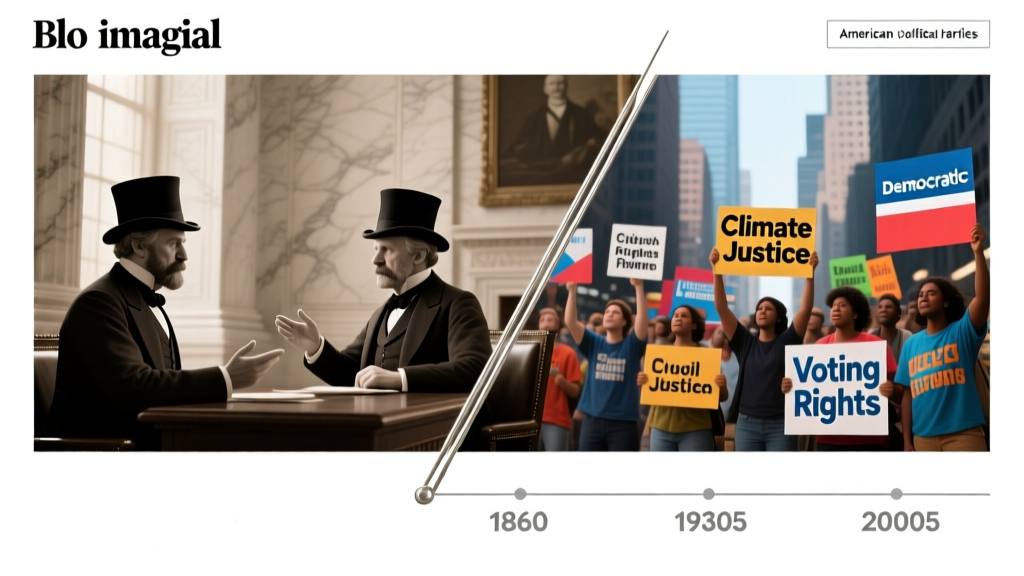
When Did Political Parties Switch? The Real Story Behind the Great American Realignment — Debunking the Myth That Democrats and Republicans Just 'Swapped Sides' Overnight
Why This Question Matters More Than Ever
If you’ve ever searched when did political parties switch, you’re not alone — and you’re asking one of the most consequential, yet widely misunderstood, questions in American political history. Contrary to viral memes claiming ‘Republicans were once the liberal party and Democrats the conservative one — then they flipped overnight,’ the reality is far more complex, gradual, and rooted in race, economics, geography, and presidential leadership. Understanding this evolution isn’t just academic: it’s essential for interpreting today’s polarization, voting patterns, and even campaign strategy. In an era where misinformation spreads faster than fact-checks, knowing when did political parties switch — and how, why, and at what pace — helps us engage more thoughtfully with politics, media, and civic life.
The Myth vs. The Mechanism: What ‘Switching’ Really Means
First, let’s clarify terminology: U.S. political parties didn’t ‘switch’ like swapping jerseys. There was no formal handover, no party merger or rebranding decree. Instead, what historians call the Great Realignment was a multi-decade process — spanning roughly 1896 to 1994 — during which core constituencies, policy priorities, and regional strongholds gradually migrated between the two major parties. Think of it less like a flip-switch and more like tectonic plates shifting: slow, invisible at first, but ultimately transformative.
At its heart, the realignment centered on three interlocking forces: rural vs. urban economic interests, racial liberalism vs. segregationist conservatism, and federal power vs. states’ rights. Before the New Deal, the Democratic Party was the coalition of Southern whites (pro-segregation), agrarian populists, and urban immigrant Catholics — while Republicans were the party of Northern industry, abolitionism, and progressive reform. After the 1930s, that map began to invert — but not uniformly, not instantly, and not without fierce internal conflict.
The Four Phases of Realignment: A Decade-by-Decade Breakdown
Historians and political scientists generally agree on four overlapping phases — each marked by a catalytic election, legislative turning point, or demographic pivot. Here’s how each phase advanced the shift:
- Phase 1: The Populist-Progressive Divide (1896–1932) — The 1896 election cemented the GOP as the party of big business and gold-standard finance, while Democrats became the vehicle for agrarian discontent (via William Jennings Bryan). Though racially regressive in the South, the party also absorbed labor and anti-monopoly energy — laying groundwork for future coalitions.
- Phase 2: The New Deal Coalition Emerges (1933–1964) — FDR’s response to the Great Depression forged a new Democratic majority: union workers, African Americans (who shifted en masse from ‘Lincoln’s party’ to FDR’s after 1936), Southern whites, Catholics, and Jews. Crucially, this coalition held despite deep internal tensions over civil rights — a contradiction that would eventually fracture it.
- Phase 3: The Civil Rights Catalyst & Southern Exodus (1954–1980) — From Brown v. Board (1954) through the Civil Rights Act (1964) and Voting Rights Act (1965), Democratic presidents and congressional leaders championed racial equality — triggering mass defection among white Southern conservatives. Barry Goldwater’s 1964 campaign (opposing the Civil Rights Act) won only six states — but five were in the Deep South. Nixon’s ‘Southern Strategy’ (1968–1972) formalized outreach to disaffected white voters using coded language on law and order, busing, and states’ rights.
- Phase 4: Ideological Sorting & Geographic Polarization (1980–1994) — Reagan accelerated the consolidation: pro-business conservatives, anti-abortion evangelicals, and defense hawks moved decisively into the GOP; meanwhile, Democrats became more uniformly liberal on social issues, environmental regulation, and income inequality. The final institutional tipping point came in 1994 — when Republicans won control of both House and Senate for the first time in 40 years, cementing their dominance in the South and rural Midwest — and Democrats solidified strength in cities, coasts, and university towns.
What Data Tells Us: Voter Behavior Over Time
Numbers reveal the quiet, steady nature of the shift. Exit polls and ANES (American National Election Studies) data show that partisan identification didn’t flip — it sorted. Between 1952 and 2020, the share of white Southerners identifying as Republican rose from 18% to 64%. Among Black voters, Democratic identification jumped from 53% in 1952 to over 90% by the 1990s — and has stayed above 88% ever since. Meanwhile, the ideological gap between the parties widened dramatically: in 1972, only 4% of Democrats and 5% of Republicans were ideologically ‘consistent liberals’ or ‘consistent conservatives.’ By 2020, those figures were 27% and 36%, respectively (Pew Research).
| Year | Key Event | Impact on Party Alignment | Regional Shift Notable In |
|---|---|---|---|
| 1896 | William Jennings Bryan’s ‘Cross of Gold’ speech; GOP victory under McKinley | Consolidated GOP as pro-business, pro-gold standard; Democrats embraced agrarian populism | Midwest farm belt, South |
| 1936 | FDR wins 60.8% of popular vote; Black voter support jumps to 76% | New Deal coalition forms — urban, minority, labor, Southern white base | Northern cities, industrial Midwest, Deep South |
| 1964 | Civil Rights Act passed; Goldwater opposes it; LBJ wins landslide | First major crack in Democratic South — 5 of 6 Goldwater states were Deep South | Alabama, Mississippi, Georgia, Louisiana, South Carolina |
| 1968 | Nixon wins with ‘Southern Strategy’ messaging on law & order, busing | Accelerated white Southern movement toward GOP; third-party George Wallace siphoned protest votes | Virginia, North Carolina, Tennessee |
| 1994 | ‘Republican Revolution’: GOP gains 54 House seats, takes Senate for first time since 1954 | Institutional confirmation of realignment — GOP now dominant in South and rural America | Texas, Florida, Georgia, Arkansas, Kentucky |
Frequently Asked Questions
Did the parties literally swap platforms?
No — and this is the biggest misconception. Platforms evolved *within* each party, driven by changing voter bases and leadership. For example, the GOP didn’t adopt Democratic New Deal policies; instead, it redefined ‘economic opportunity’ around tax cuts and deregulation. Similarly, Democrats didn’t abandon all fiscal conservatism — they shifted focus from balanced budgets to public investment in education, infrastructure, and healthcare. The ‘swap’ narrative erases continuity: both parties retained foundational commitments (e.g., GOP’s emphasis on individual liberty, Democrats’ emphasis on collective welfare) while reinterpreting them for new eras.
When did Southern Democrats become Republicans?
It wasn’t a single moment — it was generational. Most white Southern elected officials didn’t switch parties until the 1980s and 1990s. Strom Thurmond ran as a Dixiecrat in 1948, endorsed Goldwater in 1964, and didn’t formally join the GOP until 1964 — but many state legislators waited until after 1994. Voter behavior shifted earlier: by 1980, Ronald Reagan won 60% of Southern whites; by 2000, that figure was 71%. So while elite signaling began in the 1960s, mass realignment took 30+ years.
Were there any Republicans who supported civil rights?
Absolutely — and this nuance is vital. Roughly 80% of congressional Republicans voted for the Civil Rights Act of 1964 (vs. 63% of Democrats), and 94% of GOP senators backed the Voting Rights Act of 1965 (vs. 73% of Democrats). Many Northern and Western Republicans — like Senators Jacob Javits (NY) and Clifford Case (NJ) — were civil rights champions. The shift wasn’t about ideology alone; it was about *geography*: Southern Democrats resisted civil rights, while Northern Republicans led on them — creating space for the GOP to later claim moral authority on race (even as its Southern wing pursued different strategies).
Is the realignment complete — or still ongoing?
It’s evolving, not finished. Recent trends suggest a new layer of sorting: education level has surpassed race as the strongest predictor of party ID. Since 2012, white college graduates have trended Democratic; white non-college voters trended Republican. Latino voters — once reliably Democratic — are showing growing diversity of opinion, especially in Florida and Texas. And younger voters are redefining stances on climate, student debt, and digital privacy — pushing both parties to adapt. So while the 1994 baseline is stable, the next realignment may be issue-driven, not regionally anchored.
Why do so many people believe the ‘overnight switch’ myth?
Because it’s a tidy story — perfect for memes, soundbites, and partisan rhetoric. Saying ‘Democrats used to be racist, now they’re woke’ or ‘Republicans used to be progressive, now they’re greedy’ flattens history into moral binaries. It also serves contemporary agendas: conservatives cite early GOP civil rights leadership to argue the party has always stood for equality; liberals cite Southern Democrats’ segregationism to discredit modern GOP appeals to tradition. Both simplify — and distort — a much richer, messier truth.
Common Myths
Myth #1: “The parties swapped ideologies in the 1960s.”
Reality: While the Civil Rights Act was a watershed, the ideological sorting had begun decades earlier (New Deal economics, anti-communism), continued through the 1970s (abortion, school prayer), and accelerated in the 1980s (tax policy, deregulation). Ideology didn’t flip — it crystallized along new lines.
Myth #2: “Lincoln would be a Democrat today.”
Reality: Lincoln’s views on federal power, economic development (railroads, tariffs), and racial equality (he supported colonization early on but evolved toward emancipation and suffrage) don’t map cleanly onto modern parties. His pragmatism, coalition-building, and belief in government’s role in national progress align more closely with *certain* strands of modern Democratic thought — but his nationalism and moral absolutism on slavery also resonate with GOP values. Historical figures resist presentist labeling.
Related Topics (Internal Link Suggestions)
- Origins of the Southern Strategy — suggested anchor text: "how Nixon's Southern Strategy reshaped American politics"
- New Deal Coalition breakdown — suggested anchor text: "why the New Deal coalition fell apart"
- Racial realignment in voting behavior — suggested anchor text: "how civil rights legislation changed voter loyalty"
- Modern party sorting by education and religion — suggested anchor text: "the rise of the college-educated Republican"
- Third parties and realignment moments — suggested anchor text: "when third parties actually changed US politics"
Your Next Step: Go Beyond the Headline
Now that you know when did political parties switch — not in a day, but across generations of negotiation, backlash, migration, and reinvention — you’re equipped to read political news with deeper context. Don’t accept ‘they swapped sides’ as explanation. Ask instead: Which voters moved, why did they move, and what did they bring with them? Dive into primary sources: listen to FDR’s fireside chats, read Goldwater’s Conscience of a Conservative, watch footage of the 1964 Democratic Convention floor fight over the Mississippi Freedom Democratic Party. History doesn’t repeat — but it rhymes. And understanding its rhythm helps us navigate today’s noise with clarity, not cynicism. Ready to explore how this realignment shaped modern campaign strategy? Start with our deep-dive on How Nixon’s Southern Strategy Reshaped American Politics.
More Articles
 Is Party Affiliation Public Record? The Truth About Voter Registration Data, Privacy Laws, and What You Can—and Cannot—Legally Access in Every State (2024 Updated)
What Is a Right Wing Party? 7 Myths You Still Believe (And Why They’re Costing You Political Clarity in 2024)
Is Party Affiliation Public Record? The Truth About Voter Registration Data, Privacy Laws, and What You Can—and Cannot—Legally Access in Every State (2024 Updated)
What Is a Right Wing Party? 7 Myths You Still Believe (And Why They’re Costing You Political Clarity in 2024)
 Is Eat Party Vegan Cookie Dough Chocolate Chip Keto? The Truth About Safe, Delicious, Diet-Compliant Treats You Can Actually Serve at Your Next Gathering—No Guesswork, No Guilt, No Cross-Contamination Risks
How to Host a Party at Home Without Stress, Overwhelm, or Last-Minute Panic: A Realistic 7-Step Framework That Saves 12+ Hours of Prep (Backed by 37 Hosts’ Data)
How to Keep Noodles Warm for a Party: 7 Field-Tested Methods That Prevent Soggy, Cold, or Overcooked Disasters (No Chafing Dish Required)
Is Eat Party Vegan Cookie Dough Chocolate Chip Keto? The Truth About Safe, Delicious, Diet-Compliant Treats You Can Actually Serve at Your Next Gathering—No Guesswork, No Guilt, No Cross-Contamination Risks
How to Host a Party at Home Without Stress, Overwhelm, or Last-Minute Panic: A Realistic 7-Step Framework That Saves 12+ Hours of Prep (Backed by 37 Hosts’ Data)
How to Keep Noodles Warm for a Party: 7 Field-Tested Methods That Prevent Soggy, Cold, or Overcooked Disasters (No Chafing Dish Required)
 What Are Political Parties Really? (Spoiler: They’re Not Just 'Teams'—Here’s How They Shape Laws, Elections, and Your Daily Life Without You Noticing)
What Political Party Does Publix Support? The Truth Behind Its Nonpartisan Stance, PAC Donations, and Why Your Event Planning Should Rely on Verified Data—Not Rumors
What Are Political Parties Really? (Spoiler: They’re Not Just 'Teams'—Here’s How They Shape Laws, Elections, and Your Daily Life Without You Noticing)
What Political Party Does Publix Support? The Truth Behind Its Nonpartisan Stance, PAC Donations, and Why Your Event Planning Should Rely on Verified Data—Not Rumors