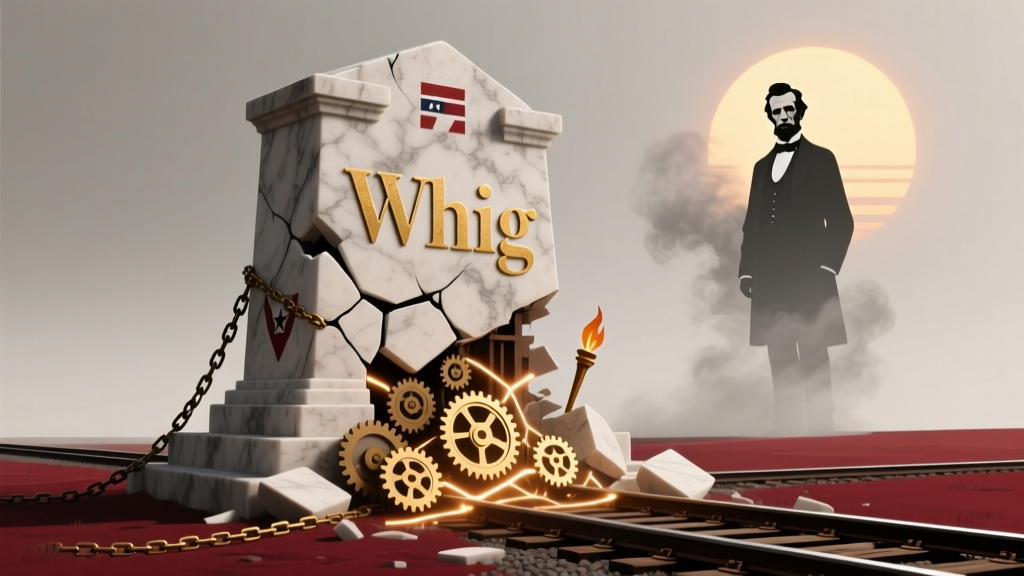
What Was the Whig Party? The Surprising Truth Behind America’s Forgotten Political Force — How a Coalition That Fought Slavery, Championed Infrastructure, and Shaped Lincoln’s Rise Vanished in Just 20 Years
Why This Obscure 19th-Century Party Still Shapes Your Politics Today
If you’ve ever wondered what was the whig party, you’re not alone — and your curiosity hits at something deeper than history trivia. This wasn’t just another forgotten political label. The Whig Party was the first major national coalition to explicitly oppose executive overreach, pioneer federal investment in infrastructure, and force the nation to confront slavery as a defining moral and constitutional crisis — all before dissolving in 1856. Its collapse didn’t erase its influence; it rechanneled it. Abraham Lincoln began his career as a Whig congressman. The Republican Party’s founding platform in 1854 borrowed wholesale from Whig economic policy and moral rhetoric. Even today, debates over federal power, tariffs, banking reform, and the role of Congress versus the presidency echo Whig arguments verbatim. Understanding what was the Whig Party isn’t about nostalgia — it’s about recognizing the DNA of modern American governance.
The Birth of a ‘Constitutional Opposition’: From Anti-Jackson Fury to National Coalition
The Whig Party didn’t spring from ideology — it erupted from outrage. In 1828, Andrew Jackson won the presidency on a wave of populist energy, promising to dismantle elite institutions and expand democracy to white male voters. But his actions alarmed many: vetoing the recharter of the Second Bank of the United States in 1832 without offering a constitutional alternative; using the ‘spoils system’ to fire thousands of civil servants and replace them with loyalists; and most explosively, enforcing the Indian Removal Act — leading to the Trail of Tears. To opponents, Jackson wasn’t a reformer — he was ‘King Andrew I,’ a monarch in democratic clothing.
These critics coalesced under the name ‘Whigs’ — a deliberate, loaded reference to the British Whigs who opposed royal absolutism in the 17th and 18th centuries. It was a branding masterstroke: instantly framing Jackson as a tyrant and themselves as defenders of constitutional balance. By 1834, former National Republicans (like Henry Clay), Anti-Masons (a reform movement suspicious of secret societies and elite influence), and disaffected Democrats had formed a fragile but functional alliance. Their unifying principle? Restoring congressional supremacy — especially over finance, internal improvements, and judicial appointments.
Clay’s ‘American System’ became their blueprint: a triad of policies designed to bind the nation economically and politically. First, a protective tariff to nurture Northern manufacturing. Second, a national bank to stabilize currency and credit. Third, federal funding for ‘internal improvements’ — roads, canals, and later railroads — to connect regions and stimulate commerce. This wasn’t abstract theory. Between 1830 and 1840, Whig-led states like Pennsylvania and Ohio poured millions into canal networks that slashed freight costs by up to 70%. When the Whigs won control of Congress in 1841, they immediately passed the Pre-Emption Act — granting squatters legal rights to buy land they’d improved — a direct response to Western farmers’ demands and a stark contrast to Jacksonian land speculation.
Leadership, Identity, and the Illusion of Unity
The Whigs never had a single charismatic leader — they had a constellation. Henry Clay of Kentucky was the architect and moral center: the ‘Great Compromiser’ who brokered the Missouri Compromise (1820) and the Compromise of 1850. Daniel Webster of Massachusetts gave the party its intellectual heft and rhetorical fire — his 1830 ‘Second Reply to Hayne’ speech remains one of the greatest defenses of Union and national sovereignty ever delivered. William Henry Harrison, their first elected president (1840), embodied their appeal to common men — though his ‘log cabin and hard cider’ campaign masked his elite background. And then there was John Quincy Adams, who, after losing the presidency in 1828, reinvented himself as a fiery Whig congressman — the only former president to serve in the House, where he led the fight against the ‘gag rule’ silencing anti-slavery petitions.
Yet this diversity was also their fatal flaw. The party spanned New England abolitionists, Southern planters who feared Jackson’s unpredictability more than they opposed slavery, and Midwestern entrepreneurs hungry for rail subsidies. They papered over contradictions with vague appeals to ‘order,’ ‘morality,’ and ‘progress.’ Whig newspapers like the New York Evening Post and The National Intelligencer preached temperance, public education, and Sabbath observance — positioning the party as the guardian of Protestant middle-class values. But when the question of slavery moved from theoretical to existential — especially after the Mexican-American War (1846–1848) and the acquisition of vast new territories — those values fractured.
The Irreconcilable Split: Slavery, Sectionalism, and the Collapse of Consensus
No single event killed the Whigs — but the 1850 Compromise was their last gasp of unity. Clay proposed admitting California as a free state while strengthening the Fugitive Slave Act — a trade-off meant to preserve the Union. Webster endorsed it. But younger Whigs like William Seward of New York called the Fugitive Slave Act ‘a crime against humanity,’ while Southern Whigs like Robert Toombs of Georgia warned that any restriction on slavery’s expansion would trigger secession. The party held its 1852 convention in Baltimore — and imploded. After 53 ballots, they nominated the obscure General Winfield Scott, a war hero with no clear stance on slavery. He lost spectacularly to Democrat Franklin Pierce, carrying only four states.
Then came the Kansas-Nebraska Act of 1854 — sponsored by Democratic Senator Stephen Douglas, it repealed the Missouri Compromise and allowed settlers in new territories to decide slavery via ‘popular sovereignty.’ For Northern Whigs, this was the final betrayal of their foundational belief in national standards and moral restraint. Thousands abandoned the party overnight. In Ripon, Wisconsin, anti-slavery Whigs, Free Soilers, and disaffected Democrats met in a schoolhouse and founded the Republican Party — explicitly rejecting the expansion of slavery. Former Whig leaders flooded into the new party: Lincoln, Seward, Salmon Chase, and Edward Bates. By 1856, the Whig National Convention couldn’t even agree on whether to hold one — and formally ceased operations. Their last presidential candidate, Millard Fillmore, ran under the nativist American Party (‘Know-Nothings’) — a desperate, doomed pivot that confirmed their irrelevance.
Legacy in Law, Language, and Leadership: What the Whigs Gave Us
The Whigs vanished — but their fingerprints are everywhere. Consider the Homestead Act of 1862: signed by Lincoln, it granted 160 acres of public land to any citizen willing to farm it for five years. Its language and structure were lifted directly from Whig land policies championed by Clay and Adams. Or the Morrill Land-Grant Acts (1862 & 1890), which used federal land sales to fund agricultural and mechanical colleges — fulfilling the Whig vision of government as an engine of human capital development. Even the modern Republican emphasis on infrastructure investment (e.g., the Bipartisan Infrastructure Law of 2021) echoes Clay’s American System.
Linguistically, the Whigs bequeathed us enduring political grammar. ‘Manifest Destiny’ was coined by Whig journalist John O’Sullivan in 1845 to justify continental expansion — a phrase still invoked in foreign policy debates. ‘The loyal opposition’ — now a cornerstone of democratic norms — was first articulated by Whig congressmen defending their right to dissent without treason. And Lincoln’s famous ‘House Divided’ speech (1858) wasn’t original rhetoric — it adapted Webster’s 1850 warning that ‘the Union cannot exist half slave and half free,’ proving how deeply Whig moral logic permeated Republican thought.
| Feature | Whig Party (1834–1856) | Modern Parallel / Legacy | Key Evidence |
|---|---|---|---|
| Economic Philosophy | Pro-business, pro-infrastructure, pro-national bank, protective tariffs | Republican ‘pro-growth’ platform; Biden’s infrastructure bills citing ‘Clay’s vision’ | 1841 Tariff Act raised duties to 32%; Whig-controlled PA funded $10M in canals (1830s) |
| Slavery Stance | Officially ‘non-extensionist’ — opposed slavery’s spread but accepted its existence in South | Early Republican Party platform (1856): ‘no extension of slavery’; Lincoln’s 1860 platform | 1852 Whig platform: ‘We will not agitate the slavery question’ — yet 60% of Northern Whig congressmen voted against Kansas-Nebraska Act |
| Governance Model | Strong Congress, restrained presidency, independent judiciary | Contemporary debates over executive orders, signing statements, and administrative state overreach | Whigs filed 37 impeachment resolutions against Jackson; fought removal of Treasury deposits in 1833 |
| Cultural Influence | Championed public schools, temperance, Sabbath laws, moral reform | Modern ‘culture war’ alignments on education, religious liberty, social issues | Whig-dominated MA passed first statewide public school law (1837); NY Whigs led 1846 temperance referendum |
Frequently Asked Questions
Was the Whig Party liberal or conservative by today’s standards?
Neither — and both. On economics, Whigs were ‘conservative’ in favoring elite-led development (banks, tariffs, corporations) but ‘liberal’ in supporting federal activism (infrastructure, education). On slavery, they were morally conflicted: many Northern Whigs evolved into abolitionists, while Southern Whigs defended slavery as constitutional. Their closest modern analogue is a fusion of Eisenhower-era Republican pragmatism and progressive-era reformism — prioritizing institutional stability over ideological purity.
Why did the Whig Party fail while the Republican Party succeeded?
The Whigs failed because they tried to hold together incompatible visions of America — a pro-slavery South and an increasingly anti-slavery North — through compromise and silence. The Republicans succeeded because they made slavery’s containment the non-negotiable core of their identity. As Lincoln wrote in 1858: ‘A house divided against itself cannot stand.’ The Whigs hoped to avoid that division; the Republicans embraced it as necessary for survival.
Did any Whig presidents serve full terms?
No. William Henry Harrison died of pneumonia 31 days after inauguration in 1841 — the shortest presidency in U.S. history. His successor, John Tyler, was a Whig in name only; he vetoed Whig banking legislation and was expelled from the party. Zachary Taylor, elected as a Whig in 1848, died 16 months into office in 1850. Millard Fillmore, who completed Taylor’s term, was the last Whig president — but by 1852, the party was already fracturing.
Are there any Whig Party descendants active today?
No formal lineage exists — the party dissolved completely by 1856. However, its ideological DNA flows through multiple channels: the Republican Party (economic nationalism, infrastructure investment), the modern Democratic Party (public education advocacy, moral reform traditions), and even third parties like the Reform Party (fiscal responsibility + anti-corruption messaging). Historians call this ‘Whig dispersal’ — where a coalition’s values outlive its structure.
How did the Whigs view immigration and nativism?
Most Whigs opposed nativist movements like the Know-Nothings, seeing them as divisive distractions from economic progress. However, after 1850, as Irish and German Catholic immigration surged, some Northern Whigs softened their stance — fearing Democratic alliances with immigrant voters. This tension contributed to Fillmore’s 1856 run under the nativist American Party, a final, fatal departure from Whig principles.
Common Myths About the Whig Party
- Myth #1: The Whigs were a monolithic anti-Jackson protest group with no real platform. Reality: They developed a sophisticated, nationally coordinated agenda — the American System — with detailed policy proposals, regional implementation strategies, and measurable outcomes (e.g., Ohio’s canal network increased wheat exports by 210% between 1830–1845).
- Myth #2: The Whigs collapsed solely because of slavery. Reality: Slavery was the breaking point, but structural weaknesses mattered equally — lack of patronage machinery (they refused spoils), weak state-level organizations, and dependence on charismatic leaders who aged or died (Clay died in 1852; Webster in 1852; Harrison in 1841).
Related Topics (Internal Link Suggestions)
- Missouri Compromise of 1820 — suggested anchor text: "how the Missouri Compromise delayed civil war for 34 years"
- Henry Clay’s American System — suggested anchor text: "the economic blueprint that built America’s first infrastructure boom"
- Origins of the Republican Party — suggested anchor text: "from Whig collapse to Lincoln’s rise in 12 turbulent years"
- Andrew Jackson’s presidency — suggested anchor text: "how King Andrew reshaped democracy — and created his fiercest enemies"
- Compromise of 1850 — suggested anchor text: "the last great bargain before the Civil War"
Conclusion & Your Next Step
So — what was the Whig Party? It was America’s first experiment in building a national political identity around ideas rather than personality or region — an ambitious, flawed, and ultimately tragic effort to reconcile growth with conscience, power with principle, and union with freedom. Its story isn’t closed. Every time Congress debates infrastructure spending, every time a president faces pushback over executive authority, every time moral urgency collides with political pragmatism — we’re living in the Whig inheritance. If this deep dive changed how you see 19th-century politics — or helped you spot Whig logic in today’s headlines — go further. Read Henry Clay’s 1850 Senate speeches online (freely available via the Library of Congress), compare them to modern policy debates, and ask: What compromises are we making today — and which ones might fracture tomorrow? Then share one insight with someone who thinks history is just names and dates. Because understanding what was the Whig Party proves history isn’t past tense — it’s present conditional.
More Articles
 How Many Players Is Mario Party Jamboree? The Real Answer (Plus How to Maximize Fun for 1–4 Players—No More Guesswork or Last-Minute Switches!)
How to Unlock Bowser Map in Mario Party Jamboree: The 4-Step Shortcut (No Missed Minigames, No Grind—Just Pure Bowser Chaos)
How Many Players Is Mario Party Jamboree? The Real Answer (Plus How to Maximize Fun for 1–4 Players—No More Guesswork or Last-Minute Switches!)
How to Unlock Bowser Map in Mario Party Jamboree: The 4-Step Shortcut (No Missed Minigames, No Grind—Just Pure Bowser Chaos)
 How Much Is a Taco Bell Party Pack Really? We Called 12 Locations, Checked 2024 Menu Updates, and Compared It to DIY Tacos—Here’s the Exact Cost Per Person (Plus Hidden Fees You’ll Regret Missing)
What Did the Boston Tea Party Do? The Truth Behind the Myth: How This 1773 Protest Sparked a Revolution (Not Just Threw Tea Overboard)
How to Dress for a Kentucky Derby Party Without Looking Costumed, Overdressed, or Underprepared: A Realistic 7-Step Style Guide That Works for Every Budget and Body Type
How Much Is a Taco Bell Party Pack Really? We Called 12 Locations, Checked 2024 Menu Updates, and Compared It to DIY Tacos—Here’s the Exact Cost Per Person (Plus Hidden Fees You’ll Regret Missing)
What Did the Boston Tea Party Do? The Truth Behind the Myth: How This 1773 Protest Sparked a Revolution (Not Just Threw Tea Overboard)
How to Dress for a Kentucky Derby Party Without Looking Costumed, Overdressed, or Underprepared: A Realistic 7-Step Style Guide That Works for Every Budget and Body Type
 What to Wear for Glow Party: The 7-Second Glow-Up Formula (No Blacklight Tests, No Regrets, Just Instant Radiance)
 What Is a Garden Party Attire? The 7-Second Dress Code Decoder (No More Awkward Outfit Guessing or Last-Minute Panic)