What Was the First Political Party in America? The Surprising Truth Behind the Federalists vs. Anti-Federalists — and Why Most Textbooks Get It Wrong (Spoiler: It Wasn’t the Democrats or Republicans!)
Why This Question Matters More Than Ever
What was the first political party in America? That simple question cuts to the heart of how our democracy evolved — and why today’s hyperpolarized two-party system feels so inevitable, yet historically accidental. In an era where political identity dominates social media feeds, school board meetings, and dinner tables, understanding the origins of organized partisanship isn’t just academic trivia — it’s civic literacy. The answer reshapes how we interpret the Constitution, the presidency, and even the Electoral College. And spoiler: it wasn’t the Democratic or Republican Party — both came decades later. Instead, the nation’s first true political party emerged not from a convention hall or campaign rally, but from heated debates in George Washington’s own cabinet.
The Federalist Party: Birth in Disagreement, Not Doctrine
The Federalist Party didn’t launch with a manifesto or a logo. It coalesced quietly between 1789 and 1792 — not as a formal organization, but as a network of like-minded officeholders, editors, and financiers united by one urgent conviction: the new federal government needed energetic authority, sound credit, and centralized economic leadership. Its architects weren’t fringe activists — they were Alexander Hamilton (Secretary of the Treasury), John Jay (first Chief Justice), and John Adams (Vice President). Crucially, they operated *within* the framework of the newly ratified U.S. Constitution — a document many Anti-Federalists had opposed precisely because they feared such concentrated power.
Hamilton’s Reports on Public Credit (1790) and the Report on Manufactures (1791) became de facto party platforms. His plan to assume state war debts, create a national bank, and levy excise taxes sparked fierce resistance — and in that resistance, the opposition crystallized. James Madison and Thomas Jefferson, initially sympathetic to strong central institutions, broke sharply with Hamilton over fiscal policy and foreign alignment (especially during the French Revolution). By 1792, Madison was anonymously writing anti-Hamilton essays in Philip Freneau’s National Gazette, while Jefferson privately called the Federalists “monarchists in principle.” Their coalition would soon be dubbed the ‘Democratic-Republicans’ — though neither term appeared in their official correspondence at first.
This wasn’t party-building in the modern sense. There were no primaries, no national committees, no standardized platforms. Instead, Federalists coordinated through patronage (appointing loyal postmasters and customs officers), newspapers (like John Fenno’s Gazette of the United States), and elite sociability (dinner parties, Masonic lodges, merchant associations). Their strength lay in urban centers — Boston, New York, Philadelphia — and among creditors, merchants, lawyers, and established planters who valued stability over radical change.
Why ‘First’ Is Trickier Than It Sounds: The Anti-Federalist Shadow
Calling the Federalists the ‘first’ political party requires careful definition — because organized opposition existed *before* them. During the ratification debates of 1787–1788, self-identified ‘Anti-Federalists’ fiercely contested the proposed Constitution. Figures like Patrick Henry, George Mason, and Richard Henry Lee warned of executive tyranny, absent bills of rights, and unaccountable judicial power. They published essays, held town meetings, and lobbied state conventions — all hallmarks of political mobilization.
So why aren’t Anti-Federalists considered the first party? Because they lacked continuity. Once the Constitution was ratified — and especially after the Bill of Rights was added in 1791 — most Anti-Federalists either disbanded, joined state governments, or merged into the emerging Democratic-Republican coalition. They were a *movement*, not a durable institution. As historian Rosemarie Zagarri observes, “Anti-Federalism was a moment, not a machine.” The Federalists, by contrast, maintained coherent leadership, sustained policy agendas, and institutional memory across multiple election cycles — winning the presidency in 1789, 1792, and 1796, and controlling Congress for much of the 1790s.
A telling case study is the 1796 presidential election — the first contested race in U.S. history. With no formal party tickets, electors cast two votes. Federalist John Adams won the presidency with 71 votes; Democratic-Republican Thomas Jefferson came second with 68 and became Vice President — a bizarre outcome that exposed the system’s fragility. Yet behind the scenes, Federalist electors coordinated to ensure Adams edged out Jefferson, while Democratic-Republicans did the same for their candidate. This silent coordination — across states, without central command — marks the operational birth of partisan discipline.
The Collapse and Legacy: How One Party’s Fall Forged the Two-Party System
The Federalist Party didn’t fade — it imploded. Its fatal flaw wasn’t ideology, but inflexibility. During the War of 1812, Federalist leaders in New England openly criticized the conflict, convened the Hartford Convention (1814–1815), and floated constitutional amendments to limit Southern political power and restrict future declarations of war. Though the convention’s final report stopped short of secession, its timing — coinciding with Andrew Jackson’s victory at New Orleans and the Treaty of Ghent — made Federalists appear treasonous and parochial. Voters punished them decisively: in the 1816 election, James Monroe (Democratic-Republican) won 183 electoral votes to Federalist Rufus King’s 34 — the party’s last gasp.
Yet its legacy endured. The Federalists pioneered tools every modern party uses: coordinated newspaper networks, targeted fundraising (especially from banks and insurers), patronage-based loyalty systems, and ideological framing of national issues (e.g., “order vs. chaos,” “credit vs. debt”). Even their opponents borrowed their tactics: Jefferson’s 1800 campaign deployed local Republican societies, printed pamphlets, and leveraged tavern networks — a direct response to Federalist infrastructure. When the Democratic-Republicans fractured after 1824, the resulting factions (Jacksonian Democrats and National Republicans) inherited both the Federalists’ organizational DNA and their policy debates — especially over banking, tariffs, and internal improvements.
Consider this irony: the modern Republican Party, founded in 1854, explicitly rejected Federalist-style elitism — yet its early platform embraced Hamiltonian economics (national bank, protective tariffs, infrastructure investment). Meanwhile, today’s Democratic Party traces its lineage to Jefferson’s coalition but governs with a regulatory apparatus Hamilton would recognize. The first party’s ghost still shapes the debate — just in reverse costume.
Key Facts at a Glance: Federalist Party Timeline & Impact
| Milestone | Year | Significance | Key Figures Involved |
|---|---|---|---|
| Constitution Ratified | 1788 | Created framework for federal authority — enabling party formation around implementation | James Madison (Federalist #10), Alexander Hamilton (Federalist #1) |
| Hamilton’s First Report on Public Credit | 1790 | Catalyzed pro- vs. anti-administration split; birth of policy-based factionalism | Alexander Hamilton, Robert Morris, Fisher Ames |
| Formation of Democratic-Republican Societies | 1793–1794 | Organized grassroots opposition — first sustained extra-governmental party structure | Benjamin Bache, David Rittenhouse, numerous local artisans & farmers |
| Alien and Sedition Acts Passed | 1798 | Federalist overreach that galvanized opposition and spurred Kentucky/Virginia Resolutions | John Adams, Timothy Pickering, Matthew Lyon (targeted critic) |
| Hartford Convention | 1814–1815 | Final major act; discredited party nationally and accelerated its demise | George Cabot, Harrison Gray Otis, Theodore Dwight |
Frequently Asked Questions
Was the Federalist Party officially founded in 1789?
No — it had no founding date, charter, or membership rolls. Historians identify 1789–1792 as its formative period, when Hamilton’s policies triggered organized support and opposition. The term “Federalist” was used descriptively before becoming a partisan label.
Did George Washington belong to the Federalist Party?
Washington never formally joined any party and publicly deplored “the baneful effects of the spirit of party” in his 1796 Farewell Address. However, he consistently endorsed Federalist policies (bank, neutrality, suppression of the Whiskey Rebellion) and appointed Federalists to key posts — making him, functionally, their most powerful ally.
Why didn’t the Federalists survive beyond 1816?
Three interlocking reasons: (1) Their base narrowed to elite coastal merchants, alienating farmers and artisans; (2) Their opposition to the War of 1812 was perceived as unpatriotic; (3) They failed to adapt ideologically — rejecting democratic expansion, suffrage reforms, and populist rhetoric that resonated nationally after 1815.
Are today’s Federalist Society and the Federalist Party related?
No. The Federalist Society (founded 1982) is a conservative legal advocacy group inspired by the *constitutional philosophy* of early Federalists — particularly judicial restraint and originalism — but it is not a political party, has no electoral function, and shares no organizational lineage.
What role did newspapers play in the first party system?
Essential. Federalists backed Gazette of the United States; Democratic-Republicans launched National Gazette (1791) and Richmond Examiner. These papers reprinted speeches, attacked opponents’ characters, circulated party resolutions, and created shared narratives — functioning as the 18th-century equivalent of social media algorithms and campaign ads combined.
Common Myths About America’s First Political Party
- Myth #1: The Democratic Party is the oldest continuous party in the U.S. — False. While the Democratic Party traces its roots to 1828, it underwent fundamental ideological and structural transformations (especially post-Civil War and New Deal). No American party maintains unbroken continuity in platform, electorate, or organization since the 1790s.
- Myth #2: Political parties were forbidden by the Founders. — Misleading. The Framers feared ‘factions’ (as Madison defined them in Federalist #10), but they didn’t anticipate or prohibit organized parties. In fact, Madison later helped build the first opposition party — proving that practical governance quickly overrode theoretical aversion.
Related Topics (Internal Link Suggestions)
- Origins of the Two-Party System — suggested anchor text: "how the two-party system began in the United States"
- Federalist Papers Explained — suggested anchor text: "what are the Federalist Papers and why do they matter"
- Jefferson vs. Hamilton Debate — suggested anchor text: "Hamilton and Jefferson's economic rivalry"
- Alien and Sedition Acts Impact — suggested anchor text: "how the Alien and Sedition Acts changed American politics"
- Early U.S. Presidential Elections — suggested anchor text: "presidential elections before the 12th Amendment"
Conclusion & Your Next Step
So — what was the first political party in America? The Federalist Party, born not from a declaration but from disagreement, not from a convention but from cabinet meetings and newspaper columns. Its story reminds us that parties aren’t static brands — they’re living organisms shaped by crisis, adaptation, and sometimes, catastrophic miscalculation. Understanding this origin doesn’t just satisfy curiosity; it equips you to read today’s headlines with deeper context — recognizing when polarization reflects enduring tensions (federal power vs. states’ rights, commerce vs. agrarianism) and when it signals something genuinely new.
Your next step? Go beyond textbooks. Visit the Library of Congress’s digitized Gazette of the United States archives, compare Hamilton’s 1790 Report with Jefferson’s 1791 response, and ask: What modern policy debate echoes their clash over debt, banking, and national identity? Then share your insight — because civic understanding multiplies when it’s discussed, not just consumed.
More Articles
 Team Building Event Venue Ideas: How to Choose the Right Space and Plan a Seamless Experience
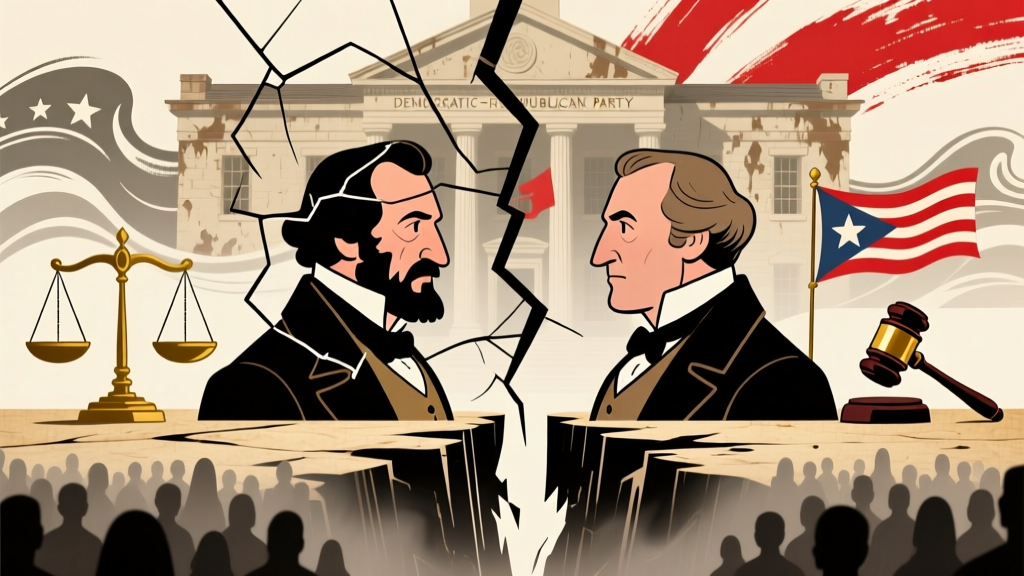 Why Did Democratic Republican Party Split? The Real Reason Isn’t What Your Textbook Said — It Wasn’t Ideology Alone, But a Perfect Storm of Personality Clashes, Regional Power Shifts, and the Rise of Mass Democracy That Shattered the Era of Good Feelings
Who to Invite to Graduation Party: The Stress-Free Guest List Framework That Prevents Awkward Omissions, Budget Blowouts, and Family Feuds (Backed by 127 Real Grad Parties)
When to Have a Graduation Party: The 7-Day Rule, Regional Timing Trends, and Why Hosting Too Early (or Too Late) Costs You 37% More in Stress & No-Shows
What Is a BDSM Party? 7 Truths You Won’t Hear at Mainstream Events (And Why Consent Isn’t Just a Word There)
Why Do Parties Gerrymander? The Real Political Strategy Behind Redistricting — Not Power Grabs, But Survival, Incumbency Protection, and Systemic Advantage (Explained with Maps, Data & 2024 Case Studies)
Why Did Democratic Republican Party Split? The Real Reason Isn’t What Your Textbook Said — It Wasn’t Ideology Alone, But a Perfect Storm of Personality Clashes, Regional Power Shifts, and the Rise of Mass Democracy That Shattered the Era of Good Feelings
Who to Invite to Graduation Party: The Stress-Free Guest List Framework That Prevents Awkward Omissions, Budget Blowouts, and Family Feuds (Backed by 127 Real Grad Parties)
When to Have a Graduation Party: The 7-Day Rule, Regional Timing Trends, and Why Hosting Too Early (or Too Late) Costs You 37% More in Stress & No-Shows
What Is a BDSM Party? 7 Truths You Won’t Hear at Mainstream Events (And Why Consent Isn’t Just a Word There)
Why Do Parties Gerrymander? The Real Political Strategy Behind Redistricting — Not Power Grabs, But Survival, Incumbency Protection, and Systemic Advantage (Explained with Maps, Data & 2024 Case Studies)
 Where Is Challenge Road in Super Mario Party? (Spoiler-Free Map Guide + 5 Pro Tips to Dominate Every Mini-Game Round Without Getting Stuck on the Wrong Path)
How Much Is a Game Truck Party Really? We Broke Down 27 Providers Nationwide to Reveal Hidden Fees, Seasonal Surprises, and Exactly What $399 vs. $1,299 Gets You (Spoiler: It’s Not Just More Consoles)
Where Is Challenge Road in Super Mario Party? (Spoiler-Free Map Guide + 5 Pro Tips to Dominate Every Mini-Game Round Without Getting Stuck on the Wrong Path)
How Much Is a Game Truck Party Really? We Broke Down 27 Providers Nationwide to Reveal Hidden Fees, Seasonal Surprises, and Exactly What $399 vs. $1,299 Gets You (Spoiler: It’s Not Just More Consoles)
 Who Attended Kris Jenner's Birthday Party? The Real Guest List Breakdown (Not the Tabloid Version) — What A-Listers Actually Showed Up, Who Was Snubbed, and Why It Matters for Your Next High-Stakes Event