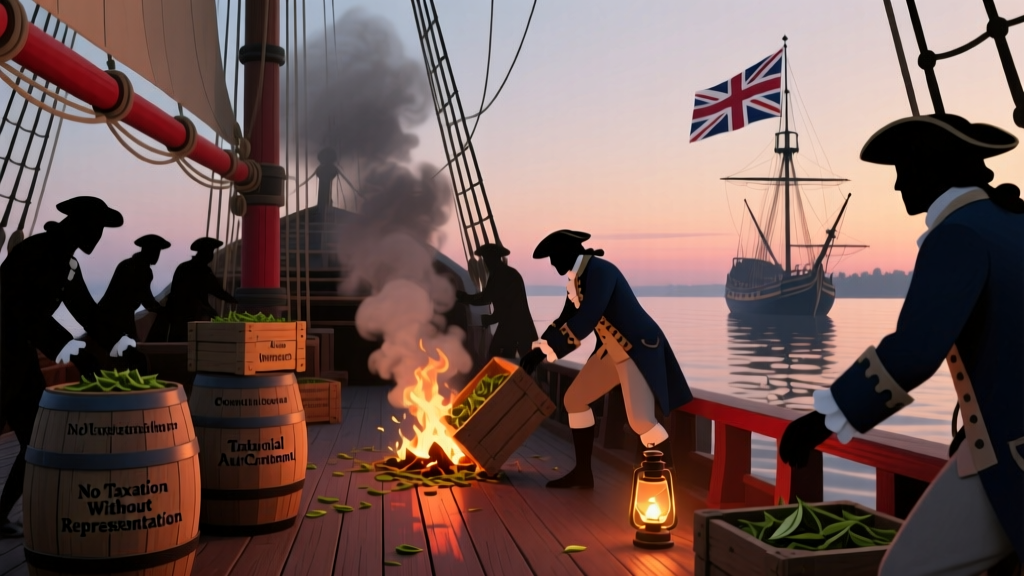
What Was the Cause of the Boston Tea Party? The Real Story Behind the Protest (Not Just 'Tea Taxes') — 5 Overlooked Political Triggers That Sparked the Revolution
Why This Isn’t Just About Tea — And Why It Still Matters Today
What was the cause of the Boston Tea Party? Most people recall a simple answer: "taxes on tea." But that oversimplification misses the explosive cocktail of corporate privilege, constitutional principle, and grassroots organizing that made December 16, 1773, a point of no return. In an era where civic engagement is surging—and schools, museums, and historical societies are redesigning Revolutionary War programming for Gen Z audiences—understanding the *true* cause isn’t just academic. It’s essential for building accurate, resonant, and ethically grounded events, curricula, and public commemorations. When your team plans a living history day, designs a classroom simulation, or scripts a museum exhibit, mistaking symbolism for substance risks misrepresenting colonial agency—and undermining trust in historical storytelling.
The Tea Act of 1773: A Corporate Bailout Disguised as Tax Relief
The Boston Tea Party wasn’t a knee-jerk reaction to a new tax. In fact, the Townshend Duty on tea had been partially repealed in 1770—leaving only a symbolic 3-pence-per-pound tax intact, deliberately retained to assert Parliament’s right to tax the colonies. What ignited outrage in 1773 was the Tea Act, passed in May of that year—not to raise revenue, but to rescue the financially collapsing British East India Company (BEIC). The Act granted BEIC a government-sanctioned monopoly: direct export rights to America, exemption from the London duty, and permission to sell through handpicked consignees—bypassing colonial merchants entirely.
This wasn’t abstract policy. It hit local economies hard. Boston’s mercantile class—many of whom were already smuggling Dutch tea to avoid the remaining Townshend tax—saw their livelihoods threatened overnight. Worse, the consignees appointed in Boston (including two sons of royal governor Thomas Hutchinson) were widely viewed as political insiders profiting from imperial favoritism. As Samuel Adams wrote in the Boston Gazette, the Act was ‘a dangerous engine… to enslave us’—not because of the price of tea, but because it cemented a system where economic power flowed exclusively through Crown-approved channels.
Self-Government Under Siege: The Constitutional Crisis Beneath the Crates
Colonists didn’t object to paying taxes *per se*. They objected to being taxed without representation in the body imposing them—a principle they’d upheld since the 1689 English Bill of Rights and reinforced through decades of colonial charters. What escalated tension in 1773 was how the Tea Act undermined existing mechanisms of local consent. Massachusetts’ charter gave its elected assembly authority over trade regulation and port governance. Yet the Tea Act empowered royal officials—including Hutchinson—to override local customs officers, suspend harbor regulations, and even compel unloading of tea against town meeting resolutions.
When Boston’s citizens held a mass meeting at Old South Meeting House on November 29, 1773—attended by over 5,000 people—they didn’t just demand the tea be sent back. They demanded the consignees resign *and* that Governor Hutchinson grant a clearance pass for the ship Dartmouth to depart with its cargo intact. His refusal wasn’t bureaucratic stubbornness—it was a deliberate assertion that royal authority superseded town sovereignty. As John Adams later reflected: ‘The question was not whether we should pay the tax, but whether we should surrender our right to govern ourselves.’
From Boycott to Blockade: How Organized Resistance Made the Tea Party Inevitable
The Boston Tea Party wasn’t spontaneous. It was the culmination of over a decade of coordinated, nonviolent resistance—what historians now call ‘constitutional disobedience.’ Between 1765 and 1773, colonists developed a sophisticated infrastructure of protest: committees of correspondence (linking 13 colonies), merchant nonimportation agreements, women-led ‘homespun’ campaigns, and port-wide boycott enforcement squads.
In Boston, the ‘Sons of Liberty’ weren’t masked anarchists—they were respected artisans, printers, lawyers, and shopkeepers who operated under written rules and accountability. Their 1773 strategy was precise: prevent the tea from being landed (to avoid customs duties), pressure consignees to resign, and compel ships to leave port. When Hutchinson denied clearance, and when customs officials refused to grant the Dartmouth a 20-day grace period before seizure, the committee shifted tactics. On December 16, after a final 3-hour meeting at Old South, 116 men—many disguised as Mohawk warriors not to hide identity (most were known), but to symbolize their status as ‘Americans,’ not British subjects—boarded three ships and dumped 342 chests of tea into the harbor. Crucially, they destroyed only tea—leaving other cargo, ship rigging, and crew belongings untouched. This discipline signaled moral legitimacy, not lawlessness.
What Sparked the Revolution? Five Interlocking Causes (Not One)
Reducing the Boston Tea Party to ‘taxation without representation’ flattens its complexity. Here’s what actually converged:
- Economic displacement: The Tea Act threatened colonial merchants’ autonomy and profits;
- Constitutional erosion: Royal override of local governance mechanisms undermined charter rights;
- Corporate-state collusion: BEIC’s monopoly revealed how imperial policy served private interests over public good;
- Failed diplomacy: Repeated petitions, resolutions, and offers of compromise were dismissed by Parliament;
- Moral framing: Colonists positioned themselves as defenders of English liberty—not rebels against it.
| Cause Category | Key Evidence | Impact on Colonial Response | Modern Event-Planning Insight |
|---|---|---|---|
| Economic Monopoly | BEIC granted exclusive rights; consignees selected without colonial input | Triggered unified merchant boycotts & port-wide non-cooperation | When designing historical reenactments, highlight economic roles—e.g., feature merchant guilds, not just patriots & soldiers |
| Constitutional Principle | Massachusetts Charter (1691) affirmed assembly’s control over trade & ports | Transformed protest from grievance to legal defense of self-rule | Use primary-source quotes from town meeting minutes to ground exhibits in local voice—not just national narrative |
| Communication Infrastructure | Committees of Correspondence exchanged 1,200+ letters between 1772–1774 | Enabled synchronized action across colonies—e.g., NY/Philadelphia blocked tea landings same week | Replicate this network effect: partner with regional museums/schools for multi-site programming |
| Moral Symbolism | Tea destroyed—but no violence to persons or property beyond cargo | Won sympathy in England; exposed British crackdown (Coercive Acts) as disproportionate | Emphasize restraint & intentionality in interpretation—avoid glorifying destruction; spotlight ethical deliberation |
| Leadership Structure | Sons of Liberty operated via written bylaws, rotating captains, documented meetings | Ensured accountability & prevented factional splintering | Train volunteer docents using historical leadership models—not just facts, but decision-making frameworks |
Frequently Asked Questions
Was the Boston Tea Party really about tea—or was it symbolic?
It was profoundly symbolic—but rooted in material reality. Tea was the vehicle, not the subject. Colonists consumed far more smuggled Dutch tea than taxed British tea. The protest targeted the principle embedded in the Tea Act: that Parliament could grant monopolies, bypass local consent, and subordinate colonial economies to imperial corporations. As Benjamin Franklin noted, ‘It is not the tea, but the precedent, that alarms us.’
Did any colonists support the British position on the tea?
Yes—about 20% of colonists identified as Loyalists, including many officeholders, Anglican clergy, and merchants with strong transatlantic ties. In Boston, figures like Hutchinson believed imperial unity required deference to parliamentary sovereignty—even if unpopular. Their perspectives are vital for balanced programming: consider hosting ‘Loyalist Voices’ panels or dual-narrative exhibit labels.
How did Britain respond—and why did that response backfire?
Parliament passed the Coercive (Intolerable) Acts in 1774: closing Boston Harbor until restitution was paid, revoking Massachusetts’ charter, and allowing royal officials accused of crimes to be tried in England. Rather than isolating Boston, these measures united the colonies. The First Continental Congress convened in September 1774—the first pan-colonial governing body—directly catalyzed by Britain’s punitive overreach.
Were there other ‘tea parties’ besides Boston’s?
Absolutely. Between December 1773 and March 1774, similar actions occurred in Charleston (SC), Annapolis (MD), Greenwich (NJ), and Yorktown (VA). In Charleston, tea was seized and stored in a warehouse—never destroyed. In Annapolis, the ship Peggy Stewart was burned after its owner paid the duty. These regional variations reveal diverse tactics and local priorities—essential context for multi-site educational partnerships.
How can educators teach this topic without oversimplifying?
Move beyond ‘taxes = bad.’ Use document-based inquiry: compare the Tea Act text with Massachusetts’ 1691 Charter; analyze ledger entries showing Dutch vs. British tea imports; map consignee family networks. Assign roles in a simulated town meeting—merchants, sailors, women’s association reps, royal officials—with real constraints and goals. This builds historical thinking, not just recall.
Common Myths
Myth #1: “The colonists dressed as Native Americans to hide their identities.”
False. While some wore crude disguises, most participants were publicly known—and intended to be. The Mohawk imagery was deliberate political theater, invoking Indigenous sovereignty as a contrast to British imperialism. It asserted a distinct American identity rooted in the land, not London.
Myth #2: “The Boston Tea Party was the first major act of rebellion.”
Incorrect. It followed years of organized resistance: the Stamp Act riots (1765), the Liberty Tree protests (1769), and the Gaspee Affair (1772)—where Rhode Islanders boarded and burned a British customs schooner. The Tea Party succeeded because it built on proven tactics, not because it invented defiance.
Related Topics (Internal Link Suggestions)
- Tea Act of 1773 explained — suggested anchor text: "what the Tea Act really did"
- First Continental Congress outcomes — suggested anchor text: "how the Boston Tea Party led to unified colonial action"
- Living history event planning guide — suggested anchor text: "best practices for historically accurate reenactments"
- Colonial women’s political roles — suggested anchor text: "how Daughters of Liberty shaped resistance"
- British East India Company history — suggested anchor text: "the corporate power behind the tea crisis"
Your Next Step: Design With Depth, Not Drama
Understanding what was the cause of the Boston Tea Party transforms how you plan, teach, or interpret this moment. It shifts focus from spectacle to system—from ‘angry men dumping tea’ to ‘a community defending self-determination through disciplined, principled action.’ Whether you’re scripting an immersive audio tour, developing a teacher workshop, or coordinating a bicentennial commemoration, start with the five interlocking causes. Audit your materials: Do they reflect economic agency? Constitutional nuance? Regional variation? Moral reasoning? Then, take action: Download our free ‘Boston Tea Party Planning Toolkit’—complete with primary-source timelines, role-play scenarios, and partnership templates for cross-institutional programming. Because honoring history means honoring its complexity—not reducing it to a slogan.
More Articles
 Which Side Is the Federalist vs Anti-Federalist Party? Debunking the #1 Myth That’s Still Confusing Students, Teachers, and Event Planners in 2024
What Is the Whig Party in Simple Terms? — The 2-Minute Breakdown That Explains Why This Forgotten Political Force Shaped Modern Democracy (No Textbook Jargon!)
Is Colorado a one party recording state? Yes — but here’s exactly when it’s legal, when it’s risky, and how to avoid civil lawsuits or criminal charges even if you’re technically compliant.
Who Throws the All White Party? The Truth Behind This Iconic Summer Tradition — Plus How to Host One (Without the Awkwardness, Overbudgeting, or Fashion Faux Pas)
Which Side Is the Federalist vs Anti-Federalist Party? Debunking the #1 Myth That’s Still Confusing Students, Teachers, and Event Planners in 2024
What Is the Whig Party in Simple Terms? — The 2-Minute Breakdown That Explains Why This Forgotten Political Force Shaped Modern Democracy (No Textbook Jargon!)
Is Colorado a one party recording state? Yes — but here’s exactly when it’s legal, when it’s risky, and how to avoid civil lawsuits or criminal charges even if you’re technically compliant.
Who Throws the All White Party? The Truth Behind This Iconic Summer Tradition — Plus How to Host One (Without the Awkwardness, Overbudgeting, or Fashion Faux Pas)
 Grand Opening Vendor Selection Tips: Build the Right Team for a High-Impact Launch
What Is Homecoming Party? The Real Purpose (It’s Not Just Football & Crowns) — A Step-by-Step Planning Guide for Parents, Students & Advisors Who Want It to Feel Meaningful, Not Messy
What Is a Waiting to Exhale Party? The Real Meaning, History, and Step-by-Step Guide to Throwing One That Honors Black Sisterhood—Not Just the Movie
Why Is a Two Party System Good? 7 Evidence-Based Advantages Most Civics Textbooks Skip — Stability, Accountability, and Real-World Voter Clarity Explained Without Jargon
Grand Opening Vendor Selection Tips: Build the Right Team for a High-Impact Launch
What Is Homecoming Party? The Real Purpose (It’s Not Just Football & Crowns) — A Step-by-Step Planning Guide for Parents, Students & Advisors Who Want It to Feel Meaningful, Not Messy
What Is a Waiting to Exhale Party? The Real Meaning, History, and Step-by-Step Guide to Throwing One That Honors Black Sisterhood—Not Just the Movie
Why Is a Two Party System Good? 7 Evidence-Based Advantages Most Civics Textbooks Skip — Stability, Accountability, and Real-World Voter Clarity Explained Without Jargon