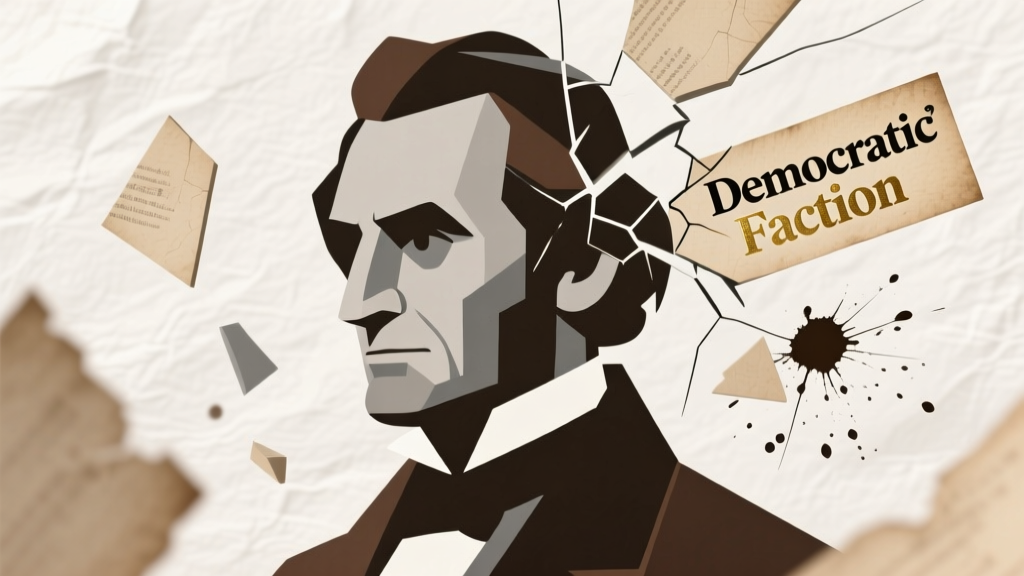
What Was Andrew Jackson's Political Party? The Surprising Truth Behind the 'Democratic' Label — How His Faction Invented Modern Party Politics (and Why Textbooks Get It Wrong)
Why This Question Matters More Than Ever
What was Andrew Jackson's political party? That simple question opens a door to understanding how American democracy transformed from an elite deliberative system into a populist, party-driven force — and why today’s hyper-partisan landscape has roots in Jackson’s 1828 campaign. Far from a mere trivia footnote, Jackson’s party affiliation signals the birth of modern political organizing: patronage networks, national conventions, voter mobilization tactics, and even early forms of political advertising. In an era of rising political polarization and renewed interest in democratic resilience, revisiting Jackson’s party isn’t nostalgia — it’s strategic historical literacy.
The Democratic-Republican Schism: From Unity to Fracture
Before there was a ‘Democratic Party,’ there was the Democratic-Republican Party — the dominant coalition founded by Thomas Jefferson and James Madison in opposition to Federalist centralization. By the 1824 presidential election, however, this once-unified bloc had fractured under pressure from regional tensions, economic shifts, and personality-driven rivalries. Four candidates — Jackson, John Quincy Adams, Henry Clay, and William H. Crawford — all claimed allegiance to the same party label, yet represented starkly different visions: Jackson as the ‘man of the people’ from Tennessee; Adams as the intellectual diplomat from Massachusetts; Clay as the ‘American System’ nationalist from Kentucky; and Crawford as the old-guard Virginia establishment.
The so-called ‘Corrupt Bargain’ of 1825 — when Clay threw his support to Adams in the House of Representatives after no candidate secured a majority, and then became Adams’ Secretary of State — ignited Jackson’s supporters. They didn’t just feel cheated; they felt the system itself had been hijacked by backroom elites. Their response wasn’t resignation — it was organization. Over the next three years, Jackson allies built county committees, published pro-Jackson newspapers (like the United States Telegraph), held mass rallies, and deployed slogans like ‘Old Hickory for President!’ and ‘The People’s Choice!’ — laying groundwork no previous campaign had attempted at scale.
Birth of the Democratic Party: Not a Name, But a Movement
Crucially, Jackson did not found the Democratic Party on a single date with a charter and bylaws. Its emergence was organic, contested, and deliberately ambiguous. In 1827–1828, his supporters began calling themselves ‘Democrats’ — reclaiming a term previously used pejoratively by Federalists to mock Jeffersonians as rabble-rousers. But they also called themselves ‘Jackson Men,’ ‘Friends of Jackson,’ or simply ‘Republicans’ (still invoking the original party name). The first official use of ‘Democratic Party’ in a national convention context came in 1832 — not 1828 — when Jackson’s supporters convened in Baltimore to nominate him for a second term. That convention established delegate selection rules, platform planks (including opposition to the Second Bank of the United States), and formalized the ‘spoils system’ as a principle: ‘to the victor belong the spoils of office.’
This wasn’t just branding — it was infrastructure. Local ‘Jackson Clubs’ evolved into permanent county committees. Editors like Francis Preston Blair (of the Washington Globe) became de facto party strategists. Postmasters, customs officials, and land-office clerks were replaced en masse after Jackson’s 1829 inauguration — not out of petty vengeance, but as a deliberate effort to embed party loyalty into the federal bureaucracy. As historian Sean Wilentz notes, ‘Jacksonian Democracy was less about ideology than about access — access to office, access to credit, access to land — and the party was the vehicle that delivered it.’
The Whig Counter-Revolution and the Party’s Enduring DNA
Opposition to Jackson coalesced rapidly into the Whig Party — a ‘coalition of coalitions’ including National Republicans, Anti-Masons, and disaffected Democrats. Ironically, the Whigs adopted many Jacksonian tactics: national nominating conventions (starting in 1831), coordinated newspaper networks, and charismatic campaigning (Henry Clay in 1832, William Henry Harrison in 1840). The Whigs’ 1840 ‘Log Cabin and Hard Cider’ campaign — portraying Harrison as a humble frontiersman despite his wealthy background — was a direct mimicry of Jackson’s 1828 image crafting.
Yet the Democratic Party outlived the Whigs (which collapsed by 1856) because it adapted. Under Martin Van Buren, it institutionalized the ‘two-party system’ as a stabilizing feature rather than a threat. It absorbed immigrant voters (especially Irish Catholics fleeing famine), championed states’ rights while expanding federal power through Indian removal and territorial acquisition, and maintained a flexible stance on slavery — opposing abolitionist agitation while protecting Southern slaveholding interests. This ideological elasticity — prioritizing coalition maintenance over doctrinal purity — remains a hallmark of the modern Democratic Party.
Key Turning Points: A Timeline of Party Formation
| Year | Event | Significance for Party Identity |
|---|---|---|
| 1824 | Four Democratic-Republicans run for president; Jackson wins popular & electoral vote plurality but loses in House | Exposed fatal weakness of consensus-based party; catalyzed grassroots organizing |
| 1827–28 | Formation of ‘Jackson Clubs’ across states; publication of pro-Jackson newspapers; first use of ‘Democrat’ as self-designation | Shift from factional loyalty to structured, identity-based affiliation |
| 1829 | Jackson’s inauguration; ‘Kitchen Cabinet’ informal advisors; systematic replacement of federal officeholders | Institutionalized patronage as party glue; blurred line between government and party apparatus |
| 1832 | First national Democratic convention in Baltimore; nomination of Jackson & Van Buren; adoption of party platform | Formalized party structure, discipline, and public accountability via platform |
| 1834 | Whig Party formally organized in opposition to ‘King Andrew’ and executive overreach | Confirmed two-party system; forced Democrats to define themselves against a coherent rival |
Frequently Asked Questions
Was Andrew Jackson a Democrat or a Republican?
Neither — in the modern sense. He led the Democratic faction of the former Democratic-Republican Party, which evolved into the Democratic Party by 1832. The modern Republican Party wasn’t founded until 1854, long after Jackson’s presidency (1829–1837) and death (1845).
Did Andrew Jackson create the Democratic Party?
He was its central catalyst and symbolic founder, but the party emerged collectively through state-level organizing, newspaper advocacy, and institutional innovation between 1825–1832. Jackson provided the unifying figurehead and policy agenda (anti-Bank, anti-elitism, expansionism), but figures like Martin Van Buren, Amos Kendall, and William B. Lewis built its machinery.
What were the core beliefs of Jackson’s Democratic Party?
Its unifying principles were: (1) strict construction of the Constitution (except when expanding executive power), (2) opposition to centralized banking and paper currency, (3) rotation in office (‘spoils system’) to prevent entrenched bureaucracies, (4) expansion of white male suffrage (while simultaneously enforcing Native American removal and defending slavery), and (5) states’ rights — except when asserting federal authority to enforce tariffs or remove tribes.
How did Jackson’s party differ from Jefferson’s Democratic-Republicans?
Jefferson’s party emphasized agrarian virtue, limited government, and philosophical republicanism. Jackson’s Democrats prioritized mass participation, party loyalty, executive energy, and concrete material benefits (land, credit, office). They embraced patronage, national conventions, and partisan press — tools Jefferson would have viewed as corrupting influences.
Why do some historians call Jackson’s party ‘the first modern political party’?
Because it pioneered sustained voter mobilization, permanent local organizations, coordinated national messaging, professional political operatives, and the fusion of electoral strategy with governing philosophy — features that define parties today, unlike the loose, elite-driven caucuses of the Early Republic.
Common Myths
Myth #1: ‘Andrew Jackson founded the Democratic Party in 1828.’
Reality: While Jackson’s 1828 campaign was the movement’s launchpad, the party lacked formal structure, a national platform, or consistent naming until the 1832 convention. Even Jackson’s own cabinet referred to themselves as ‘Republicans’ in internal memos as late as 1831.
Myth #2: ‘The Democratic Party has existed continuously since Jackson’s time without major rupture.’
Reality: The party fractured catastrophically in 1860 over slavery, producing Northern and Southern Democratic tickets. After the Civil War, it spent two decades as the ‘white man’s party’ in the South while struggling for relevance nationally — only regaining dominance with Grover Cleveland in 1884 and later FDR’s New Deal realignment.
Related Topics (Internal Link Suggestions)
- Andrew Jackson’s Spoils System — suggested anchor text: "how Jackson’s patronage system reshaped federal employment"
- Bank War of 1832 — suggested anchor text: "Jackson’s veto of the Second Bank recharter and its political fallout"
- Trail of Tears and Jacksonian Democracy — suggested anchor text: "the dark contradiction of democracy and dispossession"
- 1824 Presidential Election — suggested anchor text: "the election that broke the Era of Good Feelings"
- Origins of the Whig Party — suggested anchor text: "how opposition to Jackson forged America’s second major party"
Conclusion & Next Step
So — what was Andrew Jackson's political party? It was the embryonic Democratic Party: a revolutionary, contradictory, and enduring coalition born from outrage, organized through innovation, and hardened by opposition. Understanding it isn’t about assigning a label — it’s about recognizing how party identity evolves through struggle, adaptation, and power. If you’re teaching this era, curating a museum exhibit, or designing a civic education module, go beyond the textbook answer. Pull primary sources: Jackson’s 1829 inaugural address, the 1832 Democratic platform, or Van Buren’s Inquiry into the Origin and Course of Political Parties. Then ask your students, colleagues, or audience: What does ‘party’ mean today — and how much of Jackson’s DNA still pulses beneath the surface? Ready to explore how his policies shaped voting rights, banking, or Indigenous policy? Dive into our deep-dive guides linked above.
More Articles
 How to Pick Jewelry for a Cocktail Party: The 7-Second Rule (What Your Neckline, Dress Color & Venue Lighting Really Demand — Not What You Think)
 Step-by-Step Guide to a Pop-Up Shop
How to Manage Noise for Late-Night House Party: 7 Real-World Tactics That Actually Stop Neighbor Complaints (Without Killing the Vibe)
What Is Far Right Party? The Truth Behind the Label: How to Spot Ideological Red Flags, Avoid Misinformation, and Understand Real-World Impact — Not Just Headlines
Step-by-Step Guide to a Pop-Up Shop
How to Manage Noise for Late-Night House Party: 7 Real-World Tactics That Actually Stop Neighbor Complaints (Without Killing the Vibe)
What Is Far Right Party? The Truth Behind the Label: How to Spot Ideological Red Flags, Avoid Misinformation, and Understand Real-World Impact — Not Just Headlines