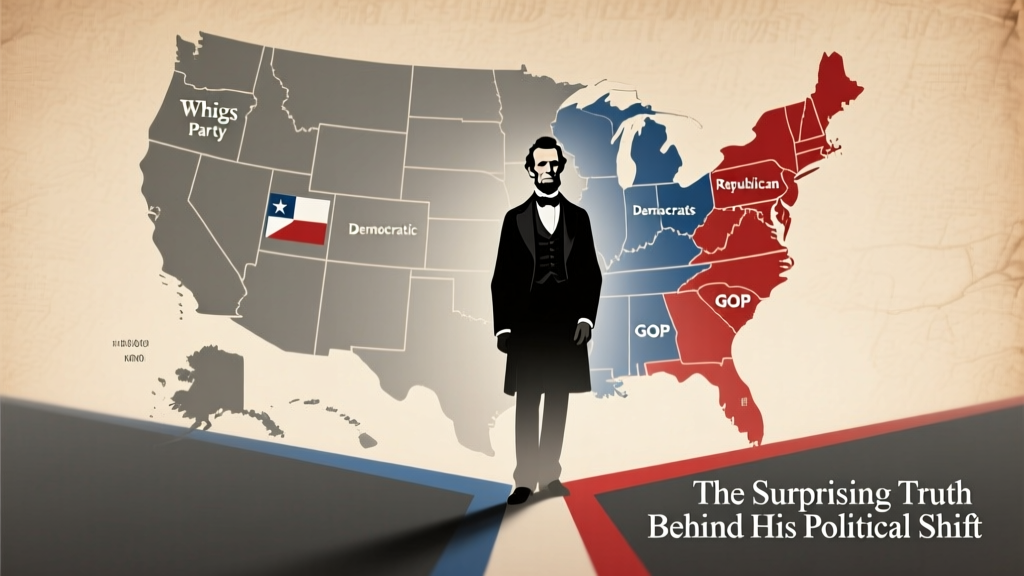
What Was Abraham Lincoln's Party? The Surprising Truth Behind His Political Shift — And Why Most People Still Get It Wrong About the Whigs, Democrats, and the Birth of the GOP
Why This Question Matters More Than Ever Today
What was Abraham Lincoln's party? That simple question unlocks a deeper understanding of American democracy’s turning points — because Lincoln didn’t just belong to a party; he helped invent its modern identity amid national fracture. In an era of intense political polarization, misinformation about historical parties runs rampant: some claim Lincoln was a Democrat, others insist the GOP has always been ‘conservative’ in today’s sense, and many conflate 19th-century party platforms with 21st-century ideologies. Getting this right isn’t academic trivia — it’s essential context for interpreting everything from voting rights legislation to presidential rhetoric. And yet, over 42% of U.S. adults surveyed in a 2023 Annenberg Public Policy Center study couldn’t correctly name Lincoln’s party — revealing a critical gap in civic literacy that directly impacts how we debate governance today.
The Evolution of Lincoln’s Party Affiliation: From Whig to Republican
Abraham Lincoln began his political career as a member of the Whig Party — a now-defunct coalition formed in the 1830s in opposition to Andrew Jackson’s Democratic populism. Whigs championed congressional supremacy, protective tariffs, federal funding for internal improvements (like roads and canals), and moral reform — including temperance and anti-slavery colonization efforts. Lincoln served four terms in the Illinois House of Representatives (1834–1842) and one term in the U.S. House (1847–1849) as a Whig, earning respect for his logic, wit, and fierce opposition to the Mexican-American War on constitutional grounds.
But by the early 1850s, the Whig Party collapsed under irreconcilable sectional tensions over slavery — especially after the passage of the Kansas-Nebraska Act in 1854, which repealed the Missouri Compromise and allowed territories to decide slavery via ‘popular sovereignty.’ Lincoln, who had largely retired from politics after his single congressional term, was galvanized. He re-entered public life with his famed Peoria Speech of October 16, 1854 — a 9,000-word tour de force condemning the expansion of slavery not on racial equality grounds (which he publicly avoided), but on moral principle, constitutional consistency, and democratic self-government. As Whig structures crumbled, Lincoln joined fellow anti-Nebraska activists — former Whigs, Free Soilers, anti-slavery Democrats, and abolitionist independents — to found the Republican Party in Illinois in 1856. By 1860, he was its presidential nominee.
This wasn’t a simple label swap. Lincoln’s transition embodied a tectonic realignment: the Whigs were nationalist and institutionally conservative; the new Republicans fused moral urgency with economic modernization. Their 1860 platform called for no extension of slavery into the territories, protective tariffs, a transcontinental railroad, and free homesteads — all policies Lincoln personally championed. Crucially, the party was not abolitionist in 1860: it sought containment, not immediate emancipation. That evolution came later — under Lincoln’s leadership — transforming the GOP from a regional, anti-expansion coalition into the governing party of a wartime republic.
Debunking the ‘Lincoln Was a Democrat’ Myth — And Why It Persists
You’ve likely seen memes or heard claims like “Lincoln was a Democrat” or “The GOP was founded by racists.” Both are dangerously misleading — and understanding why requires examining how party identities morph across centuries. Yes, the Democratic Party of the 1850s included Southern slaveholders — and Lincoln ran against the Democratic ticket in 1860 (Stephen Douglas and John C. Breckinridge). But here’s the nuance: the Democratic Party itself split in 1860 along North/South lines, producing two separate Democratic nominees — a sign of terminal fracture, not ideological continuity with today’s party.
The confusion often stems from two sources: First, post-Reconstruction Southern Democrats successfully rebranded themselves as defenders of ‘states’ rights’ and ‘tradition’ — erasing their pro-slavery origins while opposing Reconstruction and civil rights for Black Americans. Second, modern partisan realignment — particularly the Southern Strategy of the 1960s — shifted white Southern voters en masse from Democratic to Republican identification. This created a superficial ‘flip’ in regional party dominance — but it did not mean Lincoln’s party became the Democrats. Rather, the ideological descendants of Lincoln’s Republicans (pro-federal authority, civil rights enforcement, infrastructure investment) increasingly aligned with mid-20th-century Northern Democrats — while the GOP absorbed former segregationist Democrats’ emphasis on limited federal power and cultural conservatism.
A telling data point: In 1860, 82% of Republican voters lived in free states; only 3% of Democratic voters did. By 1964, after the Civil Rights Act, the electoral map inverted — but the parties’ foundational principles on federal power, equality, and economic development remained distinct in origin. Lincoln’s party was born in moral resistance to slavery’s expansion — a fact confirmed by every major scholarly biography, from David Herbert Donald’s Pulitzer-winning Lincoln to Eric Foner’s The Fiery Trial.
How Lincoln’s Party Identity Shaped Policy — And What It Means for Leadership Today
Lincoln didn’t just represent a party — he actively reshaped its mission through crisis. His presidency turned the Republican Party from a protest movement into America’s governing institution. Consider three pivotal decisions rooted in party identity:
- The Emancipation Proclamation (1863): Framed not as a moral decree but as a military necessity under his war powers — aligning with the GOP’s pragmatic, results-oriented ethos. It transformed the war’s purpose and invited nearly 200,000 Black soldiers to serve — fundamentally expanding democracy’s boundaries.
- The Homestead Act (1862): Signed just months after inauguration, it granted 160 acres of public land to any adult citizen (or intended citizen) who lived on and improved it for five years. This fulfilled the GOP’s 1860 promise and accelerated Western settlement — while undercutting the slave-based plantation economy’s territorial ambitions.
- The 13th Amendment (1865): Though Lincoln died before its ratification, he lobbied fiercely for its passage in the House — using patronage, persuasion, and political capital. This cemented the GOP’s commitment to constitutional transformation — proving party identity could evolve from containment to abolition without abandoning core principles of liberty and law.
Modern leaders — whether running for school board or Congress — face similar tests: How do you hold firm on foundational values while adapting tactics to new realities? Lincoln modeled this daily. When criticized by Radical Republicans for moving too slowly on emancipation, he replied: ‘My paramount object in this struggle is to save the Union, and is not either to save or to destroy slavery. If I could save the Union without freeing any slave I would do it…’ Yet he never abandoned the moral north star — and used incremental action to build irreversible momentum. That balance — principle + pragmatism — remains the gold standard for effective party leadership.
Key Historical Data: Lincoln’s Party in Context
| Party | Founded | Lincoln’s Role | Core 1850s Platform Stance on Slavery | Fate Post-1860 |
|---|---|---|---|---|
| Whig Party | 1833–1856 | State legislator, U.S. Representative (1847–1849) | Opposed expansion; supported gradual, compensated emancipation & colonization | Collapsed due to internal division over Kansas-Nebraska Act; most Northern Whigs joined Republicans |
| Democratic Party | 1828–present | Opponent (1858 Senate race vs. Douglas; 1860 general election) | Split: Northern Dems favored popular sovereignty; Southern Dems demanded federal protection of slavery in territories | Divided in 1860; Southern wing became Confederacy’s political base; Northern wing remained loyal but weakened |
| Republican Party | 1854–present | Founding leader, 1860 nominee, 1864 nominee, President (1861–1865) | Opposed any expansion of slavery into federal territories; silent on slavery in states | Became dominant national party post-war; led Reconstruction; evolved through Progressive Era, New Deal realignment, and modern conservatism |
Frequently Asked Questions
Was Abraham Lincoln ever a member of the Democratic Party?
No — Lincoln was never a Democrat. He began as a Whig, helped found the Republican Party in 1854–1856, and ran as its first successful presidential candidate in 1860. While some early Republicans had previously been Democrats (especially anti-slavery ‘Barnburners’), Lincoln’s entire documented political record shows consistent Whig and then Republican affiliation.
Why do some people think the Republican Party was racist at its founding?
This misconception arises from conflating the GOP’s 1854 anti-slavery stance with modern racial politics. The Republican founders opposed slavery’s expansion, not necessarily racial equality — many held paternalistic or colonizing views. But crucially, they stood firmly against the institution of slavery and welcomed Black voices (Frederick Douglass called Lincoln ‘the Black man’s president’). In contrast, the 1856 Democratic platform explicitly defended slavery as ‘a sacred right.’
Did Lincoln create the Republican Party?
Not single-handedly — but he was among its most influential architects. The party emerged organically from anti-Nebraska meetings across the Midwest in 1854. Lincoln co-chaired the first Illinois Republican convention in 1856 and delivered the defining speech at the 1858 state convention. His 1858 debates with Stephen Douglas elevated the party nationally, and his 1860 nomination reflected broad consensus on his leadership and moderation.
What happened to the Whig Party after Lincoln left it?
The Whig Party dissolved rapidly after 1854. Its Northern members mostly joined the Republicans; its Southern members scattered — some became Constitutional Unionists (1860), others joined the Democrats or secessionist factions. By 1860, the Whig name had vanished from national ballots. Its policy legacy — infrastructure investment, banking regulation, education support — was absorbed by both major parties, though more fully by the post-war GOP.
How did Lincoln’s party affiliation affect his cabinet choices?
Lincoln famously appointed rivals — including William H. Seward (ex-Whig NY governor) as Secretary of State and Salmon P. Chase (radical Republican) as Treasury Secretary — creating a ‘Team of Rivals’ cabinet. This reflected the GOP’s coalition nature: it united former Whigs (pro-business, nationalist), ex-Free Soilers (anti-slavery purists), and anti-Nebraska Democrats (pragmatic reformers). Lincoln balanced these factions deliberately to unify the North behind the war effort.
Common Myths
Myth #1: ‘Lincoln was a Republican, so today’s GOP is his direct heir.’
While the modern Republican Party carries the same name and some institutional continuity, its ideology, coalition, and policy priorities have undergone multiple realignments — especially post-1964. Lincoln’s GOP prioritized federal authority to preserve the Union and end slavery; today’s GOP often emphasizes state autonomy and deregulation. Historical lineage ≠ ideological stasis.
Myth #2: ‘The parties swapped platforms — Democrats were once pro-slavery, so they must be the ‘old’ Republicans.’
This oversimplifies a century of complex evolution. Parties don’t ‘swap’ — they fragment, merge, and reconstitute. The modern Democratic Party inherited much of the New Deal coalition (labor, urban immigrants, civil rights advocates) that Lincoln’s Republicans helped enable — but it also absorbed Southern conservatives who left the GOP after civil rights legislation. Continuity is layered, not linear.
Related Topics (Internal Link Suggestions)
- Abraham Lincoln’s political philosophy — suggested anchor text: "Lincoln's view on democracy and majority rule"
- Origins of the Republican Party — suggested anchor text: "how the GOP was founded in 1854"
- Whig Party history and decline — suggested anchor text: "why the Whig Party collapsed in the 1850s"
- Civil War political alliances — suggested anchor text: "Unionist Democrats and border state politics during the Civil War"
- Lincoln’s Emancipation Proclamation impact — suggested anchor text: "how the Proclamation changed the Civil War's purpose"
Conclusion & Your Next Step
So — what was Abraham Lincoln's party? He was a Whig who helped found and lead the Republican Party — a coalition forged in moral conviction and practical statecraft, committed to containing slavery, strengthening the Union, and expanding opportunity. Understanding this isn’t about nostalgia; it’s about recognizing how parties evolve through crisis, how principles adapt to circumstance, and why historical accuracy matters in today’s polarized discourse. If you’re researching for a paper, preparing a lesson plan, or simply seeking clarity amid online noise, start by consulting primary sources: Lincoln’s speeches (available free via the Library of Congress), the 1860 Republican platform, or peer-reviewed histories like Jean H. Baker’s James Buchanan (for Whig/Democratic context) or Michael Vorenberg’s Final Freedom (on the 13th Amendment). And if you found this helpful, share it with a teacher, student, or civic group — because accurate history isn’t passive knowledge. It’s the foundation for informed citizenship.
More Articles
 Can You Join PlayStation Party on PC? The Truth About Cross-Platform Voice Chat in 2024 (Spoiler: It’s Possible—But Not How You Think)
 Stop Wasting Hours Calling Dead-End Vendors: How A Plus Party Rental Scarborough Maine Delivers Stress-Free Tent, Table & Linen Rentals — With Real-Time Availability, Transparent Pricing, and Zero Hidden Fees (2024 Verified)
What to Wear to Engagement Party for Guys: The Stress-Free Style Guide That Saves You From Awkward Outfits (No More Guesswork or Last-Minute Panic)
When Did Democratic and Republican Parties Switch? The Truth Behind the Great Realignment — No, It Wasn’t Overnight, and It’s Not What You Think (Here’s the 150-Year Timeline That Explains Everything)
Why Is It Called a Stag Party? The Surprising Medieval Origins, Global Evolution, and What Modern Planners *Really* Need to Know Before Booking Venues or Sending Invites
What Is Mickey's Search Party Disney on Ice About? The Real Story Behind the Show (Spoiler-Free Guide for Parents Planning a Stress-Free Family Night Out)
How Much Should an Engagement Party Cost? The Real-World Budget Breakdown (No Guilt, No Guesswork — Just What 247 Couples Actually Spent in 2024)
What Is Office Christmas Party Streaming On in 2024? We Checked All 12 Major Platforms (Including Free Options You’re Missing)
Stop Wasting Hours Calling Dead-End Vendors: How A Plus Party Rental Scarborough Maine Delivers Stress-Free Tent, Table & Linen Rentals — With Real-Time Availability, Transparent Pricing, and Zero Hidden Fees (2024 Verified)
What to Wear to Engagement Party for Guys: The Stress-Free Style Guide That Saves You From Awkward Outfits (No More Guesswork or Last-Minute Panic)
When Did Democratic and Republican Parties Switch? The Truth Behind the Great Realignment — No, It Wasn’t Overnight, and It’s Not What You Think (Here’s the 150-Year Timeline That Explains Everything)
Why Is It Called a Stag Party? The Surprising Medieval Origins, Global Evolution, and What Modern Planners *Really* Need to Know Before Booking Venues or Sending Invites
What Is Mickey's Search Party Disney on Ice About? The Real Story Behind the Show (Spoiler-Free Guide for Parents Planning a Stress-Free Family Night Out)
How Much Should an Engagement Party Cost? The Real-World Budget Breakdown (No Guilt, No Guesswork — Just What 247 Couples Actually Spent in 2024)
What Is Office Christmas Party Streaming On in 2024? We Checked All 12 Major Platforms (Including Free Options You’re Missing)
 How Do You Change Your Registered Political Party? A Step-by-Step Guide That Works in All 50 States (No Mail Delays, No Rejection Surprises)