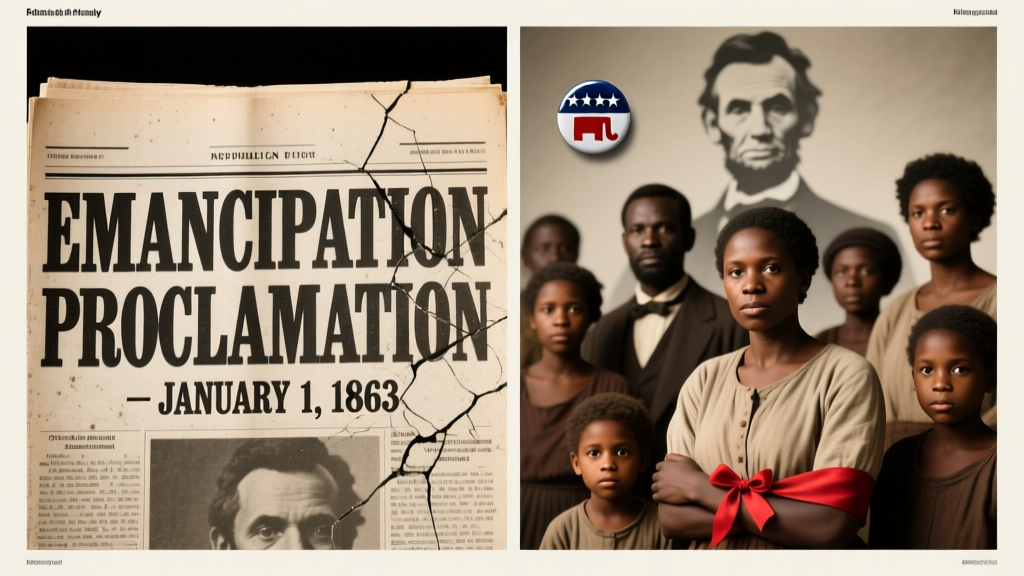
What Party Freed the Slaves? The Truth Behind Lincoln, the Republican Party, and Why This Question Reveals Deep Misconceptions About Emancipation, Reconstruction, and Who Really Drove Abolition Forward — Not Just One Person or Party
Why This Question Matters More Than Ever
What party freed the slaves? That simple question sits at the heart of how Americans understand freedom, power, and responsibility in our democracy — and yet it’s almost always answered too quickly, too narrowly, and too inaccurately. In classrooms, political debates, and viral social media threads, the phrase ‘the Republican Party freed the slaves’ circulates as settled fact — but history tells a far richer, more contested, and deeply collaborative story. Understanding who actually secured emancipation isn’t just about assigning credit; it’s about recognizing how liberation emerges not from top-down decrees alone, but from relentless pressure from below, strategic alliances across lines of race and ideology, and the courageous agency of enslaved people themselves. With rising polarization and historical revisionism reshaping civic education, getting this right has urgent real-world consequences — for voting rights, reparations discourse, curriculum standards, and how we teach young people that justice is built, not granted.
The Myth of the Singular ‘Liberator Party’
Let’s begin by naming what’s missing from the common narrative: the word ‘party’ in ‘what party freed the slaves’ is a linguistic trap. Political parties in the 1860s bore little resemblance to today’s GOP or Democratic Party — their platforms, coalitions, and regional bases were fluid, contradictory, and often internally fractured. The Republican Party of 1860–1865 was a new, fragile coalition of anti-slavery Whigs, Free Soilers, disaffected Democrats, and abolitionist activists. Crucially, it did not enter the Civil War committed to ending slavery — President Lincoln’s 1860 platform promised only to contain slavery, not abolish it. His famous letter to Horace Greeley in 1862 made that explicit: ‘My paramount object in this struggle is to save the Union, and is not either to save or to destroy slavery.’ So while the Republican-controlled Congress passed the 13th Amendment in January 1865, that vote rested on years of escalating pressure — from enslaved people fleeing plantations en masse (a phenomenon historians now call ‘self-emancipation’), from Black regiments proving battlefield valor (nearly 180,000 served in the USCT), and from Radical Republicans like Thaddeus Stevens and Charles Sumner who pushed Lincoln leftward, often against his initial instincts.
Meanwhile, Democrats were deeply divided: Northern ‘War Democrats’ supported the Union effort but opposed emancipation as a war aim; Southern Democrats had seceded precisely to protect slavery. Yet even among Republicans, support for abolition wasn’t monolithic — many moderate members feared economic disruption, racial ‘upheaval,’ or backlash from border states. The Emancipation Proclamation itself, issued January 1, 1863, applied only to Confederate-held territory — deliberately excluding slaveholding Union states like Kentucky and Delaware. That legal limitation wasn’t oversight; it was political calculus. So asking ‘what party freed the slaves’ risks flattening a dynamic, contested process into a static branding exercise — when in truth, emancipation was won through overlapping forces: constitutional amendment, military action, grassroots rebellion, moral suasion, and legislative compromise.
Four Key Forces Behind Emancipation — and Who Led Each
Historians increasingly frame emancipation as a ‘process,’ not an event — one driven by four interlocking engines, each with distinct leadership and strategies:
- Enslaved People’s Self-Emancipation: From the first weeks of the Civil War, thousands fled to Union lines — forcing commanders like Benjamin Butler at Fort Monroe to declare them ‘contraband of war’ in May 1861. By 1862, over 100,000 formerly enslaved people lived in ‘contraband camps,’ serving as laborers, spies, scouts, and eventually soldiers. Their mass flight destabilized the Confederacy’s economy and logistics — making slavery unenforceable long before legal abolition.
- The Abolitionist Movement: Decades before the war, Black and white abolitionists built infrastructure for resistance: the Underground Railroad, anti-slavery newspapers (The Liberator, North Star), lecture circuits, and petition campaigns. Frederick Douglass didn’t wait for Lincoln — he pressured him relentlessly, famously declaring in 1863, ‘Who would be free themselves must strike the blow.’
- Radical Republicans in Congress: While Lincoln moved cautiously, figures like Senator Charles Sumner and Representative Thaddeus Stevens introduced bills for immediate emancipation, land redistribution (‘40 acres’), and civil rights. Their 1864 push for the 13th Amendment — passed by the Senate in April, then stalled in the House until Lincoln made it a priority in his 1864 re-election campaign — proved decisive.
- Military Necessity & Union Strategy: As the war dragged on, Union generals realized enslaved labor sustained the Confederate war machine. Enlisting Black troops (authorized by the 1862 Militia Act and expanded by the Emancipation Proclamation) added manpower while depriving the South of workers. General William T. Sherman’s Special Field Orders No. 15 (January 1865), setting aside land for freed families, reflected this shift — though it was later revoked by President Andrew Johnson.
How the 13th Amendment Actually Passed — A Step-by-Step Breakdown
The ratification of the 13th Amendment is often cited as ‘proof’ that the Republican Party freed the slaves — but the legislative journey reveals how fragile and contested that victory truly was. Below is a precise reconstruction of the vote counts, timing, and political maneuvering that turned constitutional theory into reality.
| Stage | Date | Votes (Y/N) | Key Context & Obstacles |
|---|---|---|---|
| Senate Passage | April 8, 1864 | 38–6 (2/3 majority achieved) | Strong support from Radicals; moderate Republicans joined after Lincoln signaled backing. No Democrats voted yes. |
| House First Vote | June 15, 1864 | 93–65 (fell 13 votes short) | Opposition came from War Democrats and conservative Republicans fearing backlash in upcoming elections. Lincoln called it ‘a failure’ in his diary. |
| Lincoln’s Intervention | Fall 1864 | N/A | Lincoln made amendment passage a central plank of his re-election campaign; instructed allies to secure votes via patronage promises, persuasion, and delaying tactics. |
| House Final Vote | January 31, 1865 | 119–56 (exactly 2/3 majority) | 16 Democrats crossed party lines; 2 opposition members were absent. Celebrated with impromptu singing of ‘John Brown’s Body’ in the chamber. |
| Ratification Completed | December 6, 1865 | 27 of 36 states | Required approval by former Confederate states — coerced under Reconstruction Acts. Mississippi didn’t ratify until 1995 (and didn’t notify the federal government until 2013). |
Reconstructing the Narrative: What Emancipation Really Required
If we zoom out beyond party labels, emancipation demanded three non-negotiable conditions — none of which any single party controlled alone:
- Moral Clarity: Sustained, decades-long abolitionist witness — led overwhelmingly by Black intellectuals, preachers, and organizers — that reframed slavery as a national sin, not a regional institution.
- Political Will: A temporary alignment of interests between Lincoln’s preservationist Unionism, Radical Republicans’ egalitarian vision, and border-state pragmatism — held together by wartime emergency.
- Grassroots Power: The irreversible momentum created by enslaved people’s collective refusal to remain enslaved — walking off plantations, joining armies, testifying before Congress, founding schools and churches — transforming ‘freedom’ from a legal status into lived reality.
A telling example: In 1865, when Union troops arrived in Galveston, Texas, to announce emancipation on June 19th (Juneteenth), they didn’t bring a new law — the 13th Amendment wasn’t ratified yet. They enforced the Emancipation Proclamation — which had been law for over two years. But enforcement required boots on the ground, intelligence from Black informants, and the willingness of freedpeople to assert their liberty despite violent resistance. That day wasn’t delivered by a party; it was claimed by people.
Frequently Asked Questions
Did Abraham Lincoln free the slaves?
No — Lincoln issued the Emancipation Proclamation in 1863, but it only applied to areas in active rebellion and relied on Union military control to take effect. It did not free enslaved people in loyal border states (Delaware, Kentucky, Maryland, Missouri) or parts of Louisiana and Virginia under Union occupation. True, universal abolition came with the 13th Amendment’s ratification in December 1865 — a constitutional process Lincoln championed but did not live to see completed.
Was the Democratic Party pro-slavery?
Yes — the national Democratic Party of the 1850s and early 1860s actively defended slavery as a constitutional right and promoted popular sovereignty (letting territories decide). Its 1860 platform affirmed the ‘right’ of citizens to take enslaved people into federal territories. After the war, Southern Democrats led the ‘Redeemer’ movement that dismantled Reconstruction and imposed Jim Crow — showing continuity in opposing Black political and economic autonomy.
Why do some claim the Republican Party ‘owns’ emancipation?
This narrative emerged strongly during the late 19th and early 20th centuries, as the GOP rebranded itself as the ‘Party of Lincoln’ amid growing Black disenfranchisement in the South. It served political purposes — legitimizing Republican rule in the North and distancing the party from post-Reconstruction failures. Modern retellings often omit that the GOP’s commitment to racial equality eroded sharply after 1877, and that Black voters shifted allegiance to the Democratic Party during the New Deal and Civil Rights eras — precisely because the GOP abandoned its Reconstruction-era promises.
Were there abolitionist Democrats?
Yes — a small but significant number. Known as ‘Free Soil Democrats’ or ‘Anti-Slavery Democrats,’ figures like Salmon P. Chase (who later became Lincoln’s Treasury Secretary and Chief Justice) and Preston King broke with their party over slavery. However, they were exceptions — and most left the Democratic Party entirely to join the Free Soil or Republican parties by the late 1850s.
What role did Black leaders play in passing the 13th Amendment?
Black leaders were indispensable. Frederick Douglass lobbied Lincoln directly and mobilized Black communities to support the amendment. Elizabeth Cady Stanton and Susan B. Anthony organized petition drives with over 400,000 signatures. Most crucially, Black soldiers’ service — facing discrimination, lower pay, and higher mortality — created irrefutable moral and practical arguments for full citizenship. As Congressman James Ashley declared during House debate: ‘We are not dealing with things, but with men — men who have bled for your country.’
Common Myths
- Myth #1: ‘The Republican Party abolished slavery single-handedly.’
Reality: The GOP provided essential legislative leadership, but emancipation required enslaved people’s resistance, abolitionist organizing, military strategy, and cross-party (though narrow) cooperation. Without self-emancipation and Black troop enlistment, the amendment likely wouldn’t have passed — or been enforceable.
- Myth #2: ‘Lincoln freed the slaves with a pen stroke.’
Reality: Lincoln’s proclamation was a wartime measure with limited reach. Its power depended entirely on Union armies advancing — and on enslaved people seizing the opportunity it represented. As historian Ira Berlin writes: ‘Slaves freed themselves. The Emancipation Proclamation merely recognized their achievement.’
Related Topics (Internal Link Suggestions)
- Juneteenth History and Meaning — suggested anchor text: "what Juneteenth really commemorates"
- Reconstruction Era Policies and Failures — suggested anchor text: "why Reconstruction collapsed"
- Black Soldiers in the Civil War — suggested anchor text: "USCT regiments and their legacy"
- Abolitionist Movement Leaders — suggested anchor text: "Frederick Douglass, Harriet Tubman, and the network that ended slavery"
- 13th Amendment Text and Interpretation — suggested anchor text: "how the loophole in the 13th Amendment still impacts mass incarceration"
Conclusion & Next Steps
So — what party freed the slaves? The honest answer is: no single party did. Emancipation was forged in the crucible of war, protest, legislation, and courage — by enslaved people who walked toward freedom, by Black soldiers who fought for it, by abolitionists who named it as justice, and by a coalition of politicians who, however imperfectly, codified it into law. Reducing this to a partisan trophy distorts history and weakens our capacity to build genuine racial justice today. Your next step? Go deeper. Visit a local historic site tied to Underground Railroad activity. Read primary sources like the WPA Slave Narratives. Support organizations preserving Black-led emancipation history — like the Equal Justice Initiative or the Museum of African American History. Because understanding how freedom was won isn’t just about the past. It’s about recognizing the same tools — coalition-building, moral clarity, and unwavering grassroots pressure — that will secure equity in our time.
More Articles
 Who Pays for the Bachelor Party? The Unspoken Rules (and Real-World Exceptions) Every Groom & Best Man Needs to Know Before Booking Anything
 What Is the Function of the Political Parties? 7 Core Functions You Were Never Taught in Civics Class — And Why They Matter More Than Ever in Today’s Polarized Democracy
Why Was Republican Party Formed? The Shocking Truth Behind Its 1854 Birth — Not Slavery Alone, But a Strategic Coalition of Conscience, Commerce, and Constitutional Crisis That Changed America Forever
Which Party Has Held the Presidency the Most? The Surprising Truth Behind 234 Years of U.S. Leadership — and Why the Answer Isn’t What You Think (Spoiler: It’s Not Just About Wins)
What Is the Function of the Political Parties? 7 Core Functions You Were Never Taught in Civics Class — And Why They Matter More Than Ever in Today’s Polarized Democracy
Why Was Republican Party Formed? The Shocking Truth Behind Its 1854 Birth — Not Slavery Alone, But a Strategic Coalition of Conscience, Commerce, and Constitutional Crisis That Changed America Forever
Which Party Has Held the Presidency the Most? The Surprising Truth Behind 234 Years of U.S. Leadership — and Why the Answer Isn’t What You Think (Spoiler: It’s Not Just About Wins)
 What to Serve with Pizza at a Party for Adults: 12 Unexpectedly Sophisticated Pairings (That Keep Guests Eating, Talking, and Coming Back for More)
What Is the Bison Political Party? You’re Not Alone — Here’s the Real Story Behind the Viral Campus Movement (And How to Launch One)
Are Party Favors Necessary? The Honest Truth About ROI, Guest Experience, and When Skipping Them Actually Elevates Your Event (Backed by 127 Real Wedding & Birthday Surveys)
What to Wear to Frat Parties: The Real-World Dress Code Breakdown (No More Awkward Outfits or Last-Minute Panic)
What to Serve with Pizza at a Party for Adults: 12 Unexpectedly Sophisticated Pairings (That Keep Guests Eating, Talking, and Coming Back for More)
What Is the Bison Political Party? You’re Not Alone — Here’s the Real Story Behind the Viral Campus Movement (And How to Launch One)
Are Party Favors Necessary? The Honest Truth About ROI, Guest Experience, and When Skipping Them Actually Elevates Your Event (Backed by 127 Real Wedding & Birthday Surveys)
What to Wear to Frat Parties: The Real-World Dress Code Breakdown (No More Awkward Outfits or Last-Minute Panic)
 ‘A Little Party Never Killed Nobody Trump’: Why This Viral Meme Is Reshaping Modern Event Planning (And How to Host One Without the Cringe)