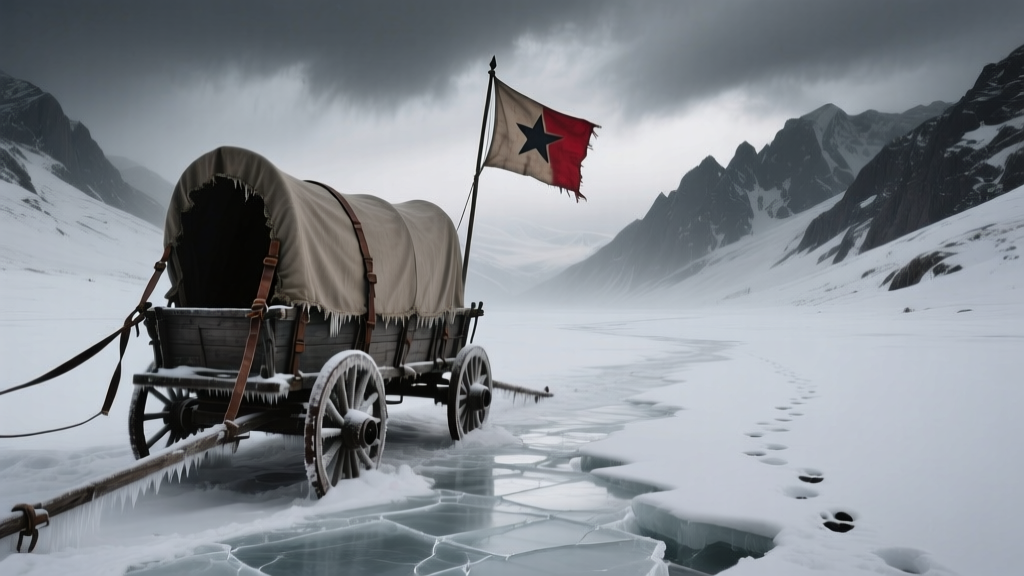
What Is the Donner Party? The Shocking Truth Behind America’s Most Infamous Pioneer Tragedy — And Why Everything You Think You Know Is Wrong
Why This Story Still Haunts Us Today
What is the Donner Party? At its core, the Donner Party was a group of 87 American pioneers who set out for California in 1846—and became trapped by early, catastrophic snowfall in the Sierra Nevada mountains, leading to starvation, desperation, and cannibalism. But reducing it to that single grim fact does profound injustice to the complexity, humanity, and enduring lessons embedded in this pivotal moment in U.S. westward expansion. More than a morbid footnote, the Donner Party episode remains a vital case study in leadership failure, group psychology under duress, frontier medicine, Indigenous knowledge exclusion, and how narrative power shapes national memory. In an era of renewed interest in historical accountability and ethical storytelling, understanding what is the Donner Party means confronting not just what happened—but how we’ve chosen to remember it.
The Journey That Should Have Been Routine
The Donner Party wasn’t a singular, pre-formed expedition—it was a loose coalition of families and individuals drawn together by shared destination and optimism. Led by brothers George and Jacob Donner and James F. Reed, the group departed Springfield, Illinois, in mid-April 1846, aiming for Sacramento Valley. They carried wagons loaded with household goods, seed stock, tools, and Bibles—not survival gear for high-altitude winter entrapment. Their fatal deviation came in early July near Fort Bridger (present-day Wyoming), when they opted to follow the untested ‘Hastings Cutoff’—a purported shortcut promoted by Lansford Hastings in his self-published Emigrants’ Guide to Oregon and California. Hastings had never traversed the route himself. His pamphlet promised ‘a fine, level road, with plenty of water and grass.’ Reality delivered 100 miles of brutal, unmapped desert across Utah’s Bonneville Salt Flats and the rugged Wasatch Mountains—costing the party over two weeks, breaking axles, exhausting oxen, and depleting food reserves before they’d even reached the Sierra.
By late October, the group—now fragmented into three subgroups due to delays and disagreements—reached Truckee Lake (now Donner Lake) at roughly 5,900 feet elevation. On October 28, a massive blizzard dumped over 10 feet of snow in 48 hours. Passes were buried. Wagons were immobilized. The last known communication from the camp—a letter carried by two men who escaped on foot—reached Sutter’s Fort on November 13. Rescue wouldn’t begin for another six weeks.
Life and Death at Truckee Lake: Beyond the Cannibalism Narrative
While popular retellings fixate on cannibalism, the real horror unfolded across four months of escalating physiological and psychological collapse. Medical historian Dr. William R. D. Blackwood’s analysis of survivor diaries reveals a cascade of preventable failures: no trained physician accompanied the party; rudimentary first aid relied on mustard plasters and whiskey; scurvy appeared within weeks due to zero fresh produce; frostbite led to gangrene and amputations without anesthesia; and respiratory infections raged unchecked in unventilated cabins.
Of the 87 who entered the mountains, 48 survived—including 41 who endured the winter encampment and 7 who escaped earlier via the ‘Forlorn Hope’ rescue attempt. The ‘Forlorn Hope’—17 people who set out on December 16—became the first to resort to cannibalism on December 20 after exhausting all food and killing their dogs. Their harrowing trek across frozen terrain, often crawling on frozen limbs, resulted in only 2 survivors reaching help. Yet crucially, cannibalism occurred in *all three* major camps (the Alder Creek site, the main Truckee Lake cabins, and the ‘Starved Camp’ further west), and was practiced *only after every other source of nutrition—including boiled leather, candle wax, and rodent carcasses—was exhausted*. Survivor Luisa Amelia Knight later testified: ‘We did not eat human flesh until the third week of January… and then only because the children cried for food and the mothers could not bear it.’
Rescue Missions: Heroism, Hubris, and Hard Choices
Four official relief parties launched between December 1846 and April 1847—each reflecting shifting public sentiment, logistical constraints, and moral calculus. The First Relief (led by Charles Stanton and William Eddy) reached the lake on February 19, rescuing 23 people but refusing to carry the severely ill, declaring them ‘beyond saving.’ The Second Relief (March 1) brought blankets and food but left 12 critically injured behind—including 10-year-old Eliza Donner, who survived by drinking melted snow mixed with her own urine for antiseptic properties, per her later account. The Third Relief (late March) included women like Eliza Poor Donner’s mother, who walked 120 miles carrying her infant while organizing food distribution. The Fourth Relief (April) found only five emaciated survivors at Alder Creek—including Lewis Keseberg, falsely accused of murdering Tamsen Donner (whose body was never recovered).
Notably, the Miwok and Washoe peoples living near the eastern Sierra had long warned travelers about the dangers of late-season passage and offered guidance—but their counsel was dismissed as ‘superstitious.’ Decades later, oral histories collected by anthropologist Grace Dangberg documented Washoe elders recounting how they tracked the party’s distress signals and prepared food caches—but were turned away at gunpoint by terrified, armed settlers.
Archaeology, Memory, and Modern Reckoning
For over 150 years, the Donner Party was memorialized through sensationalized dime novels, Wild West shows, and Hollywood films emphasizing gore over grief. A turning point arrived in 1990, when archaeologists from the University of California, Berkeley, conducted the first systematic excavation at the Alder Creek site. Using ground-penetrating radar and artifact analysis, they uncovered evidence contradicting long-held assumptions: no human bone fragments were found at cooking hearths (suggesting ritualized, non-culinary handling of remains); thousands of animal bone fragments showed meticulous butchering patterns consistent with starvation-level resource optimization; and the presence of imported mercury-based medicine vials indicated attempts at medical intervention previously undocumented.
Today, the Donner Memorial State Park preserves the site—and deliberately avoids sensational displays. Its museum features audio recordings of descendant interviews, interactive timelines showing parallel Indigenous displacement during the same period, and a ‘Decision Point’ exhibit where visitors weigh the ethics of each major choice made by the party. As historian Michael Wallis observes: ‘The Donner Party isn’t about monsters. It’s about ordinary people making catastrophic decisions in a system designed to reward speed over safety, individualism over community, and conquest over coexistence.’
| Relief Expedition | Launch Date | Key Personnel | People Rescued | Critical Ethical Tension |
|---|---|---|---|---|
| First Relief | December 21, 1846 | Charles Stanton, William Eddy, Selim Woodworth | 23 (primarily able-bodied) | Refused to assist those deemed ‘too weak to survive the journey’—establishing triage precedent |
| Second Relief | Early March 1847 | John Stark, William Foster, members of the Reed family | 17 (including 7 children) | Brought limited supplies; left 12 behind despite pleas—later justified as ‘preserving rescuers’ lives’ |
| Third Relief | Mid-March 1847 | Mrs. Margaret Breen, James Reed, Daniel Rhoads | 13 (including critically ill) | Included women who carried infants while walking 120+ miles—highlighting gendered labor in rescue |
| Fourth Relief | Early April 1847 | William Johnson, John Rhodes, Charles Stone | 5 (last survivors at Alder Creek) | Faced accusations of looting; recovered journals proving Keseberg’s innocence regarding Tamsen Donner’s death |
Frequently Asked Questions
Did the Donner Party really practice cannibalism?
Yes—but only after all conventional and desperate food sources (including boiled hides, candles, rodents, and pets) were exhausted. Forensic analysis of campsite remains confirms human remains were handled with ritual care—not as food waste. Survivor accounts consistently describe it as a final, agonizing act of communal survival—not predation or depravity.
Who was Tamsen Donner, and what happened to her?
Tamsen Donner was an educated schoolteacher, botanist, and diarist who kept meticulous records of the journey. She chose to stay with her dying husband George at the Alder Creek camp while sending her five daughters with the First Relief. Her final known words, written on a scrap of paper given to a rescuer, were: ‘I shall not cross the mountains.’ Her body was never recovered, and theories range from burial by Keseberg to consumption during the final weeks—though no evidence supports murder.
How many children survived the Donner Party?
Of the 22 children who entered the Sierra, 15 survived—including all five Donner daughters, aged 3 to 14. Their survival is attributed to prioritization in rescue efforts, maternal protection strategies (e.g., sharing body heat, rationing breast milk), and lower caloric needs relative to adults. Two-year-old Eliza Poor Donner famously survived by sucking on frozen pine boughs for moisture and nutrients.
Was Lansford Hastings punished for promoting the cutoff?
No. Hastings faced no legal consequences. He later served in the Confederate Army and died in 1870. His guidebook remained in print for decades, and the ‘Hastings Cutoff’ was retroactively blamed for the disaster—though historians now emphasize that poor leadership, lack of contingency planning, and systemic overconfidence in Manifest Destiny ideology were equally culpable.
Are there any living descendants of the Donner Party?
Yes—hundreds. The Donner, Reed, and Murphy families have active descendant associations. The Donner Family Association hosts biennial reunions at Donner Memorial State Park and funds educational scholarships. Many descendants advocate for reframing the story around resilience, ethics, and historical empathy rather than sensationalism.
Common Myths
- Myth #1: ‘The Donner Party was a single, unified group that made one bad decision.’ Reality: It was a fluid coalition of 11 independent family units with competing priorities, leadership fractures, and divergent survival strategies—some groups succeeded in hunting or caching food; others didn’t.
- Myth #2: ‘Cannibalism defined the entire experience.’ Reality: Less than 25% of the 87 members resorted to it—and only after 40+ days of starvation. The majority died of exposure, disease, or injury—not hunger alone.
Related Topics (Internal Link Suggestions)
- Westward Expansion Trails — suggested anchor text: "pioneer trails map and history"
- Manifest Destiny History — suggested anchor text: "how manifest destiny shaped U.S. policy"
- Survival Psychology Studies — suggested anchor text: "what extreme stress reveals about human behavior"
- Indigenous Knowledge in Exploration — suggested anchor text: "Native American trail guidance ignored by settlers"
- Historical Archaeology Methods — suggested anchor text: "how archaeologists uncover forgotten stories"
Your Next Step: Engage With History—Responsibly
Now that you know what is the Donner Party—not as a cautionary tale of hubris, but as a multidimensional human story of preparation, fracture, endurance, and contested memory—you’re equipped to move beyond stereotypes. Visit the Donner Memorial State Park’s online archive to read digitized diaries. Read survivor Patrick Breen’s original journal entries—unfiltered and heartbreakingly mundane. Or explore the Donner Party Descendants’ oral history project, where fourth- and fifth-generation voices reclaim narrative agency. History isn’t fixed—it’s interpreted. And your interpretation matters. Start today: download the free primary source reader compiled by UC Davis’ California History Project, and read the first entry—the weather log from October 25, 1846, written just days before the snow fell. What would you have done?
More Articles
 Which Is the Best Mario Party? We Tested All 12 Mainline Games Across 4 Key Criteria (Fun Factor, Balance, Replay Value & Accessibility) So You Don’t Waste $60 on the Wrong One
What Party Was the Confederacy? The Shocking Truth Behind the Misconception That It Was a Political Party — And Why This Historical Confusion Still Impacts Education, Textbooks, and Public Memory Today
What to Wear to Las Vegas Pool Party: The 7-Second Dress Code Decoder (No More Awkward Outfit Regrets, Sweat-Stained Towels, or Bouncer Side-Eye)
How to Change Political Parties in California: A Step-by-Step, No-Stress Guide That Takes Less Than 5 Minutes (No Mail, No Waiting, No Mistakes)
Can a governor appoint a senator from a different party? Yes — but it’s rare, politically explosive, and governed by 50 unique state laws that dictate who *can* be appointed, when, and under what constraints.
What to Make for a Football Party: 12 Crowd-Pleasing, Make-Ahead, Budget-Savvy Recipes (Plus 5 Game-Day Hacks That Save 3+ Hours)
What Is a Mardi Gras Party? (And Why Your First One Doesn’t Need Beads, Bourbon, or a Parade Permit—Here’s the Real Blueprint)
Which Is the Best Mario Party? We Tested All 12 Mainline Games Across 4 Key Criteria (Fun Factor, Balance, Replay Value & Accessibility) So You Don’t Waste $60 on the Wrong One
What Party Was the Confederacy? The Shocking Truth Behind the Misconception That It Was a Political Party — And Why This Historical Confusion Still Impacts Education, Textbooks, and Public Memory Today
What to Wear to Las Vegas Pool Party: The 7-Second Dress Code Decoder (No More Awkward Outfit Regrets, Sweat-Stained Towels, or Bouncer Side-Eye)
How to Change Political Parties in California: A Step-by-Step, No-Stress Guide That Takes Less Than 5 Minutes (No Mail, No Waiting, No Mistakes)
Can a governor appoint a senator from a different party? Yes — but it’s rare, politically explosive, and governed by 50 unique state laws that dictate who *can* be appointed, when, and under what constraints.
What to Make for a Football Party: 12 Crowd-Pleasing, Make-Ahead, Budget-Savvy Recipes (Plus 5 Game-Day Hacks That Save 3+ Hours)
What Is a Mardi Gras Party? (And Why Your First One Doesn’t Need Beads, Bourbon, or a Parade Permit—Here’s the Real Blueprint)