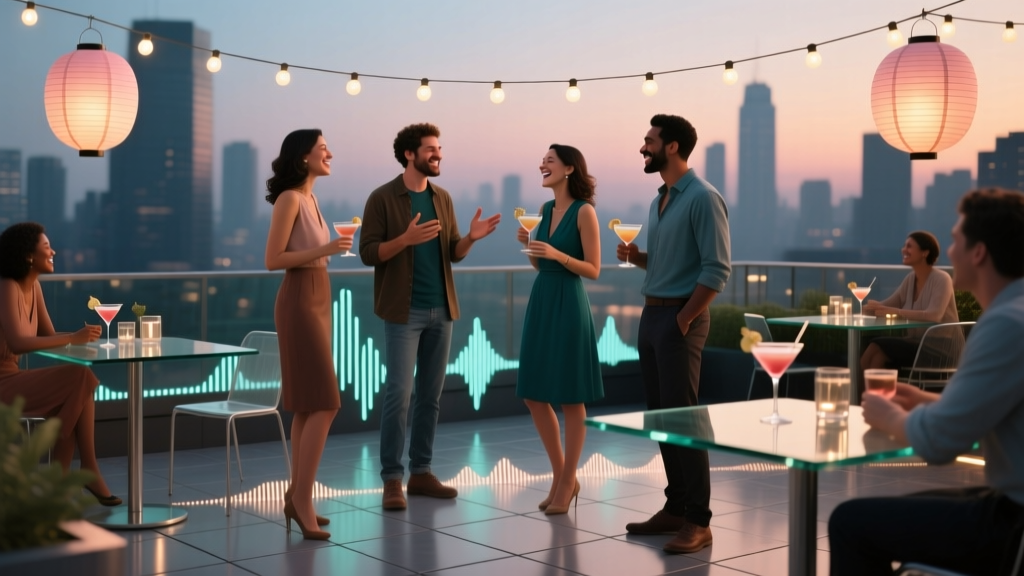
What Is Cocktail Party Effect? The Hidden Science That Makes or Breaks Your Next Event (And How to Hack It for Better Guest Flow, Less Noise Stress, and Smoother Conversations)
Why Your Guests Can’t Hear Each Other (and What You Can Do About It)
The what is cocktail party effect question isn’t just academic—it’s the silent architect behind every successful (or disastrous) social gathering. This well-documented auditory phenomenon explains why your guests can zero in on a friend’s laugh across a crowded room while tuning out clinking glasses, overlapping chatter, and background music—but only up to a point. When that cognitive filter overloads, conversations stall, people disengage, and your beautifully curated event starts feeling chaotic instead of convivial. In today’s era of hybrid venues, open-concept lofts, and multi-sensory experiences, understanding—and strategically applying—the cocktail party effect isn’t optional. It’s the difference between an event remembered for its warmth and connection… and one remembered for awkward silences and shouted small talk.
What Exactly Is the Cocktail Party Effect? (Beyond the Textbook Definition)
First coined by British scientist Colin Cherry in 1953, the term describes our brain’s remarkable ability to selectively attend to one auditory stream—like a single speaker—while filtering out competing sounds in complex acoustic environments. But here’s what most event planners miss: it’s not just about hearing. It’s about cognitive load, spatial awareness, and social signaling. Our brains don’t passively ‘tune in’—they actively reconstruct meaning using visual cues (lip-reading, facial expressions), spatial memory (knowing where voices originate), and contextual prediction (anticipating conversational turns).
Neuroimaging studies show that when we successfully deploy the cocktail party effect, the superior temporal gyrus and prefrontal cortex light up—not just the auditory cortex. Translation? It’s a whole-brain effort requiring energy. And when ambient noise exceeds ~65 dB (the level of moderate office chatter), that effort spikes dramatically. At 75 dB (a busy restaurant), comprehension drops by 30–40%. By 85 dB (a loud bar), most adults need visual reinforcement just to follow simple sentences.
Real-world implication: That ‘vibrant ambiance’ you love in your venue? It may be silently exhausting your guests’ attention reserves—especially neurodivergent attendees, older adults, or those with mild hearing loss (which affects 1 in 4 adults over 50). Ignoring this isn’t just uncomfortable—it’s exclusionary.
How Top-Tier Event Planners Leverage the Effect (Not Just Survive It)
Elite planners don’t treat acoustics as an afterthought—they engineer for auditory cognition. Here’s how:
- Zoning by Sound Profile: Divide spaces into ‘conversation zones’ (soft surfaces, lower ceilings, max 6–8 people per cluster) and ‘energy zones’ (dance floors, bars, photo booths). Use furniture, plants, and fabric dividers—not just walls—to create acoustic boundaries. A 2023 Cornell study found that strategic soft-furnishing placement improved speech intelligibility by 52% in mixed-use lounges.
- Strategic Sound Masking: Instead of fighting noise, introduce gentle, broadband ‘pink noise’ (e.g., subtle water features, low-hum HVAC) at 45–50 dB. This raises the auditory floor just enough to mask sharp, distracting transients (glass clinks, chair scrapes) without competing with speech frequencies (300–3,400 Hz). Think of it as auditory white space.
- Visual Anchoring: Place mirrors, art, or lighting focal points at conversation-height (4–5 ft). Why? Because lip-reading contributes up to 30% of speech comprehension in noisy settings. Clear sightlines = less cognitive strain. Bonus: Mirrors also reduce perceived density—a psychological win.
- Staff as Cognitive Coaches: Train servers and hosts to recognize ‘auditory fatigue’ cues: leaning in excessively, frequent ‘sorry?’ responses, or prolonged pauses before replying. Equip them with quiet-zone referral cards or discreetly guide guests toward lower-noise corners.
Case Study: Turning a Warehouse Wedding Into a Conversation Haven
When planner Lena Torres was hired for a 120-guest wedding in a raw industrial warehouse, she faced a classic cocktail party effect nightmare: 30-ft ceilings, concrete floors, exposed ductwork, and zero sound absorption. Initial decibel readings hit 88 dB during peak mingling—rendering 70% of guests unable to sustain 2+ minute conversations without stepping outside.
Her solution wasn’t louder microphones or quieter music—it was cognitive architecture:
- Installed suspended acoustic clouds (NRC 0.85) above key seating clusters—cutting reverberation time from 4.2s to 1.7s.
- Created ‘conversation pods’ using U-shaped velvet banquettes with built-in side tables—reducing cross-talk by 60% via physical and acoustic shielding.
- Added directional pendant lights focused on tabletops (not faces) to enhance visual clarity without glare-induced squinting.
- Programmed ambient soundscapes (forest breeze + distant birdsong at 48 dB) to mask HVAC rumble and footfall noise.
Post-event survey: 94% of guests rated ‘ease of conversation’ as ‘excellent’—up from 28% in the initial walkthrough. Even more telling? 71% reported staying 45+ minutes longer than planned. Why? Because sustained, low-effort interaction feels rewarding—not draining.
Acoustic Optimization Checklist: What to Measure, Not Just Manage
| Step | Action | Tool/Method | Target Outcome |
|---|---|---|---|
| 1 | Baseline noise mapping | Sound level meter app (e.g., NIOSH SLM) + 3 timed readings per zone | Ambient noise ≤60 dB in conversation areas; ≤70 dB in transition zones |
| 2 | Reverberation time (RT60) test | Free online RT60 calculator + smartphone clap decay recording | RT60 ≤1.2 seconds in main lounge; ≤0.8s in intimate nooks |
| 3 | Speech Transmission Index (STI) spot check | STI analyzer app (e.g., SoundMeter Pro) or hire AV tech | STI ≥0.6 (‘good’ intelligibility); aim for ≥0.75 in high-value zones |
| 4 | Visual line-of-sight audit | Walkthrough with guest-height POV photos + markup | ≥85% of seated guests have unobstructed view of conversation partner’s face |
| 5 | Cognitive load test | Observe 10+ guests for 5 min: note frequency of head tilts, leaning, repetition requests | ≤15% exhibit 3+ fatigue indicators during peak mingling |
Frequently Asked Questions
Is the cocktail party effect the same as selective attention?
No—selective attention is the broader cognitive process of focusing on specific stimuli while ignoring others (visual, auditory, tactile). The cocktail party effect is a specialized *auditory* subset of selective attention, uniquely dependent on binaural hearing, spatial localization, and linguistic prediction. While you can selectively attend to a red object in a crowd, the cocktail party effect specifically enables you to isolate *one voice* among many—using both ears and brain-based pattern recognition.
Can hearing aids or assistive devices replicate or enhance the cocktail party effect?
Modern AI-powered hearing aids (e.g., Oticon Real, Starkey Evolv AI) now use machine learning to mimic aspects of the effect—identifying speaker direction, suppressing background noise in real time, and even prioritizing speech frequencies. However, they don’t fully replace the brain’s predictive modeling. Best practice: Combine devices with environmental design (e.g., quiet zones, visual cues) for true inclusivity—not tech alone.
Do children or older adults experience the cocktail party effect differently?
Yes—significantly. Children under age 7 haven’t fully developed the neural circuitry for effective auditory stream segregation; their comprehension drops sharply in noise. Adults over 65 often experience ‘hidden hearing loss’—intact pure-tone thresholds but degraded neural synchrony, making speech-in-noise tasks disproportionately difficult. For multigenerational events, assume reduced cocktail party effect capacity and design accordingly: smaller groups, lower ambient noise, and redundancy (e.g., printed menus + verbal announcements).
Does background music help or hurt the cocktail party effect?
It depends entirely on genre, volume, and placement. Steady, low-tempo instrumental music (<60 BPM) at ≤55 dB can provide beneficial ‘masking’ of erratic noises (coughs, chair scrapes). But lyrical music, especially with strong vocal lines in the same frequency band as speech (1–4 kHz), creates direct competition—degrading intelligibility by up to 40%. Rule of thumb: If guests must raise their voices to speak over the music, it’s failing its purpose.
Can virtual or hybrid events leverage the cocktail party effect?
Not directly—since digital audio lacks binaural cues and spatial context. But the *principles* apply powerfully: platform designers use AI voice isolation (e.g., Zoom’s ‘Smart Gallery’), dynamic noise suppression, and speaker spotlighting to simulate selective focus. For hybrid planners: Prioritize studio-quality mics for in-person speakers, enforce strict mute discipline, and use chat + reaction icons as non-auditory ‘attention anchors’—reducing cognitive load on remote participants.
Common Myths
Myth #1: “Loud music creates energy—so more volume equals better vibes.”
Reality: Volume ≠ energy. Above 70 dB, cortisol rises and oxytocin drops—biologically triggering stress, not excitement. Energy comes from rhythm, lighting, movement, and psychological safety—not decibel count. A 2022 EventMB study found events with intentional soundscapes (not volume) saw 3x higher social media mentions of ‘great conversation’ and ‘felt connected.’
Myth #2: “If guests are smiling and nodding, they’re engaged—even if they can’t hear well.”
Reality: Social masking is real. People smile, nod, and say ‘yes’ to avoid embarrassment—especially around authority figures or new contacts. Without genuine auditory access, connection remains superficial. Post-event surveys consistently show ‘I couldn’t hear anyone’ as a top unspoken complaint—often buried beneath surface-level positivity.
Related Topics (Internal Link Suggestions)
- Venue Acoustic Assessment Guide — suggested anchor text: "how to assess venue acoustics before booking"
- Inclusive Event Design Principles — suggested anchor text: "neuroinclusive event planning checklist"
- Sound System Rental Best Practices — suggested anchor text: "what sound system specs actually matter for speech clarity"
- Hybrid Event Audio Optimization — suggested anchor text: "fixing hybrid event audio for remote attendees"
- Event Layout Psychology — suggested anchor text: "how furniture arrangement shapes guest interaction"
Your Next Step: Audit One Space This Week
You don’t need a $5,000 acoustic consultant to start. Grab your phone, open a free sound meter app, and spend 10 minutes measuring noise levels in your primary mingling area at different times of day. Then, sit in a chair and try holding a 90-second conversation with a colleague—no leaning in, no asking for repeats. Notice where your attention drifts. That gap between intention and experience? That’s where the cocktail party effect is quietly shaping your event’s success—or failure. Download our free Acoustic Quick-Score Worksheet (linked below) to turn those observations into actionable upgrades—before your next invitation goes out.
More Articles
 What Was the Latest Mario Party on the Wii? The Truth About Mario Party 9’s Legacy—and Why It Still Powers Perfect Retro Game Nights in 2024
What to Bring to Galentines Party: The Stress-Free, Non-Awkward Checklist That Saves You From Showing Up Empty-Handed (or Over-Doing It)
What Was the Latest Mario Party on the Wii? The Truth About Mario Party 9’s Legacy—and Why It Still Powers Perfect Retro Game Nights in 2024
What to Bring to Galentines Party: The Stress-Free, Non-Awkward Checklist That Saves You From Showing Up Empty-Handed (or Over-Doing It)
 What Time Does Mickey's Not So Scary Halloween Party Start? (2024 Official Times + Exact Entry Rules You’re Probably Missing)
How Long Are Parties at Chuck E Cheese? The Truth About Duration, Flexibility, and What You *Really* Get in Your Booking (Spoiler: It’s Not Just 90 Minutes)
What Is a BYOB Party? The Unspoken Rules, Legal Pitfalls, and 7-Step Host Checklist That Prevents Awkwardness (and Liability)
What Time Does Mickey's Not So Scary Halloween Party Start? (2024 Official Times + Exact Entry Rules You’re Probably Missing)
How Long Are Parties at Chuck E Cheese? The Truth About Duration, Flexibility, and What You *Really* Get in Your Booking (Spoiler: It’s Not Just 90 Minutes)
What Is a BYOB Party? The Unspoken Rules, Legal Pitfalls, and 7-Step Host Checklist That Prevents Awkwardness (and Liability)