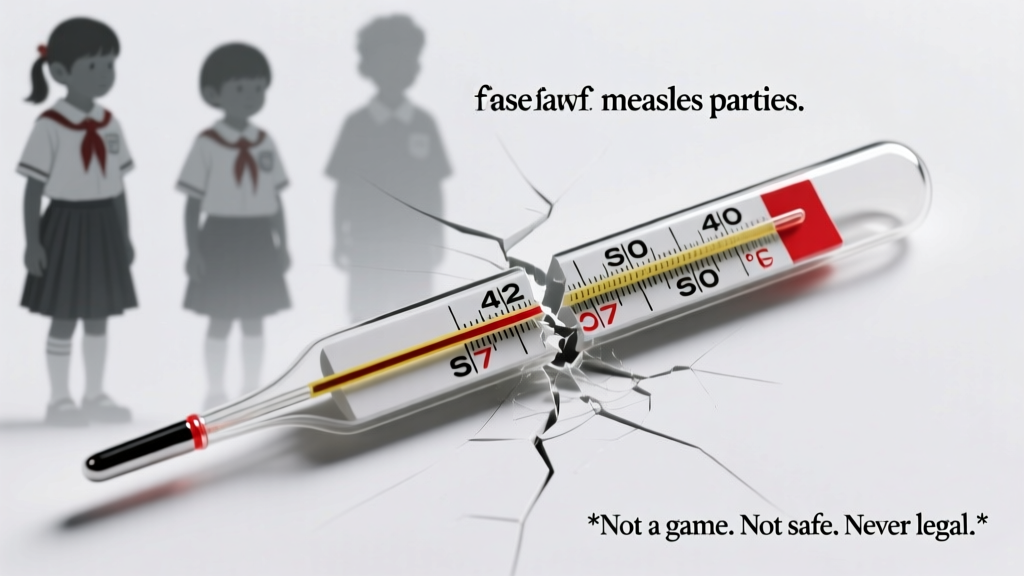
What Is a Measles Party? The Dangerous Truth Behind This Outdated, Illegal, and Medically Reckless 'Event' — And Why No Responsible Parent Should Ever Consider It
Why This Question Matters More Than Ever — Especially Right Now
What is a measles party? At first glance, the phrase sounds like a quirky throwback to mid-century childhood rituals — but in reality, it refers to a deeply hazardous, medically discredited practice where unvaccinated children are deliberately exposed to active measles virus, often at informal gatherings disguised as 'playdates' or 'immunity parties.' With U.S. measles cases surging to a 25-year high in 2024 — including outbreaks across Texas, Ohio, and New York linked to low vaccination rates — understanding why this concept persists, how it’s marketed online, and why it violates public health law isn’t just academic. It’s urgent. Parents, educators, pediatricians, and school administrators are encountering misinformation that frames measles exposure as 'natural immunity' — ignoring the fact that measles kills 1–3 of every 1,000 infected children and can cause permanent brain damage, deafness, or immune amnesia. This article cuts through the noise with evidence-based clarity, legal context, and actionable guidance for protecting kids — the right way.
The Origins and Evolution of a Dangerous Myth
The term 'measles party' emerged in the late 1990s and early 2000s alongside rising vaccine hesitancy, fueled by the now-retracted 1998 Lancet paper falsely linking the MMR vaccine to autism. Though that study was debunked, retracted, and its author stripped of his medical license, the myth metastasized — and with it, the idea that 'catching measles naturally' was safer or more 'holistic' than vaccination. Early versions involved parents mailing dried saliva swabs or sharing used tissues; later, Facebook groups and encrypted messaging apps hosted closed communities coordinating exposures. In 2019, a CDC investigation traced a Minnesota outbreak directly to a 'measles party' attended by 12 unvaccinated children — 9 became ill, 2 required ICU admission, and one developed subacute sclerosing panencephalitis (SSPE), a fatal degenerative brain disease with onset years after infection. These aren’t theoretical risks: they’re documented, preventable tragedies.
Today, the language has shifted — many proponents avoid the term 'measles party' outright, instead using coded phrases like 'immunity boosting,' 'natural exposure events,' or 'viral playgroups.' But the intent remains identical: deliberate infection. And while no state explicitly bans 'measles parties' by name, multiple jurisdictions have taken legal action. In 2023, a Washington county prosecutor filed child endangerment charges against two parents who knowingly brought their symptomatic, unvaccinated child to a preschool — exposing 27 classmates. Courts ruled that willful exposure to a reportable, life-threatening disease meets statutory definitions of neglect.
Why Measles Isn’t ‘Just a Rash’ — The Hard Science of Risk
Measles is one of the most contagious human viruses known — each infected person spreads it to 12–18 others in a susceptible population (R₀ > 12). For comparison, SARS-CoV-2’s original strain had an R₀ of ~2.5–3. That extreme transmissibility stems from aerosolized viral particles that remain airborne for up to two hours — meaning you don’t need direct contact to get infected. You simply need to walk into a room an infected person occupied minutes earlier.
Beyond contagion, measles uniquely disables the immune system — a phenomenon called 'immune amnesia.' A landmark 2019 Science Immunology study tracked 77 unvaccinated children before and after measles infection and found they lost 11–73% of their pre-existing antibody repertoire — effectively erasing immune memory built up over years. This leaves survivors vulnerable to secondary infections (like pneumonia or sepsis) for months or even years. As Dr. Michael Mina, lead researcher, stated: 'It’s like rebooting your immune system — but without the backup files.'
Complication rates are sobering:
- Pneumonia: Occurs in ~6% of cases — the leading cause of measles-related death
- Encephalitis: Brain swelling in ~1 in 1,000 cases — 15–25% result in permanent disability
- SSPE: A rare but 100% fatal neurodegenerative disease appearing 7–10 years post-infection — risk is 13x higher in children infected before age 2
- Death: Globally, measles kills ~128,000 people annually — mostly children under 5. In high-income countries, fatality is ~1 in 1,000, but climbs to 1 in 100 among malnourished or immunocompromised children
Vaccination changes everything. Two doses of MMR are 97% effective at preventing measles. Importantly, they confer lifelong immunity — unlike natural infection, which does *not* guarantee protection against future strains and carries all the above risks. There is no scientific basis for claiming 'natural immunity' is superior. Period.
Legal, Ethical, and Community Consequences
Organizing or participating in a measles party isn’t just medically reckless — it carries tangible legal liability. Every U.S. state classifies measles as a 'reportable disease,' meaning clinicians and labs must notify public health authorities within 24 hours of diagnosis. Once reported, health departments launch contact tracing — and if evidence points to intentional exposure, investigators interview attendees, review digital communications, and assess whether criminal negligence or child endangerment statutes apply.
In 2022, Oregon passed HB 4002 — the nation’s first law explicitly naming 'intentional exposure to vaccine-preventable diseases' as grounds for civil penalties, including fines up to $10,000 and mandatory public health education. Similar bills are pending in Vermont, Maine, and Illinois. Civil lawsuits have also succeeded: In 2021, a family whose infant contracted measles from an unvaccinated sibling’s 'exposure playdate' won $2.3 million in damages for lifelong neurological impairment — citing failure to adhere to community care standards.
From an ethical standpoint, measles parties violate core principles of medical ethics: non-maleficence ('do no harm'), justice (fair distribution of risk), and autonomy (children cannot consent to life-altering risk). They also erode herd immunity — the protective barrier that shields infants too young for vaccines, cancer patients undergoing chemo, and others who cannot be vaccinated. When vaccination rates dip below 95% in a community, outbreaks ignite. In Clark County, Washington, 2019, coverage fell to 78% — triggering 73 cases, school closures, and $1.2M in emergency response costs borne by taxpayers.
What to Do Instead: Evidence-Based Immunity Building & Prevention
If you’re asking 'what is a measles party?' because you’re worried about your child’s immunity — or pressured by social circles promoting 'natural' exposure — here’s what actually works:
- Get fully vaccinated on schedule: First MMR dose at 12–15 months; second at 4–6 years. For international travel or outbreaks, infants as young as 6 months may receive an early dose (though it doesn’t count toward the routine series).
- Verify immunity if uncertain: A simple blood test (measles IgG titer) confirms protection — especially important for adults born between 1957–1989, when one-dose regimens were common and less effective.
- Support immune resilience holistically: Prioritize sleep (school-age kids need 9–12 hours), whole-food nutrition (vitamin A deficiency doubles measles mortality), and stress reduction — but never at the expense of proven prevention.
- Know your rights and responsibilities: Schools and daycare centers can legally exclude unvaccinated children during outbreaks. Some states (e.g., California, Maine) prohibit non-medical exemptions entirely.
Real-world success story: After a 2023 measles case at a Brooklyn charter school, administrators partnered with local health clinics to host 'Vaccine Confidence Days' — offering free MMR shots, multilingual Q&As with pediatric infectious disease specialists, and take-home educational kits. Within 6 weeks, kindergarten vaccination rates rose from 82% to 96%, and no secondary cases occurred.
| Approach | Risk of Measles Infection | Long-Term Immunity | Complication Risk | Legal/Social Risk |
|---|---|---|---|---|
| MMR Vaccination (2 doses) | <3% chance of breakthrough infection (mild, non-contagious) | 97% effective; lifelong protection | Negligible (fever/rash in ~10%; no serious complications) | None — aligns with public health law and school requirements |
| Natural Measles Infection | 100% (by definition) | ~95% protection against reinfection — but with massive upfront risk | 1–3 deaths per 1,000; 1 in 1,000 encephalitis; immune amnesia confirmed | High — potential for criminal charges, civil liability, school exclusion |
| 'Measles Party' Exposure | ~85–100% (depends on viral load, ventilation, proximity) | Same as natural infection — no added benefit | Identical to natural infection — but often occurs in unmonitored settings with delayed care | Extreme — considered willful endangerment in multiple jurisdictions |
Frequently Asked Questions
Is attending a measles party illegal?
While no federal law names 'measles parties,' 32 states have child endangerment statutes broad enough to cover intentional exposure to life-threatening diseases. In practice, prosecutors have charged parents under these laws — especially when harm results. Civil liability is nearly certain if your child infects another.
Can you get measles from someone who’s recently been vaccinated?
No. The MMR vaccine contains a weakened (attenuated) live virus that cannot cause measles in healthy people. Rarely, vaccine recipients may develop a mild, non-contagious rash 5–12 days post-shot — but they shed no virus and pose zero transmission risk.
What if my child was exposed to measles — what should I do immediately?
Contact your pediatrician or local health department within 72 hours. If unvaccinated or under-immunized, they may administer MMR vaccine (effective if given within 72 hours) or immune globulin (within 6 days) to reduce severity. Quarantine for 21 days and monitor for fever, cough, runny nose, conjunctivitis, and Koplik spots (tiny white spots inside mouth).
Are there any legitimate 'immunity parties'?
No. Any event designed to transmit infectious disease is medically unethical and dangerous. Legitimate immunity-building focuses on nutrition, sleep, stress management, and — crucially — vaccination. Terms like 'immunity party' are red flags for misinformation.
How do I talk to friends or family who believe in measles parties?
Lead with empathy, not confrontation: 'I know you want the best for your kids — I do too. Let’s look at the CDC data together on complication rates.' Share trusted sources (CDC, AAP, WHO) and offer to attend a vaccine consultation with them. Avoid shaming — it backfires. Focus on shared values: safety, science, and protecting vulnerable kids.
Common Myths Debunked
- Myth #1: 'Natural immunity is stronger and longer-lasting than vaccine-induced immunity.' — False. While both confer robust protection, natural infection carries catastrophic risks vaccine immunity avoids. Studies show MMR-induced antibodies persist for decades — and booster doses aren’t needed. Meanwhile, immune amnesia from measles weakens defense against *other* pathogens.
- Myth #2: 'Measles parties are private, so no one gets hurt but the consenting families.' — False. Measles is airborne and highly contagious. One infected child can expose dozens — including immunocompromised neighbors, pregnant women, and infants — turning a 'private' event into a public health emergency.
Related Topics (Internal Link Suggestions)
- MMR Vaccine Safety Facts — suggested anchor text: "Is the MMR vaccine safe for my baby?"
- How Herd Immunity Actually Works — suggested anchor text: "What percentage of people need to be vaccinated?"
- Signs and Symptoms of Measles in Children — suggested anchor text: "Early measles symptoms parents should watch for"
- Vaccine Exemptions by State — suggested anchor text: "Which states allow religious or philosophical vaccine exemptions?"
- Travel Vaccination Requirements — suggested anchor text: "Do I need extra vaccines for international trips?"
Take Action Today — Not Tomorrow
Now that you know what a measles party truly is — not a nostalgic tradition, but a preventable public health hazard rooted in misinformation — your next step is clear: protect your child *and* your community with science-backed action. Check your family’s vaccination records. Schedule any overdue doses. Talk to your pediatrician about immunity testing if you’re unsure. And if you encounter this dangerous idea online or in person, respond with compassion *and* facts — share this article, cite CDC outbreak data, or connect hesitant friends with trusted healthcare providers. Measles is 97% preventable. There’s no 'party' in prevention — just peace of mind, lifelong health, and collective responsibility. Start today.
More Articles
 How Much Do Party Planners Earn? The Real Numbers (2024) — From $25K Side Hustles to $125K+ Full-Time Salaries, Plus Exactly How to Double Your Income in 12 Months
 Did John Fetterman leave the Democrat Party? The Truth Behind Viral Rumors, Official Statements, and What His Senate Record Actually Shows — No Speculation, Just Verified Facts
Who’s Most Likely to a Party Game? The Science-Backed Framework That Cuts Awkwardness by 73% (and Gets Everyone Playing in Under 90 Seconds)
What Was the First Political Party in the United States? The Surprising Truth Behind Federalists, Anti-Federalists, and Why 'Party' Meant Something Very Different in 1789
Did John Fetterman leave the Democrat Party? The Truth Behind Viral Rumors, Official Statements, and What His Senate Record Actually Shows — No Speculation, Just Verified Facts
Who’s Most Likely to a Party Game? The Science-Backed Framework That Cuts Awkwardness by 73% (and Gets Everyone Playing in Under 90 Seconds)
What Was the First Political Party in the United States? The Surprising Truth Behind Federalists, Anti-Federalists, and Why 'Party' Meant Something Very Different in 1789
 How Long to Bake Party Wings? The Exact Timing Guide That Prevents Dry, Rubbery, or Burnt Wings Every Single Time (No More Guesswork)
Is Michigan a one-party state for recording? The truth about consent laws — what every event planner, business owner, and host must know before hitting record (and how to avoid lawsuits)
How Long to Bake Party Wings? The Exact Timing Guide That Prevents Dry, Rubbery, or Burnt Wings Every Single Time (No More Guesswork)
Is Michigan a one-party state for recording? The truth about consent laws — what every event planner, business owner, and host must know before hitting record (and how to avoid lawsuits)
 How to Text Spa Party Invitations the Right Way: 7 Mistakes Everyone Makes (and How to Avoid Them Before Your Guest List Ghosts You)