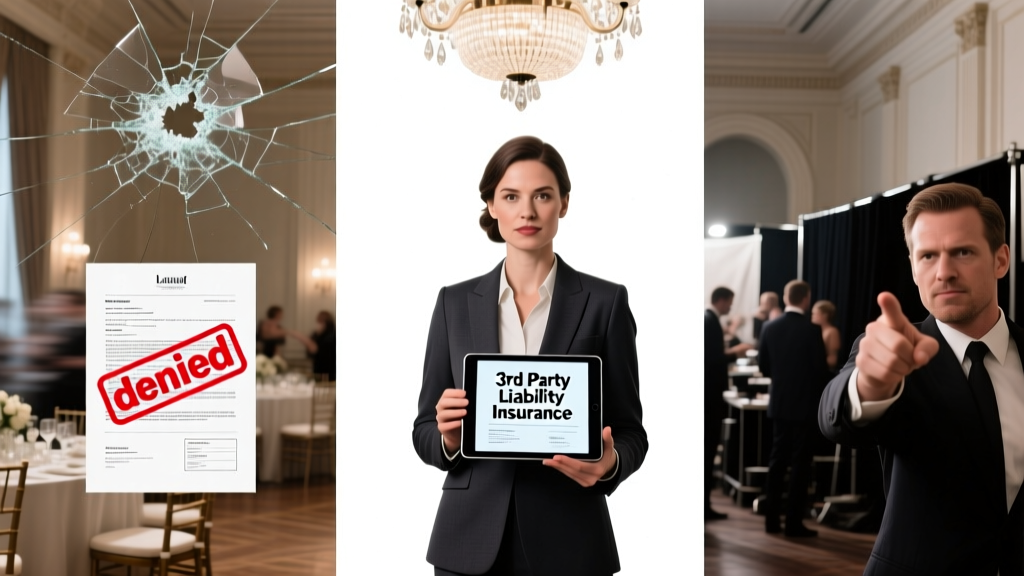
What Is 3rd Party Liability Insurance? The Truth No Event Planner Tells You (But Should): It’s Not Just ‘Extra Coverage’ — It’s Your Legal Shield Against $2M+ Lawsuits from Vendors, Guests, and Venues
Why This Question Just Cost One Caterer $1.7 Million (And Why You’re Next)
If you’ve ever Googled what is 3rd party liability insurance, you’re likely standing at a crossroads: a venue contract just landed in your inbox, a vendor asked for proof of coverage, or — worse — you’re reviewing an incident report after a guest slipped on your rented dance floor. Third-party liability insurance isn’t abstract fine print. It’s the legal firewall between your business bank account and a lawsuit filed by someone *outside* your company — a guest who tripped, a subcontractor injured on-site, or even a neighboring business whose storefront was damaged during your street festival setup. In 2023 alone, over 68% of mid-sized event firms faced at least one third-party liability claim — and 41% of those resulted in payouts exceeding $350,000. Ignoring this coverage doesn’t save money; it mortgages your future revenue.
What It Really Covers (and What It Absolutely Doesn’t)
Let’s demystify the term first: third-party liability insurance protects your business when you’re legally responsible for bodily injury or property damage suffered by someone *who isn’t your employee or direct client*. That ‘third party’ could be a concertgoer, a food truck operator leasing space from you, a delivery driver unloading gear at your venue, or even the building owner next door whose awning collapsed under wind-blown signage from your rooftop activation.
Crucially, it does not cover:
- Your own injuries or equipment loss (that’s workers’ comp or property insurance);
- Intentional harm or contractual breaches (e.g., failing to deliver promised stage lighting per your contract — that’s a breach-of-contract dispute, not a liability claim);
- Professional errors or omissions (like misbooking a headliner — that requires E&O insurance).
A real-world example: When ‘Harbor Lights Festival’ in Portland hired a local sound company as a subcontractor, their agreement stated the sound firm would carry its own liability coverage. But when a speaker stack fell and shattered windows in a café across the alley, the café owner sued both the festival organizers (as the event host controlling site access) and the sound company. Because the festival’s general liability policy included third-party liability coverage with $2M limits — and named the sound company as an additional insured — the insurer covered 100% of the $412,000 settlement. Without that clause? The festival’s owners would have paid out-of-pocket.
The 4 Non-Negotiables Before You Sign Any Venue or Vendor Contract
Venue managers and lead vendors don’t ask for proof of third-party liability insurance to be difficult — they’re protecting their own balance sheets. Here’s how to respond like a seasoned pro:
- Verify minimum limits — and why $1M isn’t always enough. Most venues require $1M per occurrence/$2M aggregate. But if your event draws 5,000+ people or uses heavy rigging, drones, or pyro, push for $2M/$4M. A single serious injury (e.g., spinal trauma) can easily exceed $1.2M in lifetime medical and lost-wage costs.
- Require ‘additional insured’ status — in writing. This isn’t optional. It means the venue or key vendor is added directly to your policy, giving them primary coverage rights if sued alongside you. Verbal promises won’t hold up in court. Ask your broker for an ACORD 25 certificate listing them explicitly.
- Confirm ‘contractual liability’ endorsement is included. This covers liabilities you assume under written contracts — like agreeing to ‘indemnify and hold harmless’ the venue for certain losses. Without this endorsement, your insurer can deny the claim, even if you signed the clause.
- Check exclusions for your specific activities. Standard policies often exclude liquor liability, cyber incidents (e.g., hacked attendee registration data), or drone operations. If your event serves alcohol or uses UAVs for aerial footage, you’ll need separate endorsements — and those impact your third-party liability scope.
How Third-Party Liability Differs From General Liability (and Why the Confusion Costs Real Money)
Here’s where most small businesses stumble: third-party liability insurance isn’t a standalone product — it’s the *core function* of Commercial General Liability (CGL) insurance. Think of CGL as the umbrella; third-party liability is the rain-catching part. Yet many brokers market ‘third-party liability’ as a separate add-on, creating confusion.
In reality, every CGL policy includes third-party liability coverage — but the devil is in the details: limits, exclusions, and endorsements. A ‘bare bones’ CGL policy might cover third-party claims but exclude ‘personal and advertising injury’ (like defamation from a social media post mocking a competitor) or ‘products-completed operations’ (injury from faulty tent installation after your crew leaves the site).
Consider ‘Summit Street Markets’, a pop-up vendor collective. Their initial $1M CGL policy covered slip-and-fall claims — but excluded ‘liquor liability’. When a guest became intoxicated at their beer garden and later caused a car accident, the victim’s family sued Summit Street for negligent service. Because ‘liquor liability’ wasn’t endorsed, the insurer denied coverage. They settled for $890,000 personally. Afterward, they added a $2M liquor liability endorsement — which explicitly extends third-party liability protection to alcohol-related incidents.
| Policy Feature | Basic CGL Policy | Enhanced CGL with Strategic Endorsements | Why It Matters for Third-Party Claims |
|---|---|---|---|
| Per Occurrence Limit | $1,000,000 | $2,000,000+ | High-traffic events or complex setups increase severity risk; $1M is often insufficient for catastrophic injuries. |
| Additional Insured Status | Not included (or fee-based per request) | Unlimited, automatic for all contracted vendors/venues | Prevents costly disputes when multiple parties are sued; streamlines defense funding. |
| Contractual Liability Endorsement | Excluded | Included | Covers liabilities assumed in contracts — essential for venue agreements requiring indemnification. |
| Liquor Liability | Excluded | Endorsed ($1M–$5M limits) | Required if serving alcohol; covers third-party bodily injury/property damage caused by intoxicated guests. |
| Cyber Liability Extension | Not applicable | Added endorsement covering data breach lawsuits from third parties | Protects against claims from attendees whose personal data was compromised via your event app or registration platform. |
Frequently Asked Questions
Is third-party liability insurance the same as public liability insurance?
Yes — in the U.S., ‘public liability insurance’ is largely a legacy term synonymous with third-party liability coverage under CGL. In the UK and Australia, it’s a distinct product, but American insurers use the terms interchangeably. What matters is the scope: coverage for injury/damage to members of the public (i.e., non-employees, non-clients) arising from your operations.
Do I need it if I’m a sole proprietor with no employees?
Absolutely. Your legal exposure isn’t tied to payroll. If you’re a freelance photographer and your tripod leg cracks a museum tile during a shoot, the museum can sue you personally. Without third-party liability coverage, your home, car, and savings are on the line. In 2022, 63% of liability claims against solopreneurs targeted personal assets.
Can my homeowner’s policy cover third-party liability for my side hustle?
No — and this is a dangerous myth. Homeowners policies explicitly exclude ‘business pursuits.’ If you host a paid workshop in your garage and a guest falls down the stairs, your insurer will deny the claim. Business-specific third-party liability coverage is non-negotiable once you earn revenue from services or events.
How much does third-party liability insurance cost for a small event business?
Premiums vary widely: a $1M policy for a low-risk planning consultancy starts around $450/year; a $2M policy with liquor and cyber endorsements for a full-service festival producer runs $2,800–$5,200 annually. Key factors: annual revenue, event size/frequency, locations, and prior claims history. Pro tip: bundling with workers’ comp and auto insurance often yields 15–22% savings.
What happens if I’m sued but don’t have third-party liability insurance?
You’ll bear 100% of defense costs (lawyers charge $300–$600/hour), settlement or judgment amounts, and court fees. Even frivolous lawsuits force you to spend thousands to get dismissed. Worse, unpaid judgments become liens on your assets and damage your credit for up to 7 years — jeopardizing future loans or venue partnerships.
Common Myths Debunked
Myth #1: “My venue’s insurance covers me if something goes wrong.”
False. Venue policies protect the venue owner — not you. They may even require you to name them as additional insured to satisfy their own lender requirements. Relying on their coverage is like driving without auto insurance because the dealership has a fleet policy.
Myth #2: “I only need it if I handle physical products or construction.”
Wrong. Third-party liability applies to any activity that could foreseeably cause injury or damage to others — including digital events (e.g., a Zoom webinar causing reputational harm via unauthorized recording), food sampling, crowd management, or even poor signage leading to trip hazards.
Related Topics (Internal Link Suggestions)
- Event Cancellation Insurance — suggested anchor text: "event cancellation insurance vs liability coverage"
- Workers' Compensation for Event Staff — suggested anchor text: "do freelance event staff need workers' comp"
- Vendor Contract Checklist — suggested anchor text: "free vendor contract template with insurance clauses"
- Liquor Liability Insurance Requirements — suggested anchor text: "how much liquor liability insurance do I need for weddings"
- Small Business Insurance Bundle — suggested anchor text: "best small business insurance packages for planners"
Next Step: Audit Your Coverage in Under 12 Minutes
You now know what is 3rd party liability insurance, why generic policies fall short, and exactly what to demand from your broker. Don’t wait for the claim letter. Grab your current certificate of insurance and run this 3-point audit: (1) Does it list ‘contractual liability’ and ‘additional insured’ as covered? (2) Are your top 3 venues/vendors named as additional insureds? (3) Do your limits match your highest-risk event’s attendance and complexity? If you answer ‘no’ to any, contact your broker tomorrow — and ask for a side-by-side quote comparing your current policy against an enhanced CGL package with the five endorsements we outlined. Your future self (and your bank account) will thank you.
More Articles
 How Many Players Can Play Mario Party Jamboree? The Real Answer (Plus How to Maximize Fun for 1–4 Players—and Why Solo Mode Isn’t What You Think)
What political party was Abraham Lincoln part of? The Surprising Truth Behind His Party Switch—and Why Most People Get It Wrong About the Whigs, Democrats, and the Birth of the Republican Party
How to Host a Birthday Party Without Stress or Overspending: The 7-Step Real-World Framework That Cuts Planning Time by 63% (Backed by 127 Hosts’ Data)
How Much to Rent a Taco Truck for a Party: The Real Cost Breakdown (Spoiler: It’s Not Just $1,200 — Here’s What 92% of Hosts Forget to Budget For)
What to Bring to a House Warming Party: The Stress-Free, Etiquette-Backed Checklist That Saves You From Awkward Gifting (and Why 'Just Show Up' Is the #1 Mistake Guests Make)
How Many Players Can Play Mario Party Jamboree? The Real Answer (Plus How to Maximize Fun for 1–4 Players—and Why Solo Mode Isn’t What You Think)
What political party was Abraham Lincoln part of? The Surprising Truth Behind His Party Switch—and Why Most People Get It Wrong About the Whigs, Democrats, and the Birth of the Republican Party
How to Host a Birthday Party Without Stress or Overspending: The 7-Step Real-World Framework That Cuts Planning Time by 63% (Backed by 127 Hosts’ Data)
How Much to Rent a Taco Truck for a Party: The Real Cost Breakdown (Spoiler: It’s Not Just $1,200 — Here’s What 92% of Hosts Forget to Budget For)
What to Bring to a House Warming Party: The Stress-Free, Etiquette-Backed Checklist That Saves You From Awkward Gifting (and Why 'Just Show Up' Is the #1 Mistake Guests Make)
 How to Choose a Third-Party Forced Labor Compliance Solution: 7 Non-Negotiable Criteria That Prevent Costly Audits, Supply Chain Disruptions, and U.S. CBP Withhold Release Orders—Backed by Real Brand Case Studies
When Was the Whig Party Founded? The Real Answer (Not What Most Textbooks Say) — Plus How Its 1833–1834 Birth Pains Shaped America’s First Modern Political Realignment
How to Choose a Third-Party Forced Labor Compliance Solution: 7 Non-Negotiable Criteria That Prevent Costly Audits, Supply Chain Disruptions, and U.S. CBP Withhold Release Orders—Backed by Real Brand Case Studies
When Was the Whig Party Founded? The Real Answer (Not What Most Textbooks Say) — Plus How Its 1833–1834 Birth Pains Shaped America’s First Modern Political Realignment
 How Much Would It Cost to Rent a Party Bus? The Real-World Price Breakdown (2024) — No Hidden Fees, No Guesswork, Just Transparent Hourly & Package Rates You Can Actually Budget For
How to Serve Chips and Salsa at a Party Without a Single Chip Breaking or Salsa Spill: 7 Proven Tactics (Backed by Catering Pros & 127 Host Surveys)
How Do Political Parties Affect Public Policy? The Hidden Levers Behind Every Law You Experience — From Campaign Promises to Congressional Roll Calls, Here’s Exactly Where Power Actually Lives (and How It Shapes Your Taxes, Healthcare, and Climate Rules)
How Much Would It Cost to Rent a Party Bus? The Real-World Price Breakdown (2024) — No Hidden Fees, No Guesswork, Just Transparent Hourly & Package Rates You Can Actually Budget For
How to Serve Chips and Salsa at a Party Without a Single Chip Breaking or Salsa Spill: 7 Proven Tactics (Backed by Catering Pros & 127 Host Surveys)
How Do Political Parties Affect Public Policy? The Hidden Levers Behind Every Law You Experience — From Campaign Promises to Congressional Roll Calls, Here’s Exactly Where Power Actually Lives (and How It Shapes Your Taxes, Healthcare, and Climate Rules)