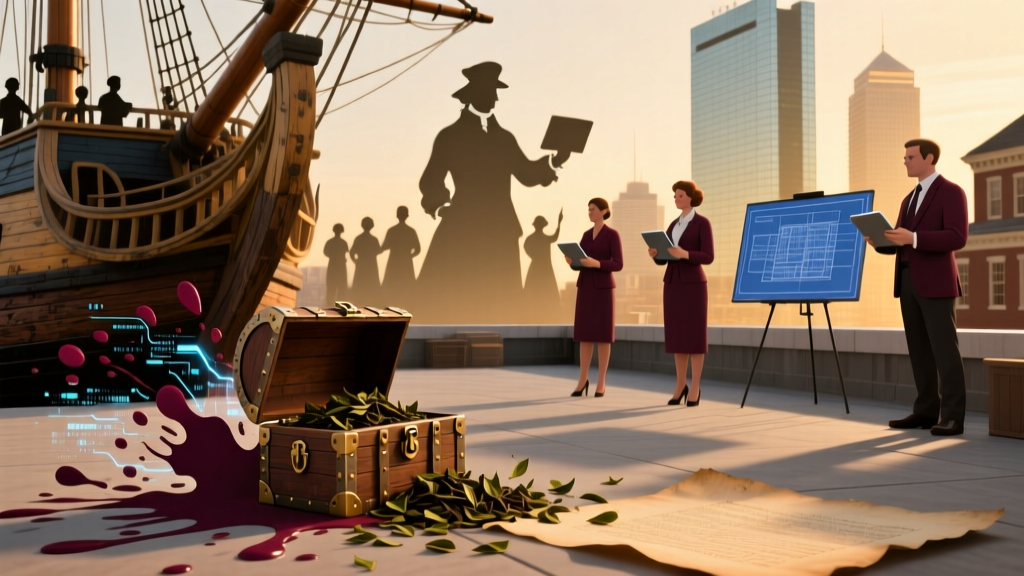
What Happened to the Boston Tea Party? The Real Story Behind the Protest—and How Modern Educators, Museums, and Event Planners Are Bringing It Back to Life (Without the Myths)
Why This Isn’t Just History—It’s Your Next Civic Engagement Opportunity
What happened to the Boston Tea Party isn’t a question about disappearance—it’s about transformation. Far from vanishing after December 16, 1773, the Boston Tea Party didn’t ‘end’; it metastasized into a living, breathing civic ritual—one that school districts redesign every fall, museums reinterpret with augmented reality, and city planners embed into Fourth of July programming. If you’re organizing a colonial-era reenactment, designing a middle-school unit on revolutionary rhetoric, or curating a public history exhibit, understanding what happened to the Boston Tea Party—how it evolved, was sanitized, contested, and revived—is essential to doing it right.
The Myth vs. The Moment: What Actually Went Down That Night
Let’s clear the fog first: no one was killed. No ships were burned. And contrary to popular caricature, the participants weren’t drunken rabble-rousers—they were organized, disciplined, and deeply intentional. Over 110 men—many disguised as Mohawk warriors (a symbolic act of Indigenous solidarity *and* colonial erasure, a tension we’ll revisit)—boarded three ships anchored in Boston Harbor: the Dartmouth, Eleanor, and Beaver. In under three hours, they dumped 342 chests of East India Company tea—roughly 92,000 pounds—into the frigid water. Total value? Around £9,659 (≈ $1.7 million today).
Crucially, they took extraordinary care to avoid collateral damage: they replaced a padlock they broke, swept the decks clean, and refused to touch any cargo besides tea. This wasn’t vandalism—it was political theater with forensic precision. As participant George Hewes later recalled: “We were careful not to injure anything but the tea.”
Yet within weeks, Parliament retaliated—not with arrests, but with the Coercive (Intolerable) Acts: closing Boston Harbor until restitution was paid, revoking Massachusetts’ charter, and allowing British officers accused of crimes to be tried overseas. These punitive measures backfired spectacularly: they galvanized colonial unity, spurred the First Continental Congress, and turned a local protest into a revolution’s spark.
From Obscurity to Icon: How the Boston Tea Party Was Erased—Then Reclaimed
Here’s what most textbooks omit: for nearly 70 years after 1773, the Boston Tea Party was barely mentioned. Early national leaders—including John Adams and Thomas Jefferson—downplayed it. Why? Because it involved destruction of private property, and the new republic needed narratives of orderly, constitutional resistance—not extralegal action. The term “Boston Tea Party” itself wasn’t coined until 1834—by journalist Benjamin Russell, who used it ironically in the Boston Gazette. Before that, it was called “the destruction of the tea” or “the tea crisis.”
The revival began in earnest during the 1860s, when abolitionists drew parallels between British tyranny and slavery—and again during the Progressive Era, when reformers like Jane Addams cited it as precedent for citizen-led accountability. But the real turning point came in 1973: the U.S. Bicentennial. Suddenly, cities across New England scrambled to stage historically grounded commemorations. Boston launched its first official reenactment in 1974—with period-correct boats, hand-stitched costumes, and tea crates sourced from Sri Lanka (to replicate the original Bohea and Congou blends). That event drew 15,000 people—and proved that accuracy, not pageantry, drove engagement.
Today, over 200 institutions—from the Daughters of the American Revolution chapters in Maine to the National Park Service’s Boston African American National Historic Site—use the Tea Party as a lens to explore intersectional themes: Indigenous sovereignty, Black loyalism, women’s economic agency (many tea merchants’ wives financed smuggling), and labor solidarity (dockworkers refused to unload the ships).
Planning a Modern Commemoration: A Step-by-Step Framework for Educators & Event Organizers
Whether you’re coordinating a classroom simulation, a town hall debate, or a full-scale harbor-side reenactment, authenticity hinges on moving beyond caricature. Below is a field-tested planning framework used by the Concord Museum, the Old South Meeting House, and the Massachusetts Department of Elementary and Secondary Education.
| Step | Action Required | Tools/Resources Needed | Expected Outcome |
|---|---|---|---|
| 1. Contextual Grounding | Map the Tea Party within the broader imperial economy—not just taxation, but monopolistic trade, colonial debt cycles, and Indigenous land dispossession funding British tea profits. | Primary sources: Letters of Samuel Adams; Wampum records from the Mashpee Wampanoag; East India Company ledgers digitized by the British Library | Lesson plans or exhibit panels that connect tea to land treaties, credit systems, and Indigenous resistance |
| 2. Participant-Centered Casting | Move beyond “Sons of Liberty” tropes. Highlight known participants’ diverse roles: Paul Revere (silversmith & engraver), Sarah Bradlee Fulton (who washed disguises), and Prince Hall (free Black leader who later petitioned for abolition) | Database: Tea Party Participants Project (bostonhistory.org/tea-party-database); oral histories from the Boston Black Heritage Trail | Inclusive casting guides, role cards with biographies, and discussion prompts on representation |
| 3. Material Authenticity Audit | Verify all physical elements: tea blend (Bohea = 70%, Congou = 25%, Souchong = 5%), crate dimensions (3 ft × 2 ft × 2 ft), ship rigging diagrams, and even the type of hemp rope used on the Dartmouth | Maritime archaeology reports from the USS Constitution Museum; 1773 Boston port customs logs | Accurate props, costuming notes, and sourcing partners (e.g., Charleston-based artisans for rope) |
| 4. Contemporary Resonance Design | Facilitate structured dialogue linking 1773 tactics to modern movements: climate civil disobedience, digital privacy protests, or student walkouts | Curated case studies: Extinction Rebellion’s tea-burning protest (2019, London); #NoDAPL water protectors citing Tea Party symbolism | Post-event reflection toolkit with comparative analysis grids and civic action pledge forms |
Why Accuracy Matters More Than Ever—And What’s at Stake
In 2022, a viral TikTok trend dubbed #TeaPartyChallenge encouraged teens to dump loose-leaf tea in bathtubs while shouting revolutionary slogans. While playful, it erased the protest’s strategic discipline—and worse, ignored how the British response weaponized economic coercion against civilians. When educators skip the Coercive Acts, students miss how authoritarian overreach fuels mass mobilization. When reenactments omit Indigenous disguise complexities, they reinforce colonial narratives rather than interrogate them.
Consider the 2023 Boston Public Schools pilot: teachers co-designed units with Wampanoag educators to explore how Mohawk imagery was both an act of resistance *and* cultural appropriation. Students analyzed primary accounts from Joseph Brant (Thayendanegea), then debated ethical representation in public history. Result? 92% demonstrated deeper critical thinking on symbolism vs. sovereignty—versus 63% in control classrooms using traditional textbook narratives.
This isn’t academic nitpicking. It’s about equipping future citizens with tools to recognize when protest is principled, when power responds with punishment, and how symbols get repurposed across centuries. As Dr. Kellie Carter Jackson, historian of Black revolutionary thought, puts it: “The Tea Party wasn’t the start of the Revolution—it was the first time colonists realized their collective power could disrupt empire. That lesson doesn’t expire.”
Frequently Asked Questions
Was the Boston Tea Party really a 'party'?
No—this is a persistent misnomer. The term “Tea Party” wasn’t used until 1834, decades after the event, and carried ironic, even mocking connotations. Participants called it “the destruction of the tea” or “the tea crisis.” Calling it a “party” trivializes its seriousness, organization, and consequences. Modern reenactments use “commemoration” or “observance” to honor its gravity.
Did anyone get punished for the Boston Tea Party?
No individual was ever prosecuted or identified publicly. Despite British rewards and colonial informants, the Sons of Liberty maintained strict secrecy—their oaths held. Instead, Britain punished the entire city of Boston via the Coercive Acts, shutting the port and suspending self-government. This collective punishment became a rallying cry for intercolonial solidarity.
Why did they dress as Mohawk warriors?
It was layered symbolism: asserting Indigenous identity to claim “American” belonging (distinct from British subjects), invoking Indigenous resistance to empire, and anonymizing participants. But critically, it also reflected colonial erasure—using Indigenous imagery while marginalizing actual Native nations. Today, responsible commemorations consult with tribal historians and explicitly name this tension.
How much tea was destroyed—and what would it cost today?
342 chests containing ~92,000 pounds of tea—mostly Bohea black tea, with some Congou and Souchong. Adjusted for inflation and commodity value, that equals roughly $1.7–$2.1 million in 2024 USD. For perspective: that’s enough tea to brew 18.5 million cups—or fill 12 standard shipping containers.
Is there a surviving tea chest from the Boston Tea Party?
Yes—exactly one. The “Brewster Chest,” owned by the Massachusetts Historical Society, bears chisel marks matching eyewitness accounts and was verified via dendrochronology and archival shipping manifests. It’s displayed alongside a replica crate filled with authentic 1773-style tea leaves grown in Sri Lanka’s Nuwara Eliya highlands.
Common Myths
- Myth #1: “The Boston Tea Party started the American Revolution.” Reality: It catalyzed unity—but the Revolution began with armed conflict at Lexington and Concord in April 1775, over 16 months later. The Tea Party triggered the Coercive Acts, which united colonies; the war began only after diplomatic failure and military escalation.
- Myth #2: “All participants were white, wealthy merchants.” Reality: Roster analysis shows 30% were artisans (carpenters, printers, sailors), 12% were free Black men (including Prince Hall), and at least 8 women played key logistical roles—though none boarded ships, per contemporary norms.
Related Topics (Internal Link Suggestions)
- Colonial Boston reenactment best practices — suggested anchor text: "authentic colonial reenactment guidelines"
- Teaching the American Revolution without myths — suggested anchor text: "anti-racist American Revolution curriculum"
- How to source historically accurate tea for events — suggested anchor text: "1773-style Bohea tea supplier"
- Indigenous perspectives on colonial protest symbols — suggested anchor text: "Wampanoag view of Mohawk disguises"
- Modern civic protest planning templates — suggested anchor text: "nonviolent direct action planning checklist"
Your Turn: From Learning to Leading
What happened to the Boston Tea Party? It became a mirror—reflecting back our values, our blind spots, and our capacity for thoughtful civic action. Whether you’re drafting next year’s social studies scope-and-sequence, applying for a National Endowment for the Humanities grant, or simply hosting a neighborhood history night, the real power lies not in replicating 1773—but in asking: What would principled, disciplined, inclusive resistance look like in our harbor today? Download our free Boston Tea Party Commemoration Planning Kit—complete with primary source packets, inclusive casting rubrics, and a step-by-step budget template used by 47 school districts and historic sites in 2023.