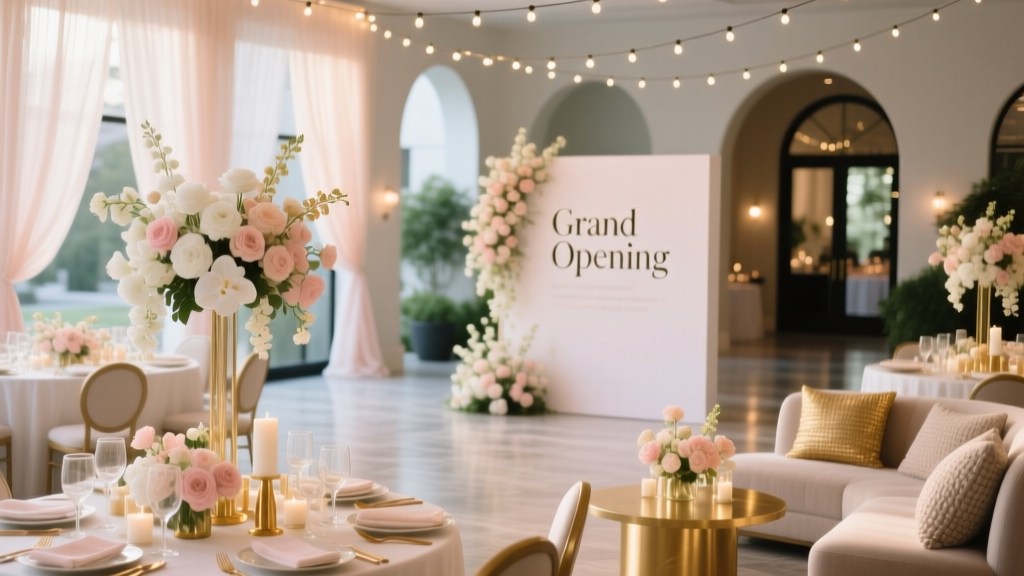
Top 25 Tips for a Grand Opening
A grand opening is more than a ribbon cutting—it’s a concentrated brand moment where first impressions turn into foot traffic, sales, press mentions, and long-term customers. Whether you’re launching a retail store, restaurant, salon, gym, medical office, studio, or service-based business, a well-coordinated grand opening helps you start strong and build local momentum quickly.
The difference between an “okay turnout” and a packed, high-energy launch usually comes down to event planning fundamentals: clear goals, a realistic timeline, tight vendor coordination, and a marketing plan that begins weeks ahead of the big day. When you plan with intention, you control the guest experience, reduce last-minute chaos, and create a share-worthy event people talk about afterward.
This guide breaks down 25 practical, proven tips for grand opening event planning—plus a step-by-step timeline, budget breakdown, vendor selection pointers, common mistakes to avoid, and a ready-to-use checklist to keep your party organization on track.
Set a Clear Strategy Before You Book Anything
1) Define your primary goal (and keep it measurable)
Choose one main objective and 2–3 supporting goals. Examples:
- Main goal: 200 attendees during a 3-hour window
- Supporting goals: 60 email sign-ups, 25 first-day purchases, 10 social posts tagged with your location
2) Identify your ideal audience
Grand openings work best when you plan for a specific crowd:
- Local neighbors and community groups
- Target customers (families, professionals, fitness enthusiasts, etc.)
- Business partners and referral sources
- Local media, bloggers, and micro-influencers
3) Choose the right format: open house vs. scheduled program
- Open house: Staggered flow, lower pressure, easier for small spaces
- Scheduled program: Ribbon cutting at a set time, better for press and photo moments
- Hybrid: Open house with one “peak moment” (ribbon cutting, demo, giveaway drawing)
4) Pick a date and time that match your customer behavior
Use real customer patterns and local context:
- Retail: weekends late morning to mid-afternoon
- Restaurants/cafes: soft-launch preview followed by peak hours
- Service businesses: weekday evening can capture after-work traffic
Check local calendars for competing events, school schedules, sports games, and seasonal weather.
Top 25 Tips for a Grand Opening (Practical and Proven)
5) Build your guest journey like a mini “experience map”
Sketch the path: entrance → welcome table → key product area → demo/tasting → photo spot → checkout/sign-up → exit with takeaway. This keeps your event planning focused on flow, not just decorations.
6) Create a simple theme tied to your brand
Skip generic themes if they don’t fit your identity. Use brand colors, signature products, or a local connection. Example: a skincare studio uses “Glow Launch Day” with bright lighting, mirrors, and a clean, modern palette.
7) Design a strong “moment” for photos and social sharing
Current event planning trends emphasize shareability:
- Branded backdrop with your logo and grand opening date
- Balloon garland or floral installation at the entrance
- Ring light station for quick selfies
8) Offer a limited-time grand opening incentive
- “First 50 guests receive…”
- Discount valid only that day (or within 7 days) to encourage return visits
- Bundle pricing that’s easy to understand
9) Collect emails and SMS—without making it awkward
Use a raffle entry, check-in QR code, or “spin-to-win” wheel. Keep it simple: name + email + opt-in permission.
10) Plan your staffing like a production
For smooth event coordination, assign roles:
- Greeter: welcomes and directs flow
- Host/MC: announcements and schedule
- Demo lead: product/service demonstrations
- Checkout lead: handles purchases and lines
- Floater: solves problems and refills supplies
11) Use timed entries or “soft windows” if your space is small
If you have limited capacity, offer RSVP time blocks (e.g., 11–12, 12–1). It improves guest comfort and protects the experience.
12) Partner with neighboring businesses
Cross-promotion boosts turnout fast. Examples:
- A new boutique partners with a local coffee cart
- A gym partners with a smoothie brand for samples
- A salon partners with a photographer for mini headshots
13) Bring the community in (Chamber of Commerce, local groups)
If relevant, coordinate a ribbon cutting with local business organizations and invite community leaders. It adds credibility and increases press potential.
14) Keep the menu simple and clean
Whether you’re serving bites, tastings, or beverages:
- Choose items that are easy to hold and low-mess
- Label allergens clearly
- Place trash bins where people naturally stop
15) Use music to set energy (and check licensing)
A curated playlist is fine for many settings, but confirm what’s required for public performance in your venue. Live acoustic sets can elevate the vibe if the space allows.
16) Make signage impossible to miss
- Sidewalk sign with arrows
- Welcome sign at the entrance
- Price lists and service menus readable from 6–10 feet away
- QR codes for booking, ordering, or joining your mailing list
17) Plan your lighting for photos
Good lighting is a modern must-have. Add soft, bright light near your photo area and key product displays.
18) Build a short program that respects attention spans
If you do speeches, keep it tight:
- Welcome (1 minute)
- Founder story and mission (2–3 minutes)
- Thank partners/community (1 minute)
- Ribbon cutting + photo moment (2 minutes)
19) Add one interactive element
- Live demo or mini workshop
- Tasting flight
- Try-it station (sample bar, mini service, product testing)
- “Meet the maker” Q&A
20) Create a prize giveaway that supports your business
Make the prize something that brings people back: a gift card, membership month, service package, or product bundle. Announce the winner after the event to keep engagement going.
21) Use a content plan (not random photos)
Assign someone to capture:
- Exterior and signage
- Guest arrivals and crowd shots
- Product/service action
- Ribbon cutting and reactions
- Testimonials (15–30 second clips)
22) Build a “wow” welcome table
- Branded tablecloth or signage
- Name tags (optional) and a simple check-in
- Flyers, menus, business cards
- Giveaway entry box or QR code
23) Have a backup plan for weather and technical issues
Even indoor events need contingencies: a tent for check-in, extra extension cords, backup speaker, and a plan if internet goes down.
24) Run a rehearsal (yes, even for small openings)
A 20-minute walk-through catches most problems: where lines form, how staff transitions between tasks, when announcements happen, and where VIPs stand for photos.
25) Follow up within 24–72 hours
Send:
- Thank-you email/SMS
- Offer reminder with a clear expiration date
- Links to book, buy, or review
- Photo recap to keep social proof growing
Step-by-Step Grand Opening Planning Timeline (with Checklist)
6–8 Weeks Before: Foundation and Bookings
- Set goals, budget, and event format
- Confirm date/time and any permits/insurance needs
- Book key vendors: catering/food, rentals, photographer, DJ/live music
- Design event branding: logo lockup, colors, signage plan
- Create your marketing plan (email, social, local listings, partners)
4–5 Weeks Before: Promotion and Partnerships
- Build RSVP page (or simple signup form) and tracking
- Contact Chamber of Commerce and local organizations for ribbon cutting
- Invite press/media and identify 5–10 local micro-influencers
- Plan your offer: discounts, bundles, giveaway prize and rules
- Order signage, flyers, and branded materials
2–3 Weeks Before: Logistics and Guest Experience
- Create floor plan: check-in, demo areas, food/beverage stations, photo spot
- Confirm staffing schedule and role assignments
- Plan music and announcements
- Finalize menu and dietary labels
- Order supplies: trash bags, sanitizer, napkins, extension cords, tape, pens
1 Week Before: Final Confirmations
- Confirm all vendor arrival times and loading instructions
- Print check-in list (if needed) and prep QR codes
- Prepare giveaway entries and winner selection process
- Schedule social posts and reminder emails
- Run a walk-through with staff
Day Before: Setup and Rehearsal
- Set up signage, photo area, and welcome table
- Prep a cash drawer/checkout station and test card readers
- Charge devices (phones, tablets, speaker, camera)
- Pack an event kit: scissors, tape, batteries, first aid, stain remover
Event Day: Execution Checklist
- Vendor check-in and load-in supervision
- Test music, mic (if used), and lighting
- Staff huddle: timeline, roles, escalation plan
- Open check-in and start guest flow
- Announcements and scheduled “moment” (ribbon cutting, demo, giveaway)
- Capture content and collect leads
- Close-out: final sales push, cleanup, vendor checkout
1–3 Days After: Follow-Up and ROI
- Send thank-you message + offer
- Post photo recap and tag partners/vendors
- Request reviews (Google, Yelp, industry platforms)
- Track results: attendance, leads, sales, bookings, reach
Budget Considerations (Sample Breakdown)
Your grand opening budget should match your expected ROI and business type. Here are common event planning expense categories and a practical starting point for allocation:
- Food & beverage (25–35%): bites, tastings, beverages, serving items
- Marketing & signage (15–25%): flyers, banners, paid social, local ads, printing
- Decor & rentals (10–20%): balloons/florals, tables, linens, stanchions, lighting
- Photo/video (10–20%): photographer, short highlight reel for future promotions
- Entertainment (5–15%): DJ, musician, emcee
- Staffing & operations (5–15%): extra help, security (if needed), cleaning
- Contingency (5–10%): weather backup, last-minute supplies
Real-world example: A new boutique plans a $2,500 grand opening.
- Food & beverage: $750 (sparkling drinks + bite-size catering)
- Marketing & signage: $500 (banner + postcards + boosted local posts)
- Decor & rentals: $350 (balloon garland + entry mat + tabletop displays)
- Photo/video: $450 (2-hour photographer)
- Entertainment: $150 (curated playlist + small speaker upgrade)
- Staffing/ops: $150 (extra associate for checkout)
- Contingency: $150
Vendor Selection Tips for Smooth Event Coordination
- Ask for “grand opening” experience: Vendors who understand tight timelines and high guest flow prevent bottlenecks.
- Confirm what’s included: Setup/breakdown, serving staff, delivery fees, overtime rates, power needs.
- Request a single point of contact: One person responsible for day-of communication reduces confusion.
- Read reviews for reliability: Focus on punctuality, professionalism, and problem-solving—not just aesthetics.
- Get everything in writing: Arrival time, load-in instructions, payment schedule, cancellation terms.
Common Grand Opening Planning Mistakes to Avoid
- Starting promotion too late: Successful party organization begins marketing 4–6 weeks out, with reminders in the final 7 days.
- No lead capture plan: A packed event without email/SMS collection makes it hard to convert interest into repeat customers.
- Overcomplicated program: Too many speeches or activities slows guest flow and hurts energy.
- Understaffing the welcome table and checkout: Long lines are one of the fastest ways to lose sales and excitement.
- Ignoring parking and wayfinding: If guests can’t easily arrive, they won’t stay long (or they’ll leave before entering).
- Skipping a contingency plan: Weather, tech issues, and supply shortages happen—plan for them.
FAQ: Grand Opening Event Planning
How long should a grand opening event last?
Most grand openings work well in a 2–4 hour window. If you expect steady traffic, use an open house format with one scheduled highlight moment (like a ribbon cutting) to concentrate energy and photos.
Do I need RSVPs for a grand opening?
RSVPs are helpful for planning staffing and food, but not always required. If your space is small or you need controlled capacity, use RSVP time blocks. If you want walk-in traffic, keep it open but still offer an optional RSVP for perks.
What should I serve at a grand opening?
Choose bite-size, low-mess foods and easy drinks. Consider dietary labels and allergens. If you’re a food business, samples of your signature item are often the best “marketing” you can offer.
How do I get local press or influencers to attend?
Invite them early, give a clear reason to cover it (community benefit, unique offering, founder story), and provide a defined photo moment. Micro-influencers often respond well to a preview time or a small hosted experience.
What’s the best way to measure success?
Track attendance, sales/bookings, email/SMS sign-ups, social reach (tags/mentions), and review growth. Compare results to your goals and note what drove the highest engagement for future events.
Actionable Next Steps
- Pick your primary goal and write it down with a number and deadline.
- Choose your event format (open house, scheduled program, or hybrid).
- Build your 6–8 week timeline and book your key vendors first.
- Create a simple floor plan that supports flow: welcome → experience → sign-up/sale → exit.
- Finalize your offer and lead capture plan so the excitement turns into repeat business.
For more step-by-step event planning, party organization checklists, vendor coordination tips, and grand opening ideas, explore the latest guides on smartpartyprep.com.
More Articles
 How to Start a Party Planner Business Without Experience, Debt, or a Single Client: A Realistic 7-Step Launch Plan That Got Sarah $12k in Revenue by Month 3
How to Change Political Party Affiliation in Maryland in 2024: A Step-by-Step Guide That Takes Less Than 5 Minutes (No Mail, No Wait, No Mistakes)
How Did the Boston Tea Party Influence the American Revolution? The 5 Unspoken Catalysts That Transformed Protest Into War — And Why Most Textbooks Get It Wrong
What Does a Political Party Leader Do? The 7 Non-Negotiable Responsibilities No One Talks About (But Every Voter Should Know)
How to Start a Party Planner Business Without Experience, Debt, or a Single Client: A Realistic 7-Step Launch Plan That Got Sarah $12k in Revenue by Month 3
How to Change Political Party Affiliation in Maryland in 2024: A Step-by-Step Guide That Takes Less Than 5 Minutes (No Mail, No Wait, No Mistakes)
How Did the Boston Tea Party Influence the American Revolution? The 5 Unspoken Catalysts That Transformed Protest Into War — And Why Most Textbooks Get It Wrong
What Does a Political Party Leader Do? The 7 Non-Negotiable Responsibilities No One Talks About (But Every Voter Should Know)
 How to Change Your Political Party NY: A Step-by-Step Guide That Takes Less Than 10 Minutes (and Avoids Disqualification from Primary Voting)