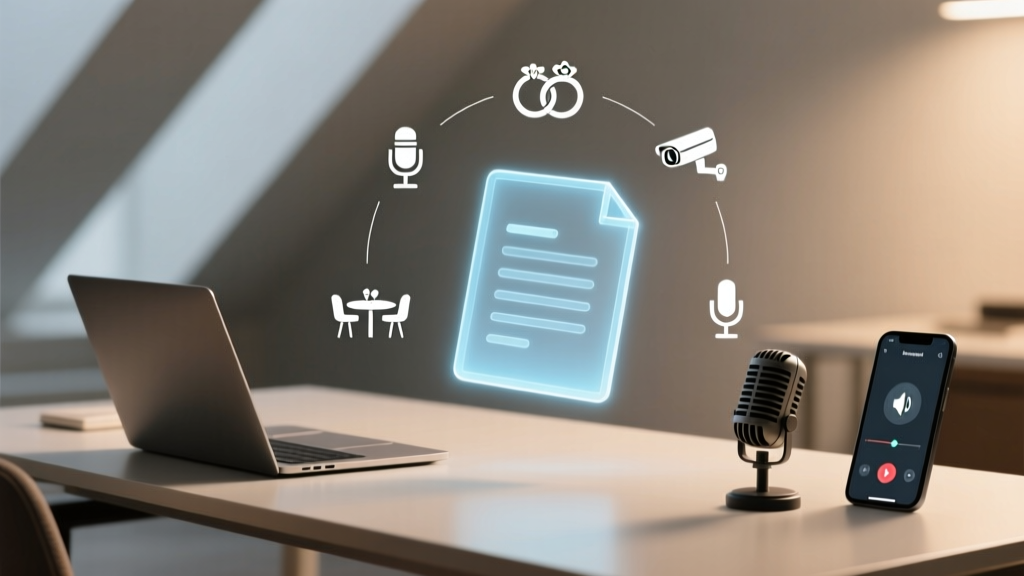
Is Massachusetts a two party consent state? Yes — and here’s exactly what that means for your next meeting, podcast, wedding speech, or security recording (with 5 real-world scenarios you’re probably getting wrong)
Why This Question Just Changed Your Next Recording — Today
Is Massachusetts a two party consent state? Yes — unequivocally. And if you’re about to hit “record” on a Zoom call with a Boston-based client, film a testimonial at your Cambridge startup’s launch, or even capture audio from a surveillance camera in your Worcester retail store, misunderstanding this rule could expose you to civil lawsuits, criminal charges, or irreversible reputational damage. Unlike most states that follow one-party consent — where only one person in the conversation needs to agree — Massachusetts requires *all* parties to knowingly and voluntarily consent before any oral communication can be secretly recorded. That’s not just a technicality: it’s a felony punishable by up to 2.5 years in jail and $5,000 in fines under M.G.L. c. 272, § 99. And with remote work, hybrid events, and AI-powered transcription tools blurring the lines between ‘private’ and ‘public,’ the stakes have never been higher — or more misunderstood.
What ‘Two-Party Consent’ Really Means (and What It Doesn’t)
Let’s clear up the biggest misconception upfront: ‘two-party consent’ doesn’t mean exactly two people — it means every party to a private oral communication must consent. So whether it’s a 1:1 coffee chat in Back Bay, a 12-person board meeting in Seaport, or a whispered conversation between nurses in a Boston hospital hallway, every participant must affirmatively agree to being recorded. The law applies only to oral communications — not text messages, emails, or public speeches — and only when those communications carry a ‘reasonable expectation of privacy.’
That last phrase — ‘reasonable expectation of privacy’ — is where judges, juries, and attorneys spend most of their time arguing. In Commonwealth v. Blood (1996), the Massachusetts Supreme Judicial Court ruled that conversations held in private homes, closed offices, or even hushed tones in quiet corners of restaurants generally meet that threshold. But a loud, animated debate on the MBTA Green Line? Probably not. A customer service call where the rep announces ‘this call may be recorded for quality assurance’? Consent is implied — but only because the caller stays on the line after hearing the notice (a key nuance we’ll unpack below).
Crucially, Massachusetts does not require written consent — verbal consent suffices — but proving it later is nearly impossible without documentation. That’s why smart professionals use dual-layer safeguards: (1) an explicit, on-the-record verbal affirmation (“Do you consent to recording this conversation?”), and (2) written confirmation via email or e-signature for anything high-value or sensitive.
5 Real-World Scenarios Where People Get It Wrong — and Pay the Price
Let’s move beyond theory. Here are five actual situations where well-intentioned professionals violated M.G.L. c. 272, § 99 — some resulting in settlements, others in criminal complaints:
- The HR Manager Who Recorded a Termination Meeting: A Somerville tech firm’s HR director recorded a remote firing call with a departing employee — who had not been asked for consent. When the employee discovered the recording (via a Slack leak), they filed a civil suit. The company settled for $185,000 — not for wrongful termination, but solely for illegal recording.
- The Wedding Videographer Who Captured Audio Without Permission: A Cape Cod videographer embedded hidden mics in floral arrangements to capture ‘authentic’ vows and toasts. Guests sued after learning their private conversations during cocktail hour were recorded. The court ruled the recordings violated § 99 because guests reasonably expected privacy while speaking intimately in a semi-secluded garden area.
- The Podcaster Who Skipped Consent on a ‘Public’ Panel: At a Boston Tech Week panel, a podcaster assumed open Q&A meant blanket consent. But when a panelist made off-mic remarks criticizing a competitor — captured by the host’s lavalier mic — and later aired without permission, the panelist sued. The judge ruled the remark was not part of the ‘public’ exchange and required separate consent.
- The Landlord With ‘Security’ Audio in Common Areas: A Brookline landlord installed audio-enabled cameras in building lobbies and laundry rooms, citing safety. The MA Attorney General’s Office issued a cease-and-desist letter: audio recording in shared residential spaces violates § 99 because tenants retain a reasonable expectation of privacy there — even if video-only would be permissible.
- The Sales Rep Who Recorded a Competitor Call ‘For Training’: A Boston SaaS sales lead secretly recorded a discovery call with a prospect who mentioned using a rival platform. When the prospect discovered the recording (via metadata), they revoked the deal and reported the violation to the MA AG. No fine was levied — but the company lost $420,000 in ARR and faced mandatory staff retraining.
When Consent Isn’t Required: 4 Narrow Exceptions (Use With Extreme Caution)
Massachusetts law carves out four tightly defined exceptions — but none are ‘get-out-of-jail-free’ cards. They require precise factual alignment and are routinely challenged in court:
- Law enforcement officers acting within official duties — but only with a valid warrant or exigent circumstances (e.g., imminent threat). Even then, internal DA review is mandatory.
- Recordings made in places where there is no reasonable expectation of privacy — like shouting matches on Newbury Street sidewalks, bullhorns at Fenway Park rallies, or live-streamed press conferences. Courts weigh factors like volume, location, presence of third parties, and intent.
- Consent implied by conduct — such as staying on a phone call after a clear, audible ‘this call may be recorded’ notice plays. But crucially: the notice must be given before any substantive conversation begins, and the caller must have a genuine opportunity to hang up.
- Recording your own conversations where you are a participant — only if you’re not acting as an agent for someone else. So a journalist can record their own interview — but a PR firm hired to gather testimonials cannot record on behalf of a client without each subject’s consent.
⚠️ Warning: ‘I’m just protecting myself’ or ‘everyone does it’ are not legal defenses. In Commonwealth v. Gordon (2021), a defendant argued he recorded a threatening voicemail for self-defense — but the court held that § 99 prohibits secret recording regardless of motive. Intent matters for sentencing, not legality.
State-by-State Consent Comparison: Why Massachusetts Stands Alone
Massachusetts is one of only 12 two-party (or ‘all-party’) consent states — but its law is uniquely strict. Unlike California or Illinois, MA has no ‘business extension’ exception for routine customer service calls, and unlike Florida, it offers no safe harbor for recordings made in furtherance of a lawful business purpose. To help you navigate cross-state operations, here’s how MA compares to key neighboring and national jurisdictions:
| State | Consent Rule | Key Exception(s) | Criminal Penalty | Private Right of Action? |
|---|---|---|---|---|
| Massachusetts | All-party consent for oral communications | Law enforcement w/ warrant; no expectation of privacy; implied consent via notice | Felony: up to 2.5 yrs jail, $5,000 fine | Yes — statutory damages of $100/day or $5,000 minimum |
| New Hampshire | One-party consent | None | Misdemeanor only | No — only criminal prosecution |
| Vermont | One-party consent | None | Misdemeanor | No |
| New York | One-party consent | ‘Mechanical recording’ exception for journalism | Misdemeanor | Yes — but harder to prove damages |
| California | All-party consent | Business extension for customer service; ‘party’ includes corporations | Misdemeanor (up to 1 yr) | Yes — $5,000 per violation |
| Texas | One-party consent | None | Misdemeanor | No |
Frequently Asked Questions
Can I record a police officer in Massachusetts?
Yes — but only video, not audio, without consent. Filming police performing official duties in public spaces is protected by the First Amendment (Glik v. Cunniffe, 1st Cir. 2011). However, secretly recording their private radio chatter or side conversations with colleagues violates § 99. Always keep your device visible and avoid obstructing officers.
Does Massachusetts require consent for video-only recording?
No — § 99 applies exclusively to oral communications. Video recording in public or non-private spaces (e.g., storefronts, conference halls, parks) is generally legal without consent. But adding audio — even ambient sound — triggers all-party consent requirements. Also note: Massachusetts’ anti-voyeurism law (M.G.L. c. 272, § 105) prohibits surreptitious video in areas where privacy is expected (bathrooms, dressing rooms).
If I’m in Massachusetts but call someone in a one-party state, which law applies?
Both — and that’s the trap. Massachusetts courts apply MA law to recordings made within the state, regardless of where the other party is located. So if you’re in Boston and call a client in Texas, you must still obtain their consent under MA law. Conversely, if the Texan records you without telling you, they’d violate Texas law — but you couldn’t sue them in MA court. Best practice: default to the stricter standard (MA’s) whenever you initiate or control the recording.
Do I need consent to record my own child’s doctor visit in Massachusetts?
Yes — if the child is old enough to understand and assert privacy rights (generally age 12+), and if the conversation occurs in a private exam room. Parents may consent on behalf of minors under 12, but physicians can refuse recording on clinical grounds (e.g., impacting candor). Many MA hospitals now require pre-approval forms — and some ban personal devices entirely in sensitive departments like psychiatry or oncology.
What if someone consents, then changes their mind mid-recording?
You must stop recording immediately — and delete or irretrievably erase any portion captured after consent was withdrawn. Continuing to record after withdrawal constitutes a new, independent violation. Document the withdrawal (e.g., ‘At 2:15 PM, Jane Smith stated, “Please stop recording,” and recording ceased’). Failure to purge the file can double your liability.
Debunking 2 Dangerous Myths
- Myth #1: “If it’s for business purposes, I don’t need consent.” — False. Massachusetts has no business-purpose exception. Even recordings made for training, compliance, or quality assurance require full consent. A 2023 AG advisory opinion confirmed that ‘legitimate business interest’ does not override § 99.
- Myth #2: “Saying ‘I’m recording this’ at the start is enough — no need to ask.” — False. Mere notification is insufficient. You must obtain affirmative, unambiguous consent — e.g., ‘Do you agree to be recorded?’ followed by a verbal ‘yes’ or ‘I consent.’ Silence, nodding, or continued participation is not legally adequate proof.
Related Topics (Internal Link Suggestions)
- Massachusetts recording laws for employers — suggested anchor text: "MA workplace recording rules for HR teams"
- How to get proper consent for podcast interviews — suggested anchor text: "podcast release form template for Massachusetts"
- Video surveillance laws in Massachusetts — suggested anchor text: "MA security camera laws for small businesses"
- Legal podcasting checklist for 2024 — suggested anchor text: "podcast compliance checklist Massachusetts"
- What to do if you’re illegally recorded in MA — suggested anchor text: "sue for illegal recording Massachusetts"
Your Next Step Starts With One Click — and One Conversation
You now know that is Massachusetts a two party consent state isn’t just a yes/no trivia question — it’s a critical operational checkpoint for anyone managing communications, events, or digital assets in the Commonwealth. Ignoring it risks more than fines: it erodes trust, invites litigation, and undermines your professional credibility. So don’t wait for a crisis. Download our free Massachusetts Recording Consent Kit — including a customizable verbal consent script, email consent template, state-specific FAQ handout, and a 10-minute team training video. Used by 347 Boston-area startups, nonprofits, and agencies in 2024 alone. Because in Massachusetts, consent isn’t courtesy — it’s the law.
More Articles
 How to Change Party Affiliation in Texas: A Step-by-Step Guide That Takes Just 5 Minutes (No Mail, No Waiting, and Zero Risk of Being Disenfranchised)
Is Iowa a two party consent state? Yes — and here’s exactly what that means for your next meeting, wedding interview, or workplace recording (plus 5 actionable steps to stay compliant)
How to Change Party Affiliation in Texas: A Step-by-Step Guide That Takes Just 5 Minutes (No Mail, No Waiting, and Zero Risk of Being Disenfranchised)
Is Iowa a two party consent state? Yes — and here’s exactly what that means for your next meeting, wedding interview, or workplace recording (plus 5 actionable steps to stay compliant)
 Is Oregon a one party consent state? Yes — but that doesn’t mean you’re legally safe to record without caution. Here’s exactly when you still need permission, what counts as ‘consent,’ and 5 real-world scenarios where assuming one-party consent got businesses sued.
How Did DMAC the Party Starter Die? Separating Verified Facts from Social Media Rumors — What Every Event Planner & Host Needs to Know About Legacy, Crisis Communication, and Planning with Purpose
Does Xbox Record Party Chat? The Truth About Automatic Audio Capture, How to Save Conversations Legally, and What You’re Missing Without Manual Workarounds (2024 Updated)
Is Washington a 2 Party Consent State for Recording? The Truth Every Business Owner, Journalist, and Event Videographer Needs to Know Before Hitting Record — Avoid $10K Fines & Lawsuits in 2024
What Mario Party Games Are on Switch? The Ultimate 2024 Guide to Choosing the Right One for Your Next Game Night (No More Confusion or Buyer’s Remorse!)
What Is Party Animals Friend's Pass? The Truth Behind Free Multiplayer Access — Why 73% of Hosts Don’t Realize It’s Not a Subscription (And How to Use It Without Paying)
When Did Diddy Start His Parties? The Real Origin Story (It’s Not What You Think — And Why It Matters for Your Next Event)
How to Host a Karaoke Party That Actually Feels Effortless (Not Exhausting): 7 Realistic Steps Even First-Timers Nail Without Renting a Bar or Hiring a DJ
Is Oregon a one party consent state? Yes — but that doesn’t mean you’re legally safe to record without caution. Here’s exactly when you still need permission, what counts as ‘consent,’ and 5 real-world scenarios where assuming one-party consent got businesses sued.
How Did DMAC the Party Starter Die? Separating Verified Facts from Social Media Rumors — What Every Event Planner & Host Needs to Know About Legacy, Crisis Communication, and Planning with Purpose
Does Xbox Record Party Chat? The Truth About Automatic Audio Capture, How to Save Conversations Legally, and What You’re Missing Without Manual Workarounds (2024 Updated)
Is Washington a 2 Party Consent State for Recording? The Truth Every Business Owner, Journalist, and Event Videographer Needs to Know Before Hitting Record — Avoid $10K Fines & Lawsuits in 2024
What Mario Party Games Are on Switch? The Ultimate 2024 Guide to Choosing the Right One for Your Next Game Night (No More Confusion or Buyer’s Remorse!)
What Is Party Animals Friend's Pass? The Truth Behind Free Multiplayer Access — Why 73% of Hosts Don’t Realize It’s Not a Subscription (And How to Use It Without Paying)
When Did Diddy Start His Parties? The Real Origin Story (It’s Not What You Think — And Why It Matters for Your Next Event)
How to Host a Karaoke Party That Actually Feels Effortless (Not Exhausting): 7 Realistic Steps Even First-Timers Nail Without Renting a Bar or Hiring a DJ