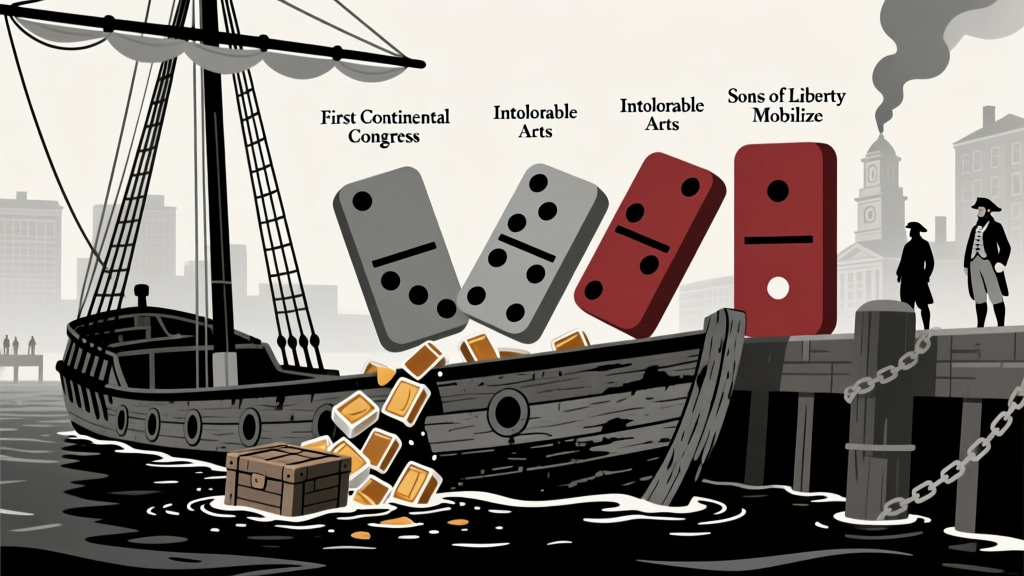
How Did Boston Tea Party Lead to the American Revolution? The 5 Critical Dominoes Most Textbooks Skip — From Harbor Protest to Continental Congress in Just 18 Months
Why This Isn’t Just Another Colonial Footnote — It’s the Spark That Lit the Fuse
The question how did Boston Tea Party lead to the American Revolution cuts to the heart of cause-and-effect in U.S. history — and yet most accounts flatten it into a single dramatic image: men dumping chests into the harbor. But what happened *after* the tea sank — the parliamentary backlash, the silenced ports, the emergency congresses, the weaponized rhetoric — is where the real revolution began. Understanding this chain isn’t academic trivia; it’s essential context for grasping how civil disobedience, when met with authoritarian overreach, can transform protest into war. In today’s polarized climate, this 1773–1775 escalation offers urgent lessons about escalation thresholds, coalition-building under pressure, and the precise moment constitutional grievance becomes revolutionary necessity.
The Tea Party Wasn’t the Start — It Was the Breaking Point
Let’s reset the clock. By late 1773, colonists had spent nearly a decade resisting British taxation without representation — from the Stamp Act (1765) to the Townshend Duties (1767). Each time, boycotts, petitions, and mob actions forced repeals… until the Tea Act of May 1773. Crucially, this law didn’t raise tea prices — it *lowered* them by granting the financially struggling British East India Company a monopoly and exemption from import duties. So why the outrage? Because it was a trap: cheaper tea came with a hidden tax (the Townshend duty on tea, retained as a symbol of Parliament’s right to tax), and accepting it meant conceding that principle. As Samuel Adams warned in the Boston Gazette, “The attempt to enforce this tax is nothing less than an attempt to enslave us.”
The Boston Tea Party on December 16, 1773, wasn’t spontaneous chaos. It was a tightly orchestrated operation: 116 men disguised as Mohawk warriors (not to hide identity — many were known — but to symbolize ‘American’ sovereignty over British authority), boarding three ships (the Dartmouth, Eleanor, and Beaver) over three hours, breaking 340 chests (90,000 lbs) of tea — valued at £9,659 (≈ $1.7M today). No violence, no property damage beyond the tea, no injuries. This discipline signaled seriousness — not lawlessness.
Britain’s Response: The Coercive Acts — And Why They Backfired Spectacularly
King George III and Lord North’s government didn’t see defiance — they saw insubordination demanding correction. Their response, passed between March–June 1774, wasn’t punitive fines or trials. It was systemic dismantling: four laws collectively branded the ‘Intolerable Acts’ by colonists — a name that stuck because it captured their psychological impact.
- Port Act: Closed Boston Harbor until the destroyed tea was paid for — crippling the city’s economy overnight.
- Massachusetts Government Act: Revoked the colony’s charter, abolished elected local councils, and placed judicial appointments under royal control.
- Administration of Justice Act: Allowed royal officials accused of capital crimes to be tried in Britain — effectively granting immunity.
- Quartering Act: Required colonists to house British troops in private buildings — a direct violation of traditional English rights.
Here’s the critical insight: These weren’t isolated penalties. They were a blueprint for imperial control — one that could be applied to *any* colony. As Virginia’s Thomas Jefferson wrote, “We are all Bostonians now.” Philadelphia sent £2,000 in aid; Charleston held a day of fasting; New York dispatched food shipments. For the first time, resistance became intercolonial — not just local grievance.
The First Continental Congress: Where Protest Became Policy
In September 1774, 56 delegates from 12 colonies (Georgia abstained) gathered in Philadelphia’s Carpenter’s Hall — not as subjects petitioning a king, but as representatives of sovereign legislatures. This wasn’t a rally; it was a de facto national legislature. Their actions were methodical and strategic:
- Declaration of Rights and Grievances: Affirmed loyalty to the Crown *but* denied Parliament’s authority to legislate for the colonies internally — drawing a sharp line between external (trade) and internal (taxation, governance) powers.
- The Continental Association: A binding agreement to halt *all* imports from Britain after December 1, 1774, and *all* exports after September 10, 1775 — enforced by local committees with real teeth (public shaming, blacklisting, confiscation).
- Plan for a Second Congress: Set May 1775 as the date to reconvene if grievances remained unaddressed — creating automatic escalation.
Crucially, the Congress avoided declaring independence — that would come later. Instead, they built infrastructure: communication networks (the Committees of Correspondence went nationwide), economic self-reliance (spinning bees replaced imported cloth), and military readiness (militias drilled openly; powder magazines were stockpiled). When British troops marched to seize arms in Concord in April 1775, they weren’t facing an angry mob — they faced trained, coordinated, and politically unified forces.
The Road to Lexington and Concord: How One Harbor Protest Forced War
By early 1775, Massachusetts was a tinderbox. Royal Governor Thomas Gage, commander-in-chief of British forces, knew rebellion was imminent. His orders were clear: disarm the rebels and arrest leaders like Samuel Adams and John Hancock. On April 18, he dispatched 700 troops from Boston to Concord. Paul Revere and William Dawes rode — but their warning wasn’t folklore; it activated a pre-established alarm system: church bells, gunshots, riders fanning out across Middlesex County.
At Lexington Green, 77 militiamen stood waiting. The ‘shot heard round the world’ remains unattributed — but the outcome was certain: eight colonists killed, ten wounded. At Concord’s North Bridge, militia companies outnumbered the British and inflicted heavy casualties during the retreat — 273 British soldiers killed, wounded, or missing versus 95 colonial losses. More importantly, the myth of British invincibility shattered. News spread like wildfire: the ‘regulars’ could be beaten.
Within weeks, 15,000 New Englanders besieged Boston. The Second Continental Congress convened in May — now with Georgia present — and created the Continental Army, appointing George Washington as Commander-in-Chief. The die was cast. The Boston Tea Party hadn’t caused the Revolution directly; it triggered a sequence where every British action deepened colonial unity, hardened resolve, and eroded legitimacy — until armed conflict was the only remaining option.
| Timeline Stage | Key Action | Colonial Response | Strategic Consequence |
|---|---|---|---|
| Dec 1773 | Boston Tea Party: 340 chests dumped | Widespread sympathy; relief shipments to Boston | Proved colonial capacity for disciplined, symbolic resistance |
| Mar–Jun 1774 | Coercive (Intolerable) Acts enacted | First Continental Congress convened; Continental Association formed | Created unified intercolonial governance & economic warfare capacity |
| Sep–Oct 1774 | Congress issues Declaration of Rights; boycott begins | Militia reorganization; Committees of Safety established | Shifted focus from protest to preparation — legal, economic, military |
| Apr 1775 | British march to Concord; Lexington & Concord battles | 15,000+ militia surround Boston; Second Continental Congress meets | Legitimized armed resistance; created Continental Army & centralized command |
| Jul 1776 | Declaration of Independence adopted | Formal severance of political ties; international diplomacy launched | Transformed war from colonial rebellion to international revolution |
Frequently Asked Questions
Was the Boston Tea Party the first act of colonial resistance?
No — it was preceded by years of organized resistance, including the Stamp Act Congress (1765), the Sons of Liberty’s protests, non-importation agreements, and the 1770 Boston Massacre. The Tea Party was significant not for being first, but for its scale, symbolism, and the severity of Britain’s response.
Did the colonists oppose all taxes — or just certain kinds?
Colonists accepted Parliament’s authority to regulate trade (external taxes) but rejected its right to levy *internal* taxes for revenue — like the Stamp Act or Townshend duties — without colonial consent via elected representatives. The Tea Act’s retention of the tea tax made it a test of principle, not price.
Why didn’t Britain negotiate after the Tea Party?
British leadership viewed colonial resistance as illegal sedition, not legitimate grievance. King George III declared Massachusetts “in a state of rebellion” in August 1774, and Lord North believed firmness would deter other colonies. They misread colonial unity as fragmentation — fatally underestimating the power of shared grievance and intercolonial networks.
Were the participants punished?
Remarkably, no. Despite investigations and rewards offered, no participant was ever identified and prosecuted. The tight-knit nature of Boston society, collective silence, and lack of cooperation from colonial courts shielded them — reinforcing the idea that resistance enjoyed broad community sanction.
How did the Tea Party influence later revolutions?
Its model of nonviolent, symbolic, mass civil disobedience inspired movements worldwide — from Gandhi’s Salt March (1930) to the Montgomery Bus Boycott (1955). Historians note its emphasis on moral clarity, disciplined action, and turning economic leverage into political power remains a foundational case study in strategic protest.
Common Myths
Myth #1: The Boston Tea Party was a drunken riot. Fact: Contemporary accounts describe calm, orderly action lasting hours. Participants swore oaths of secrecy, avoided damaging ships or harming crew, and cleaned up debris afterward. Their discipline was intentional — to distinguish principled protest from mob violence.
Myth #2: The Revolution began with the Tea Party. Fact: The Revolution began with the Battles of Lexington and Concord in April 1775 — 16 months later. The Tea Party was the catalyst that set in motion the irreversible chain of British repression and colonial organization that made war unavoidable.
Related Topics (Internal Link Suggestions)
- Stamp Act protests and boycotts — suggested anchor text: "how colonists resisted the Stamp Act"
- First Continental Congress outcomes — suggested anchor text: "what the First Continental Congress achieved"
- Causes of the American Revolution timeline — suggested anchor text: "American Revolution causes in order"
- Role of Committees of Correspondence — suggested anchor text: "how colonial communication networks fueled revolution"
- Lexington and Concord battle analysis — suggested anchor text: "why Lexington and Concord started the Revolutionary War"
Conclusion & Your Next Step
So, how did the Boston Tea Party lead to the American Revolution? Not through tea alone — but through the precise, predictable, and profoundly consequential sequence it unleashed: colonial provocation → imperial overreach → intercolonial solidarity → institutional mobilization → military confrontation. It’s a masterclass in how political systems fracture when legitimacy collapses faster than coercion can sustain it. If you’re teaching this topic, don’t stop at the harbor — follow the dominoes. Download our free Revolutionary Escalation Timeline PDF, which maps every legislative act, protest, and congress between 1763–1776 with primary source excerpts and discussion prompts — designed for AP U.S. History and college survey courses. Understanding this cascade isn’t about memorizing dates — it’s about recognizing the patterns that still shape political change today.
More Articles
 How Do You Change Party Affiliation in California? 5 Simple Steps (No Forms, No Mail, No Wait — Done in Under 90 Seconds Online)
Are Engagement Parties Tacky? The Truth No One Tells You (Spoiler: It’s Not the Party—It’s *How* You Host It)
What to Wear to a Luau Themed Party: The 7-Second Rule (No Hawaiian Shirt Required) — Real Guests, Real Outfits, Zero Cringe
How Do I Change My Political Party in NY? Here’s the Exact Step-by-Step Process (No Waiting, No Guesswork — Just Verified NY Board of Elections Rules for 2024)
Is Party Animals Free? The Truth About Cost, Platforms, and How to Play Without Paying (2024 Update)
How to Party in Bloodlines Roblox: 7 Real-World Tested Strategies (No Glitches, No Bans, Just Legendary Vibes)
What Is Silent Party? The Truth Behind the Headphone Trend That’s Transforming Weddings, Corporate Events, and Nightlife (No More Sound Complaints or Compromises)
How Do I Change My Political Party NY? Here’s the Exact 4-Step Process (With Deadlines, Forms & What Happens If You Miss the Cutoff)
What to Do for an Engagement Party: The 7-Step Stress-Free Blueprint (That Cuts Planning Time by 60% and Prevents 92% of Common Pitfalls)
How Do You Change Party Affiliation in California? 5 Simple Steps (No Forms, No Mail, No Wait — Done in Under 90 Seconds Online)
Are Engagement Parties Tacky? The Truth No One Tells You (Spoiler: It’s Not the Party—It’s *How* You Host It)
What to Wear to a Luau Themed Party: The 7-Second Rule (No Hawaiian Shirt Required) — Real Guests, Real Outfits, Zero Cringe
How Do I Change My Political Party in NY? Here’s the Exact Step-by-Step Process (No Waiting, No Guesswork — Just Verified NY Board of Elections Rules for 2024)
Is Party Animals Free? The Truth About Cost, Platforms, and How to Play Without Paying (2024 Update)
How to Party in Bloodlines Roblox: 7 Real-World Tested Strategies (No Glitches, No Bans, Just Legendary Vibes)
What Is Silent Party? The Truth Behind the Headphone Trend That’s Transforming Weddings, Corporate Events, and Nightlife (No More Sound Complaints or Compromises)
How Do I Change My Political Party NY? Here’s the Exact 4-Step Process (With Deadlines, Forms & What Happens If You Miss the Cutoff)
What to Do for an Engagement Party: The 7-Step Stress-Free Blueprint (That Cuts Planning Time by 60% and Prevents 92% of Common Pitfalls)