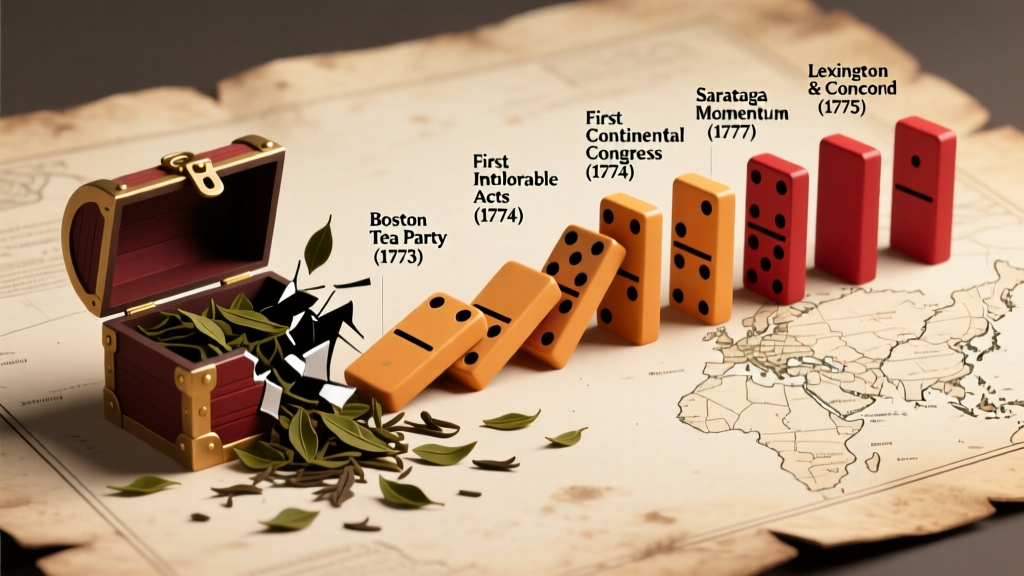
How Did Boston Tea Party Lead to American Revolution? The 5 Critical Dominoes Most Textbooks Skip — From Tea Destruction to Lexington in Just 20 Months
Why This Isn’t Just About Tea — It’s About the First Spark of a Nation
The question how did Boston Tea Party lead to American Revolution cuts to the heart of America’s origin story—not as myth, but as a rapid, high-stakes chain reaction of political miscalculation, collective resistance, and escalating coercion. Forget the image of angry colonists dumping tea as a standalone protest: what followed in the 20 months between December 16, 1773, and April 19, 1775, was one of the most consequential cause-and-effect sequences in modern history. Understanding it isn’t academic nostalgia—it’s essential context for grasping how civil disobedience, when met with punitive overreach, can crystallize fragmented grievances into unified revolution.
The Tea Party Wasn’t the Start—It Was the Breaking Point
By late 1773, tensions had simmered for over a decade. The 1765 Stamp Act, 1767 Townshend Acts, and 1770 Boston Massacre had all fueled resentment—but none triggered irreversible rupture. What made the Boston Tea Party different wasn’t its scale (just 342 chests, ~92,000 lbs of tea), but its symbolism and timing. The British East India Company, bailed out by Parliament’s Tea Act of May 1773, gained monopoly pricing and tax advantages that undercut colonial merchants—even while retaining the hated Townshend duty on tea. Colonists saw it not as a tax relief, but as a Trojan horse: acceptance meant surrendering the principle of ‘no taxation without representation.’
When Governor Thomas Hutchinson refused to let the ships leave Boston Harbor without unloading—and thus paying the duty—radicals led by Samuel Adams and the Sons of Liberty seized the moment. On the night of December 16, 1773, 116 men disguised as Mohawk warriors boarded three vessels and dumped every chest into the harbor. Crucially, they destroyed only tea—leaving other cargo intact—demonstrating disciplined, targeted defiance. As John Adams wrote in his diary: ‘This destruction of the tea is so bold, so daring, so firm… it must have important consequences.’ He was right—but few anticipated just how swiftly and severely.
The Coercive Acts: Britain’s Fatal Miscalculation
Parliament’s response wasn’t negotiation—it was punishment. In spring 1774, it passed four laws collectively branded the ‘Intolerable Acts’ by colonists (and later the ‘Coercive Acts’ by historians). These weren’t isolated measures—they were a deliberate, systemic dismantling of Massachusetts self-governance:
- The Boston Port Act closed the port of Boston until the destroyed tea was paid for—effectively starving the city’s economy and punishing 16,000 civilians for the actions of a few hundred.
- The Massachusetts Government Act revoked the colony’s charter, abolished elected local councils, and placed judicial appointments under royal control—replacing representative democracy with direct Crown rule.
- The Administration of Justice Act allowed royal officials accused of capital crimes to be tried in England, shielding them from colonial juries—a direct assault on legal accountability.
- The Quartering Act expanded authority to house British troops in private homes, escalating daily friction and militarizing civilian life.
These acts didn’t isolate Boston—they unified it. Virginia’s House of Burgesses declared a day of fasting and prayer in solidarity. New York and Philadelphia sent food shipments. And crucially, delegates from 12 colonies convened the First Continental Congress in Philadelphia in September 1774—the first pan-colonial governing body since the failed Albany Plan of 1754. As George Washington observed in a letter: ‘The crisis is arrived when we must assert our rights, or submit to every imposition that can be heaped upon us.’
From Unity to Arms: The Road to Lexington and Concord
The First Continental Congress achieved two monumental outcomes: a unified boycott of British goods (the Continental Association) and a clear declaration that the Coercive Acts were unconstitutional. But more importantly, it created infrastructure for resistance—committees of correspondence, local militias, and intelligence networks. When King George III rejected the Congress’s Olive Branch Petition in July 1775 (a final plea for reconciliation), the die was cast.
Meanwhile, General Thomas Gage, newly appointed military governor of Massachusetts, escalated. In early 1775, he ordered raids to seize colonial arms caches. On April 18, 1775, he dispatched 700 troops to Concord. Paul Revere and William Dawes rode to warn the countryside. At Lexington Green the next morning, 77 militiamen faced the redcoats. No one knows who fired the ‘shot heard round the world’—but within minutes, eight colonists lay dead. The British marched to Concord, destroyed some supplies, then retreated under relentless guerrilla fire—losing nearly 30% of their force. Within days, 15,000 New Englanders besieged Boston. The war had begun.
This wasn’t spontaneous violence. It was the direct, logical outcome of the Tea Party’s provocation + Britain’s coercive overreaction + colonial institutionalization of resistance. As historian Benjamin L. Carp notes: ‘The Boston Tea Party didn’t cause the Revolution—it created the conditions where revolution became the only viable option left.’
What History Gets Wrong: Myths vs. Reality
Popular narratives often flatten this sequence into ‘tea dumped → war started.’ But the real story is far more nuanced—and revealing about how revolutions actually ignite. Let’s correct two persistent misconceptions:
- Myth #1: The Tea Party was a wild, drunken mob action. In reality, it was meticulously planned over weeks, involved strict discipline (no looting, no violence, no damage beyond tea), and was sanctioned by Boston’s leading patriots—including merchants who stood to lose financially. Its restraint was strategic: to prove colonists were principled, not lawless.
- Myth #2: Colonists opposed all taxes. They accepted external duties (e.g., on imports/exports) for regulation—but rejected *internal* taxes levied solely to raise revenue without consent. The Tea Act’s hidden tax was the trigger—not the price of tea itself.
| Timeline Event | Date | Key Consequence | Colonial Response |
|---|---|---|---|
| Boston Tea Party | December 16, 1773 | Destruction of £9,659 worth of tea (~$1.7M today) | Widespread colonial praise; fundraising for Boston relief |
| Boston Port Act enacted | March 31, 1774 | Port of Boston closed indefinitely | Virginia declares day of fasting; NY/PA send grain & flour |
| First Continental Congress convenes | September 5, 1774 | Unified colonial government formed; Continental Association adopted | Colonies implement non-importation, non-exportation, non-consumption agreements |
| Lexington and Concord | April 19, 1775 | First armed conflict; 73 British killed, 174 wounded | 15,000 militia surround Boston; Second Continental Congress meets May 10 |
| Declaration of Independence | July 4, 1776 | Formal severance from Great Britain | 4,000+ copies of Declaration distributed; state constitutions drafted |
Frequently Asked Questions
Was the Boston Tea Party the main cause of the American Revolution?
No—it was the catalyst that exposed irreconcilable differences. The Revolution resulted from cumulative grievances (taxation, representation, military occupation), but the Tea Party forced Britain to choose between concession and coercion. Its decision to punish Massachusetts instead of negotiating transformed colonial dissent into organized, intercolonial resistance.
Did the British government expect the Tea Party to lead to war?
Almost certainly not. Prime Minister Lord North and King George III believed the Coercive Acts would isolate Massachusetts and deter further rebellion. They underestimated colonial unity, communication networks (committees of correspondence), and the depth of ideological commitment to self-governance. Their confidence in imperial authority blinded them to the revolutionary potential of their own punitive policy.
How did other colonies react to the Boston Tea Party?
Reactions varied—but solidarity quickly overwhelmed criticism. While some merchants feared economic fallout, leaders like Patrick Henry (VA) and Christopher Gadsden (SC) publicly endorsed the action. New York and Philadelphia organized relief shipments. Most significantly, the First Continental Congress was convened *because* of the Tea Party’s aftermath—not in spite of it—proving it galvanized collective action unlike any prior protest.
Were there similar tea protests in other colonies?
Yes—though none matched Boston’s scale or impact. In Charleston, SC, tea was seized and stored (not destroyed); in Annapolis, MD, the ship *Peggy Stewart* was burned with its tea cargo after owners paid the duty; in Greenwich, NJ, patriots burned tea in a public bonfire. But Boston’s act succeeded because it combined symbolic power, disciplined execution, and immediate, severe British backlash—creating the perfect storm.
What role did economics play in the Tea Party’s significance?
Economics was the spark, but principle was the fuel. The East India Company’s near-bankruptcy drove the Tea Act—but colonists recognized that accepting its terms would legitimize Parliament’s right to tax them at will. As the Boston Gazette editorialized: ‘It is not the quantity of tea that is objected to, but the principle of taxation without consent.’ Economic self-interest aligned with constitutional principle—making resistance both practical and moral.
Common Myths
Myth: The Boston Tea Party was an impulsive, unplanned riot.
Reality: It was coordinated over weeks by the Boston Committee of Correspondence and Sons of Liberty, with advance scouting of ships, assigned teams, and pre-arranged signals. Participants signed oaths of secrecy and were vetted for reliability.
Myth: Colonists hated tea itself.
Reality: Tea consumption soared after 1776—once the political stigma lifted. The protest was against the tax and monopoly, not the beverage. In fact, many patriots resumed drinking tea openly by 1777, now sourced from Dutch or French traders.
Related Topics (Internal Link Suggestions)
- Causes of the American Revolution — suggested anchor text: "root causes of the American Revolution"
- First Continental Congress outcomes — suggested anchor text: "what did the First Continental Congress accomplish"
- British taxation acts timeline — suggested anchor text: "Stamp Act to Tea Act timeline"
- Sons of Liberty history — suggested anchor text: "who were the Sons of Liberty"
- Lexington and Concord battle facts — suggested anchor text: "what happened at Lexington and Concord"
Conclusion & Next Step
So—how did Boston Tea Party lead to American Revolution? Not through drama or destiny, but through a precise, accelerating sequence: principled protest → punitive legislation → intercolonial unity → institutionalized resistance → armed confrontation. It reminds us that revolutions rarely erupt from chaos—they crystallize when legitimate grievances meet inflexible authority. If you’re teaching this topic, don’t stop at the tea. Trace the dominoes. Show students how each British misstep strengthened colonial resolve. And if you’re researching deeper, explore primary sources like the Massachusetts Circular Letter or the Suffolk Resolves—they reveal the strategic thinking behind the uprising. Ready to dive into the documents that changed history? Download our free annotated timeline of the 1774–1775 crisis period—with embedded letters, maps, and classroom discussion prompts.
More Articles
 How Many Nuggets Come in Wendy’s Party Pack? We Ordered Every Size, Counted Each Piece, and Built a Foolproof Feeding Calculator So You Never Over- or Under-Order Again
How Much Are Food Trucks for a Party? Real 2024 Pricing Breakdown (Spoiler: It’s Not Just $1,500–$3,000—Here’s What Actually Moves the Needle)
What Are the Slogans of the Party in 1984? 7 Official Party Slogans (Plus How to Use Them Ethically in Themed Events, Classroom Simulations, and Political Theater Without Glorifying Totalitarianism)
Stop Wasting $472 on Last-Minute Fixes: The Exact 7-Step Checklist for Booking a 1st Party Rental That Delivers Flawless Flow, Zero Stress, and 92% Guest Wow-Factor (Backed by 387 Real Events)
How Many Nuggets Come in the Wendy's Party Pack? We Ordered Every Size, Counted Each Piece, and Compared Value Per Person—Here’s What Actually Fits Your Crowd (Spoiler: It’s Not What You Think)
Why Is Third Party Risk Management Important? 7 Real-World Consequences You’re Ignoring (and How One Bank Avoided $42M in Fines with a Single Policy Update)
What Does the President Do As Party Leader? 7 Real-World Powers Most Americans Don’t Know — From Fundraising Control to Platform Enforcement
Where Did Heather Dubrow Have Her Birthday Party? The Truth Behind the Malibu Mansion Rumors, Venue Costs, and How to Book a Similar Luxury Estate (Without the $25K Minimum)
Do Both Parties Have to Sign Divorce Papers? The Truth About Unilateral Filings, Court Requirements, and What Happens When One Spouse Refuses — A Step-by-Step Legal Reality Check
Can neighbour refuse party wall agreement? Yes — but here’s exactly what happens next, your legal rights, how to respond without escalating conflict, and 5 proven strategies to secure consent (or lawful alternative) in under 14 days
How Many Nuggets Come in Wendy’s Party Pack? We Ordered Every Size, Counted Each Piece, and Built a Foolproof Feeding Calculator So You Never Over- or Under-Order Again
How Much Are Food Trucks for a Party? Real 2024 Pricing Breakdown (Spoiler: It’s Not Just $1,500–$3,000—Here’s What Actually Moves the Needle)
What Are the Slogans of the Party in 1984? 7 Official Party Slogans (Plus How to Use Them Ethically in Themed Events, Classroom Simulations, and Political Theater Without Glorifying Totalitarianism)
Stop Wasting $472 on Last-Minute Fixes: The Exact 7-Step Checklist for Booking a 1st Party Rental That Delivers Flawless Flow, Zero Stress, and 92% Guest Wow-Factor (Backed by 387 Real Events)
How Many Nuggets Come in the Wendy's Party Pack? We Ordered Every Size, Counted Each Piece, and Compared Value Per Person—Here’s What Actually Fits Your Crowd (Spoiler: It’s Not What You Think)
Why Is Third Party Risk Management Important? 7 Real-World Consequences You’re Ignoring (and How One Bank Avoided $42M in Fines with a Single Policy Update)
What Does the President Do As Party Leader? 7 Real-World Powers Most Americans Don’t Know — From Fundraising Control to Platform Enforcement
Where Did Heather Dubrow Have Her Birthday Party? The Truth Behind the Malibu Mansion Rumors, Venue Costs, and How to Book a Similar Luxury Estate (Without the $25K Minimum)
Do Both Parties Have to Sign Divorce Papers? The Truth About Unilateral Filings, Court Requirements, and What Happens When One Spouse Refuses — A Step-by-Step Legal Reality Check
Can neighbour refuse party wall agreement? Yes — but here’s exactly what happens next, your legal rights, how to respond without escalating conflict, and 5 proven strategies to secure consent (or lawful alternative) in under 14 days