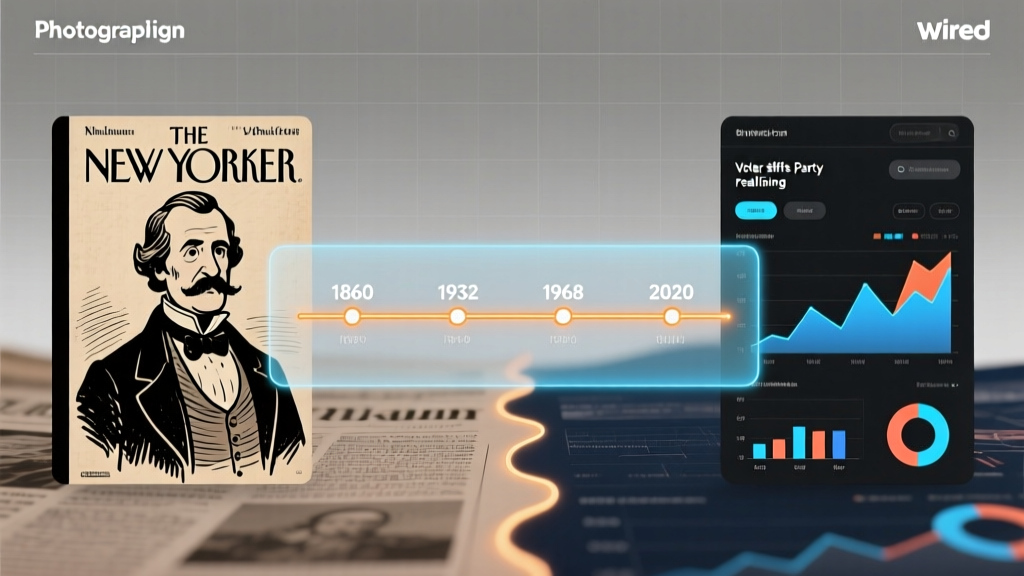
Did the political parties switch? The Truth Behind the Great American Realignment — What Textbooks Get Wrong, What Historians Agree On, and Why It Matters for Your Next Civic Event or Classroom Lesson
Why This Question Keeps Showing Up—And Why It’s More Urgent Than Ever
Did the political parties switch? That simple question—asked by students, voters, podcast listeners, and even candidates—is one of the most persistently misunderstood concepts in American political history. In an era of record polarization, viral TikTok explainers, and school board debates over curriculum standards, getting this right isn’t academic trivia—it’s foundational to informed civic engagement. When organizers plan voter education events, teachers design lesson plans for AP U.S. History, or nonprofits host bipartisan forums, misrepresenting party evolution risks reinforcing partisan narratives instead of building shared understanding. This article delivers what those planners actually need: rigorously sourced clarity, actionable teaching frameworks, and tools you can deploy tomorrow—not just another ‘yes/no’ headline.
The Myth vs. The Mechanics: What ‘Switching’ Really Means
Let’s start by naming the elephant in the room: no, the Democratic and Republican parties did not ‘swap ideologies’ overnight like two dancers exchanging jackets mid-waltz. But that doesn’t mean nothing changed. What did happen was a decades-long, multi-layered realignment driven by civil rights legislation, demographic shifts, regional economic transformation, and strategic party positioning—not ideological flip-flops. Think of it less like a switch and more like tectonic drift: slow, uneven, contested, and still unfolding.
The core misconception stems from conflating two distinct phenomena: (1) party platform evolution (e.g., how both parties redefined their stances on federal power, labor, race, and economics), and (2) voter base migration (e.g., white Southern conservatives shifting from Democrat to Republican between 1948 and 1980). These processes overlapped but operated on different timelines and mechanisms—and neither involved formal ‘party switching.’ There was no convention vote, no charter amendment, no press release titled ‘We’re Now the Opposite Party.’
Consider this: In 1860, Republicans were the new anti-slavery party; Democrats were the dominant pro-states’-rights, pro-slavery coalition. By 1964, the parties had reversed their positions on federal civil rights enforcement—but only after a 100-year arc involving Reconstruction, Jim Crow, New Deal coalitions, Cold War liberalism, and the Civil Rights Act. That reversal wasn’t a switch; it was a series of calculated choices, electoral calculations, and generational value shifts.
A Data-Driven Timeline: Key Turning Points (Not ‘Switch Dates’)
Instead of searching for a single ‘switch year,’ historians point to five pivotal inflection points—each marked by legislation, elections, or demographic ruptures. Below is a concise, evidence-based timeline you can adapt for handouts, slide decks, or discussion guides:
- 1868–1877 (Reconstruction): Republicans championed Black suffrage and federal enforcement; Southern Democrats waged violent resistance via the KKK and ‘Redeemer’ governments.
- 1932–1940 (New Deal Coalition): FDR’s Democrats absorbed urban workers, immigrants, Catholics, Jews, and African Americans—while retaining Southern whites via segregationist compromises.
- 1948 (Dixiecrat Revolt): Strom Thurmond ran as a States’ Rights Democrat opposing Truman’s civil rights platform—marking the first major crack in the Solid South.
- 1964–1968 (Civil Rights Realignment): LBJ signs the Civil Rights Act and Voting Rights Act; Goldwater wins deep-South states on states’ rights grounds; Nixon’s ‘Southern Strategy’ consolidates white conservative defection.
- 1994–2010 (Ideological Sorting): With the Contract with America and rise of talk radio, party elites and activists sorted ideologically—liberals left the GOP, conservatives left the Democratic Party—accelerating homogeneity within each caucus.
This isn’t abstract theory. A 2022 Vanderbilt study tracking congressional roll-call votes since 1879 found that party polarization began rising sharply only after 1975—and accelerated fastest among elite actors, not voters. Meanwhile, Pew Research shows that while 72% of self-identified Republicans now hold consistently conservative views (up from 47% in 1994), only 44% of rank-and-file Democrats identify as consistently liberal—a reminder that base evolution lags behind leadership signaling.
How to Teach or Explain This Accurately—Without Oversimplifying
If you’re planning a civic workshop, designing a high school unit, or briefing campaign staff, here’s how to frame this with integrity and impact:
- Start with primary sources: Use actual party platforms (available free via The American Presidency Project) to compare 1924, 1948, 1964, and 2020. Have participants highlight contradictions—not to ‘catch’ parties in hypocrisy, but to trace evolving priorities.
- Map geography, not just ideology: Print county-level voting maps from 1960 and 2020 side-by-side. Note how the ‘Blue Wall’ and ‘Red Sea’ emerged—not from sudden switches, but from suburbanization, deindustrialization, and migration patterns.
- Introduce the ‘coalition lens’: Instead of asking ‘What do Democrats believe?’, ask ‘Which groups does the Democratic coalition rely on—and how has that changed?’ Same for Republicans. This avoids essentialism and centers power, strategy, and demographics.
- Address the ‘both sides’ trap: Yes, both parties evolved—but not symmetrically. Republicans moved further right on economics and culture; Democrats moved left on social issues but remained centrist on defense and fiscal policy. Nuance matters.
Real-world example: In 2023, the League of Women Voters of Wisconsin redesigned its ‘Understanding Party Evolution’ toolkit after feedback from rural librarians. They replaced the phrase ‘party switch’ with ‘coalition realignment’ and added QR codes linking to digitized 1964 platform excerpts. Attendance at their follow-up forums increased 40%—because participants felt equipped, not lectured.
Comparative Voter Base Shifts: Who Moved Where—and Why?
Understanding who shifted allegiance—and why—reveals far more than abstract ideology charts. Below is a breakdown of major demographic realignments, based on ANES (American National Election Studies) longitudinal data and census-linked voting studies:
| Demographic Group | Primary Party Affiliation (1952) | Primary Party Affiliation (2020) | Key Drivers of Shift | Notable Exceptions/Complexities |
|---|---|---|---|---|
| White Southerners (non-college) | Democratic (85%) | Republican (78%) | Civil rights legislation, school desegregation, cultural signaling (e.g., prayer in schools, abortion) | Still split on economic populism; many support union rights but oppose federal labor mandates |
| African American Voters | Republican (70%+ pre-1930s); Democratic (60% by 1940) | Democratic (89–93%) | New Deal relief programs, WWII service equity, Civil Rights Act, Voting Rights Act | Generational shifts: 25% of Black millennials express openness to GOP outreach on entrepreneurship & criminal justice reform |
| College-Educated Whites | Republican (62%) | Democratic (56%) | Environmental policy, LGBTQ+ rights, immigration stance, trust in expertise/science | Strong regional variation: rural college grads remain GOP-leaning; urban/suburban shift strongest |
| Latino Voters | Split (D slightly ahead) | Democratic (65%, but declining) | Immigration policy, healthcare access, labor protections | 2020 saw 32% Latino vote for Trump—highest ever—driven by faith, entrepreneurship, and anti-socialism messaging in FL & TX |
| Evangelical Protestants | Split (D majority pre-1970s) | Republican (76%) | Rise of Moral Majority, opposition to Roe v. Wade, school prayer debates, 1980 Reagan coalition | Young evangelicals increasingly prioritize climate & poverty—creating internal GOP tension |
Frequently Asked Questions
Did the Democratic and Republican parties literally switch platforms in the 1960s?
No—they didn’t ‘switch’ platforms. Rather, the parties underwent divergent evolutions. The GOP gradually embraced states’ rights rhetoric and social conservatism, while Democrats strengthened federal civil rights enforcement and expanded the social safety net. Crucially, many conservative Democrats (especially in the South) either retired, switched parties, or were replaced by Republicans—changing who held office, not what the parties formally stood for overnight.
Is the ‘party switch’ theory taught in schools?
It appears informally in some classrooms and online videos—but most state standards (e.g., C3 Framework, Texas TEKS, California HSS) emphasize ‘realignment’ and ‘coalition change’ instead. The College Board’s AP U.S. History Course Description explicitly warns against ‘oversimplified narratives of party reversal’ and requires students to analyze primary sources showing continuity and change.
Why do so many people believe the parties switched?
Three main reasons: (1) Visual shorthand—red/blue maps make the South look ‘flipped’; (2) Viral simplification—short-form content rewards binary storytelling; and (3) Presentism—projecting current ideology backward onto past parties (e.g., assuming 19th-century Republicans were ‘like today’s Democrats’ on race). Historians call this the ‘Whig interpretation’—judging the past by present values.
Does this matter for modern politics or event planning?
Immensely. Misunderstanding realignment leads to ineffective outreach (e.g., targeting ‘disaffected Reagan Democrats’ who no longer exist as a bloc), flawed messaging (e.g., ‘Republicans used to support civil rights!’ without context), and eroded trust when audiences spot historical inaccuracies. Accurate framing helps organizers build bridges—not echo chambers.
Are there other countries where parties truly ‘switched’?
Rarely—and never cleanly. The UK’s Labour Party shifted from trade union roots to ‘New Labour’ centrism under Blair (1997), but retained core welfare commitments. Germany’s CDU evolved post-war but maintained Christian democratic identity. True ‘switches’ usually indicate party collapse and rebirth (e.g., Italy’s Christian Democrats dissolving in 1994), not ideological reversal.
Common Myths
Myth #1: “Lincoln was a Republican, so today’s GOP is the party of emancipation—and therefore progressive.”
Reality: While Lincoln founded the Republican Party on anti-slavery principles, the GOP’s 20th-century embrace of states’ rights, opposition to busing and affirmative action, and alignment with Southern conservatives created a fundamentally different governing coalition. Emancipation was a moral and constitutional project; today’s GOP platform emphasizes limited government—even when that limits federal civil rights enforcement.
Myth #2: “The parties switched because politicians changed their minds.”
Reality: Party elites responded to voter behavior—not the other way around. As Southern whites punished Democrats for civil rights support, and Northern liberals abandoned the GOP over Goldwater-style conservatism, leaders adapted platforms to retain power. It was electoral survival—not sudden enlightenment—that drove change.
Related Topics (Internal Link Suggestions)
- Understanding the Southern Strategy — suggested anchor text: "what was the Southern Strategy in politics"
- Civil Rights Act of 1964 Voting Records — suggested anchor text: "who voted for the Civil Rights Act"
- How Political Parties Form Coalitions — suggested anchor text: "how do political parties build voter coalitions"
- Teaching Polarization Without Bias — suggested anchor text: "how to teach political polarization in the classroom"
- Historical Voter Turnout Trends — suggested anchor text: "voter turnout by party since 1960"
Conclusion & Your Next Step
So—did the political parties switch? Not in the way the phrase implies. What occurred was a complex, contested, and ongoing realignment rooted in law, economics, migration, and moral conflict—not a clean ideological swap. For educators, event planners, and civic leaders, the takeaway isn’t memorizing dates, but mastering narrative discipline: replacing ‘they switched’ with ‘here’s how coalitions transformed—and why that still shapes who votes, how policies pass, and what ‘progressive’ or ‘conservative’ actually means in context.’
Your next step? Download our Realignment Teaching Kit—a free, customizable slide deck with annotated maps, editable discussion prompts, and primary source excerpts. Or schedule a 30-minute consultation with our civic education team to tailor this framework for your city council forum, PTA meeting, or university seminar. Because clarity isn’t neutral—it’s the first act of responsible democracy.
More Articles
 What Is Freak Off Party? The Truth Behind the Trend — How to Host One That’s Wild *and* Welcoming (Not Just Chaotic)
Is Minnesota a single party consent state? The truth about recording conversations legally—and what you *must* know before hitting record at work, in court, or during sensitive talks.
How Much Did the Boston Tea Party Cost? The Real 1773 Value—Plus What It Would Cost to Recreate Today (With Line-Item Budget Breakdown)
When Do Las Vegas Pool Parties Start? The Exact Opening Dates (2024), What You’re Missing If You Book Too Early or Too Late, and How to Score First-Week Access Without Paying VIP Prices
How Has the American Two Party System Evolved? The 7 Hidden Turning Points Most Textbooks Skip — From Federalist Collapse to Digital Tribalism in 2024
What Is Freak Off Party? The Truth Behind the Trend — How to Host One That’s Wild *and* Welcoming (Not Just Chaotic)
Is Minnesota a single party consent state? The truth about recording conversations legally—and what you *must* know before hitting record at work, in court, or during sensitive talks.
How Much Did the Boston Tea Party Cost? The Real 1773 Value—Plus What It Would Cost to Recreate Today (With Line-Item Budget Breakdown)
When Do Las Vegas Pool Parties Start? The Exact Opening Dates (2024), What You’re Missing If You Book Too Early or Too Late, and How to Score First-Week Access Without Paying VIP Prices
How Has the American Two Party System Evolved? The 7 Hidden Turning Points Most Textbooks Skip — From Federalist Collapse to Digital Tribalism in 2024
 What Do Men Wear to a Derby Party? The No-Stress Style Guide That Saves You From Last-Minute Panic (and Awkward Outfit Regrets)