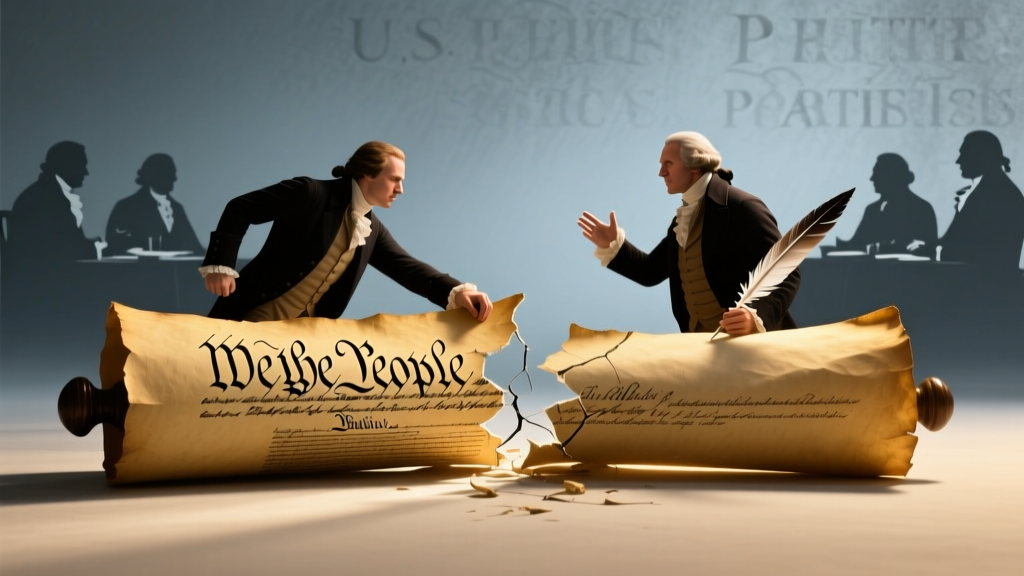
Early US Political Parties: Power, Not Ideology
Why This History Matters More Than Ever
The question why were the early US political parties formed isn’t just academic—it’s the origin story of America’s enduring partisan DNA. Today’s polarization, congressional gridlock, and even social media-driven political identity trace directly back to decisions made between 1789 and 1801—not in smoke-filled rooms, but in cabinet meetings, newspaper editorials, and hastily convened caucuses. Understanding this genesis reveals that parties weren’t planned institutions; they were emergency responses to an untested Constitution.
The Constitutional Vacuum: No Parties in the Blueprint
The U.S. Constitution contains zero mention of political parties. In fact, the Founders widely viewed them as ‘factions’—dangerous, self-interested cabals that threatened national unity. George Washington’s 1796 Farewell Address famously warned against ‘the baneful effects of the spirit of party.’ Yet within seven years of ratification, two fully operational, nationally coordinated parties—the Federalists and the Democratic-Republicans—were locked in fierce electoral and ideological combat. So what changed?
The answer lies not in philosophy alone, but in practical governance. As the first Congress convened in 1789, members quickly discovered that agreeing on *how* to implement the Constitution was far harder than drafting it. Who would control the purse strings? Could the president remove cabinet officers without Senate approval? Did states retain authority to nullify federal laws? These weren’t theoretical debates—they triggered real crises with immediate consequences.
Take the 1790 ‘Dinner Table Bargain’ between Alexander Hamilton and Thomas Jefferson, brokered by James Madison. Hamilton needed Southern votes to pass his plan for federal assumption of state war debts. Jefferson and Madison demanded the national capital be relocated to the Potomac River—a concession that secured support. This wasn’t ideology; it was transactional coalition-building. Within months, pro-Hamilton congressmen began meeting privately before House sessions. Anti-Hamilton representatives did the same. These informal gatherings—what historian Joanne Freeman calls ‘congressional caucuses’—were the first party infrastructure.
Hamilton vs. Jefferson: Policy Clashes That Forged Loyalties
While personality and patronage fueled early alignment, three concrete policy battles crystallized party identity—and proved impossible to resolve without organized opposition:
- The National Bank Debate (1791): Hamilton argued the Constitution’s ‘necessary and proper’ clause authorized a central bank. Jefferson countered that it violated strict constructionism—only powers explicitly granted could be exercised. When Washington signed the Bank Bill, supporters coalesced into the Federalist camp; opponents became the nucleus of the Democratic-Republicans.
- Neutrality Proclamation (1793): Amid the French Revolution, Jeffersonians saw France as America’s revolutionary ally; Federalists feared entanglement and favored Britain’s stability. Washington’s proclamation of neutrality—drafted by Hamilton—sparked mass protests led by Democratic-Republican societies. These grassroots groups held rallies, published pamphlets, and collected signatures—functioning as proto-party organs.
- The Alien and Sedition Acts (1798): With war looming with France, Federalists passed laws criminalizing criticism of the government. Jefferson and Madison secretly drafted the Kentucky and Virginia Resolutions, asserting states’ rights to ‘nullify’ unconstitutional laws. This wasn’t academic theory—it was a call to organized resistance. Democratic-Republican state legislatures endorsed the resolutions; Federalist states condemned them. Party lines hardened into constitutional doctrine.
Crucially, these weren’t isolated disputes. They revealed incompatible theories of governance: Federalists believed in energetic central authority, elite leadership, and commercial modernity. Democratic-Republicans championed agrarian virtue, decentralized power, and popular sovereignty—even if their ‘popular’ base excluded women, enslaved people, and most free Black citizens. Loyalty to one vision required active opposition to the other.
Media, Money, and Mobilization: How Parties Built Infrastructure
Parties didn’t just emerge from ideas—they were built with tools. By 1796, both sides operated sophisticated communication networks:
- Newspapers as Party Arms: John Fenno’s Gazette of the United States (Federalist) and Philip Freneau’s National Gazette (Democratic-Republican) received direct subsidies from Treasury and State Departments, respectively. Freneau was even hired as a State Department clerk—ostensibly to translate French documents, but primarily to write anti-Federalist editorials.
- Financial Engineering: Federalists leveraged banking connections to reward loyalists with loans and contracts. Democratic-Republicans cultivated networks of tavern keepers, printers, and militia captains who distributed speeches and organized local ‘Republican Societies’—over 40 existed by 1795, holding weekly meetings modeled on British radical clubs.
- Electoral Innovation: The 1796 election saw the first coordinated presidential ticketing—though the Electoral College system still awarded the presidency to the top vote-getter (John Adams) and vice presidency to the runner-up (Thomas Jefferson), creating an administration split down the middle. By 1800, both parties ran formal tickets (Adams/Pinckney vs. Jefferson/Burr) and deployed agents to swing-state legislatures to influence elector selection—a practice that evolved into today’s primary and convention systems.
This infrastructure transformed politics from elite deliberation into mass participation. Voter turnout in the 1800 election hit ~25%—unprecedented for the era—and included artisans, shopkeepers, and farmers who’d never voted before. Parties gave ordinary citizens a stake, a voice, and a label.
Key Turning Points: From Factions to Formal Parties
Historians identify four inflection points where informal alignments became durable institutions:
- 1792: Formation of the first congressional caucuses and the emergence of ‘Pro-Administration’ (Federalist) and ‘Anti-Administration’ (Democratic-Republican) voting blocs in the House.
- 1794: Whiskey Rebellion response—Federalists praised Washington’s use of militia to suppress tax protests; Democratic-Republicans decried it as tyrannical overreach, cementing rural support.
- 1798–99: Passage and backlash against the Alien and Sedition Acts, triggering coordinated state-level resistance and the first inter-state compact (Kentucky/Virginia Resolutions).
- 1800: The ‘Revolution of 1800’—first peaceful transfer of power between parties, achieved through disciplined campaigning, voter mobilization, and institutional adaptation (e.g., the 12th Amendment, ratified in 1804, to prevent future electoral ties).
By 1801, parties weren’t anomalies—they were the operating system of American democracy. As Jefferson wrote in 1816: ‘If I could not go to heaven but with a party, I would not go at all.’ Yet he spent his presidency building the Democratic-Republican Party into the dominant force for the next 24 years.
| Feature | Federalist Party (1792–1816) | Demo-Republican Party (1792–1824) | How It Shaped Modern Parties |
|---|---|---|---|
| Core Constituency | Merchants, bankers, lawyers, New England elites | Planters, farmers, artisans, frontier settlers | Established the template for economic-class-based coalitions still visible today (e.g., urban professionals vs. rural voters) |
| Constitutional View | Loose constructionism; implied powers justified strong federal action | Strict constructionism; states’ rights as bulwark against tyranny | Launched the enduring debate over federalism—central to modern conflicts over healthcare, education, and civil rights |
| Foreign Policy Stance | Pro-British; prioritized trade stability and debt repayment | Pro-French (initially); emphasized revolutionary solidarity and anti-monarchism | Embedded foreign policy as a partisan litmus test—echoed in Cold War alignments and modern debates over NATO or China policy |
| Mobilization Tool | Banking networks, official appointments, elite salons | Tavern meetings, Republican Societies, Fourth of July orations | Pioneered grassroots organizing techniques later adopted by abolitionists, suffragists, and labor unions |
| Demise Catalyst | Hartford Convention (1814–15), perceived as secessionist during War of 1812 | Internal fracture after 1824 ‘Corrupt Bargain’ election, leading to Jacksonian Democrats vs. National Republicans | Proved parties evolve—or collapse—based on adaptability to new issues and leadership crises |
Frequently Asked Questions
Did George Washington belong to a political party?
No—he remained officially nonpartisan throughout his presidency and actively discouraged party formation. However, his cabinet was deeply divided: Secretary of the Treasury Alexander Hamilton led the Federalists, while Secretary of State Thomas Jefferson became the Democratic-Republicans’ de facto leader. Washington’s neutrality couldn’t contain the structural tensions baked into the new government.
Were the early parties based on slavery?
Not explicitly—but slavery shaped their regional bases. Federalists drew strength from Northern commercial centers less dependent on slave labor; Democratic-Republicans dominated the slaveholding South and parts of rural Pennsylvania and Georgia. While neither party made abolition a platform (Jefferson owned enslaved people; Hamilton opposed slavery personally but profited from slave-linked commerce), their economic policies—tariffs, banking, land sales—had stark implications for slave-based agriculture versus industrial capitalism.
How did the Electoral College contribute to party formation?
Ironically, the Electoral College accelerated partisanship. Its original design assumed electors would exercise independent judgment. But by 1796, state legislatures began selecting electors pledged to specific candidates. In 1800, Democratic-Republicans instructed all 73 of their electors to vote for both Jefferson and Burr—causing a tie that threw the election to the House of Representatives for 36 ballots. This crisis exposed the system’s vulnerability to party discipline and directly led to the 12th Amendment, which formalized separate ballots for president and vice president—codifying party tickets into the Constitution.
What role did newspapers play beyond propaganda?
Newspapers were the party’s nervous system. They didn’t just report news—they created shared narratives, standardized talking points, and enabled rapid coordination. When Jefferson learned of the Alien and Sedition Acts, he alerted Madison via letter, who then drafted the Kentucky Resolutions; those were printed in sympathetic papers, reprinted across states, and debated in local societies—all within six weeks. This speed and scale of information flow was unprecedented and impossible without party-aligned press networks.
Why did the Federalist Party disappear so quickly after 1816?
The Hartford Convention (1814–15), where New England Federalists met secretly to protest the War of 1812 and propose constitutional amendments limiting federal power, was widely perceived as disloyal—even treasonous—after Andrew Jackson’s victory at New Orleans. Though the convention avoided secession talk, its demands (including requiring a 2/3 vote for embargoes or admitting new states) made Federalists appear anti-national. Combined with the ‘Era of Good Feelings’ under Monroe—a Democratic-Republican who absorbed former Federalists into his administration—the party collapsed not from weakness, but from being branded unpatriotic during a moment of surging nationalism.
Common Myths About Early Party Formation
Myth #1: “Parties formed because of philosophical differences about liberty.”
Reality: While liberty was invoked constantly, the initial split centered on administrative competence—could the new government manage debt, enforce laws, and conduct diplomacy? Ideology followed organization, not the reverse. As historian Richard Hofstadter observed, ‘The first parties were less about principle than about personnel and policy implementation.’
Myth #2: “The Founders unanimously opposed parties.”
Reality: Washington and Madison publicly condemned factions, but Madison’s 1787 Federalist No. 10 reframed ‘factions’ as inevitable and proposed controlling them through large republics and separation of powers—not eliminating them. By 1792, Madison was actively organizing the opposition to Hamilton. His pivot reveals that principled anti-party rhetoric often masked strategic coalition-building.
Related Topics (Internal Link Suggestions)
- Origins of the Two-Party System — suggested anchor text: "how the two-party system began in the United States"
- Federalist Papers and Party Politics — suggested anchor text: "did the Federalist Papers predict political parties?"
- Jeffersonian Democracy Explained — suggested anchor text: "what was Jeffersonian democracy really about?"
- Alien and Sedition Acts Impact — suggested anchor text: "how the Alien and Sedition Acts changed American politics"
- Early American Voting Rights — suggested anchor text: "who could vote in the early US elections?"
Your Turn: Connect Past to Present
Understanding why were the early US political parties formed transforms how we see today’s political battles—not as breakdowns of democracy, but as repetitions of its oldest patterns. The tension between centralized authority and local autonomy, between economic elites and populist movements, between national unity and ideological purity—it’s all been here before, forged in the crucible of 1790s Philadelphia and Richmond. If you’re researching for a paper, teaching civics, or just trying to make sense of today’s headlines, start here: download our free timeline poster of key party-formation milestones (1789–1804), complete with primary source excerpts and discussion questions—designed for educators and lifelong learners alike.
More Articles
 Grad Party Outfits 2026: Stress-Free Style Tips
 NY One-Party Consent: Recording Rules for Events (2026)
 How Can I Change My Party Affiliation In Florida (2026)
 Communist Manifesto: When Marx Wrote It (2026)
 Where to Party Near Me: The 4-Step Local Discovery System
 How to Cook Party Wings in Oven Perfectly
 How Many Maps in Mario Party Jamboree? (2026)
 What Is a Political Party? Purpose, Impact & Why It Matters
 Adverse Party Trust Tax Trap: Fix Before IRS Notices
 Main Goal of Political Parties: Beyond Elections