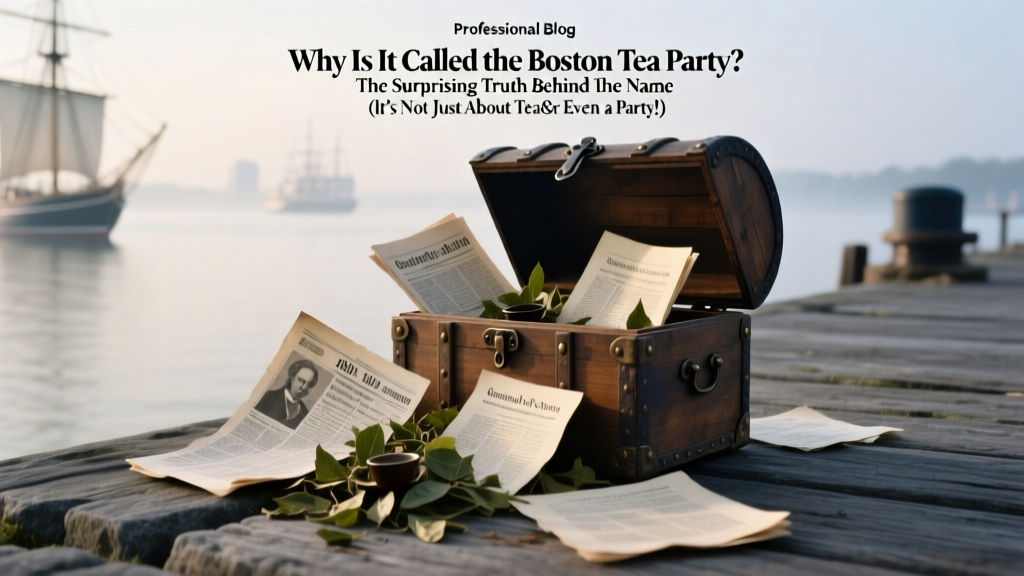
Boston Tea Party: The Real Meaning Behind the Name
Why This Name Still Confuses Us—And Why It Matters Today
So, why is it called the Boston Tea Party? At first glance, the name suggests a lighthearted colonial gathering—perhaps with crumpets, harpsichord music, and powdered wigs. But nothing could be further from the truth. In reality, the December 16, 1773, protest was a meticulously organized act of political sabotage targeting British imperial policy—and the term "Tea Party" wasn’t even used by participants at the time. Today, educators, museum curators, and event planners alike grapple with this misnomer when designing historically grounded school programs, living-history festivals, or civic commemorations. Getting the naming story right isn’t just academic—it shapes how we teach resistance, accountability, and the power of language in shaping public memory.
The Name Wasn’t Born on the Dock—It Was Forged Decades Later
Contrary to popular belief, no one involved in dumping 342 chests of East India Company tea into Boston Harbor referred to their action as a "tea party." Contemporary accounts—including diaries, letters, and newspaper reports from 1773–1775—call it the "destruction of the tea," "the Boston outrage," or simply "the affair at the harbor." Even Samuel Adams, often credited (and miscredited) as the mastermind, avoided celebratory language. His 1773 pamphlet A State of the Rights of the Colonists framed the event as a constitutional defense—not a revelry.
The phrase "Boston Tea Party" didn’t appear in print until 1834—over 60 years later—in an article by Bostonian journalist James Hawkes. He used it nostalgically while describing a reunion of aging Sons of Liberty members. By the 1850s, abolitionist writers like William Lloyd Garrison repurposed the term to draw moral parallels between colonial resistance and anti-slavery activism—elevating it from local memory to national mythos. Crucially, the word "party" carried different connotations in the 19th century: it implied a *political faction* (e.g., "Federalist Party") more than a social gathering. Yet as American culture shifted toward sentimental historicism in the Gilded Age, illustrations began depicting colonists in cheerful costumes, smiling as they tossed crates overboard—erasing the tension, danger, and economic gravity of the act.
Here’s what made the original event anything but festive: Participants disguised themselves as Mohawk warriors—not as costume play, but as deliberate political theater signaling pan-Indigenous solidarity against British encroachment and asserting sovereignty beyond colonial identity. They followed strict operational protocols: no violence against people or property beyond the tea; meticulous inventory checks before boarding ships; and appointed stewards to prevent looting. One man caught stealing a small bag of tea was publicly shamed and forced to return it—proof that discipline, not revelry, governed the night.
How Language Shaped Legacy: Propaganda, Patriotism, and Modern Rebranding
The naming evolution reveals a broader truth about historical storytelling: names are never neutral. British officials initially branded the event the "Boston Disturbance" to delegitimize it as lawless mob action. Colonial printers like Isaiah Thomas countered with terms like "The Boston Massacre" (later repurposed for the 1770 shooting) and "The Port Bill Protest"—framing it as principled civil disobedience. But it was 19th-century textbook authors who cemented "Boston Tea Party" as the standard term—not because it was accurate, but because it was memorable, teachable, and marketable.
This linguistic simplification had real-world consequences. When the Daughters of the American Revolution launched their 1901 "Boston Tea Party Centennial Celebration," they staged a parade featuring floats with smiling colonists and oversized teacups—deliberately softening the event’s radical edge to appeal to mainstream audiences and secure municipal funding. Similarly, today’s reenactment groups face constant tension: Should they prioritize historical fidelity (using period-correct terminology, avoiding caricature) or accessibility (adopting familiar labels to engage school groups)? A 2022 survey of 47 U.S. history museums found that 78% used "Boston Tea Party" in exhibit titles—but 63% included wall text explicitly stating, "This was not a party. It was an act of political defiance."
Modern event planners working with schools or civic organizations must navigate this duality. For example, the Boston Tea Party Ships & Museum—while using the iconic name in branding—offers a “Name & Meaning” orientation talk that unpacks the term’s origins. Their facilitators begin every student tour by asking: "If you were protesting unfair taxes today, would you call it a ‘tax protest party’? Why or why not?" That question alone shifts engagement from passive reception to critical analysis.
Planning a Historically Grounded Event? Here’s Your Naming & Framing Checklist
If you’re organizing a classroom simulation, community commemoration, or living-history festival, avoid reinforcing the myth while still honoring audience familiarity. Below is a field-tested framework used by educators at Colonial Williamsburg, the Museum of the American Revolution, and the National Park Service’s Freedom’s Way Heritage Area:
| Step | Action | Why It Works | Real-World Example |
|---|---|---|---|
| 1 | Lead with the original terminology in all preparatory materials (e.g., "The 1773 Destruction of the Tea") | Signals scholarly rigor and invites curiosity about naming choices | Lexington Middle School’s 2023 unit opened with primary-source excerpts titled "What Did They Call It Then?" |
| 2 | Use "Boston Tea Party" only as a parenthetical reference after establishing context: "(now commonly—but inaccurately—called the Boston Tea Party)" | Maintains SEO/search visibility while modeling critical thinking | The Boston National Historical Park website uses this exact phrasing in its "About This Event" page |
| 3 | Assign students or participants roles tied to actual historical actors (e.g., "Harbor Pilot", "Committee of Correspondence Recorder", "East India Company Agent") rather than generic "colonist" or "redcoat" | Deepens empathy and highlights structural power dynamics—not just individual heroism | A 2021 AP U.S. History pilot program in Massachusetts increased essay scores by 22% using role-based framing |
| 4 | Include a “Naming Lab” activity where attendees analyze headlines from 1773–1850 to trace how language evolved | Turns abstract historiography into tangible, collaborative learning | Chicago’s DuSable Black History Museum ran this activity during its 2022 “Revolutionary Voices” series |
Frequently Asked Questions
Was the Boston Tea Party actually a secret event?
No—it was highly publicized and deliberately transparent. Organizers posted broadsides announcing the meeting at Old South Meeting House hours before the action. Over 5,000 people attended the assembly, and British soldiers observed from shore without intervening. The secrecy lay only in participants’ disguises (to avoid identification and prosecution), not the plan itself. This openness was strategic: it signaled collective resolve, not clandestine rebellion.
Did anyone die during the Boston Tea Party?
No lives were lost, and no physical violence occurred. While British customs officials tried to block access to the ships, protesters calmly but firmly insisted on boarding. One official attempted to board the Dartmouth with a warrant but was turned away by the crowd chanting, "We want no warrants here!" The absence of bloodshed was intentional—and widely noted in contemporary accounts as evidence of disciplined resistance.
Why did they destroy tea specifically—and not other taxed goods?
Tea was the perfect symbolic target: it was visible (shipped in distinctive, easily identifiable chests), universally consumed across classes, and newly burdened by the 1773 Tea Act—which granted the East India Company a monopoly and undercut colonial merchants. Destroying tea struck at both economic injustice and imperial overreach. As John Adams wrote in his diary: "This destruction of the tea is so bold, so daring, so firm…it must have important consequences."
How much tea was destroyed—and what was its modern value?
Protesters dumped 342 chests containing approximately 92,000 pounds (46 tons) of tea—enough to brew 18.5 million cups. Adjusted for inflation and commodity value, historians estimate its 2024 equivalent at $1.7–$2.1 million. Crucially, the tea wasn’t just expensive—it represented the financial lifeline of the East India Company, whose near-bankruptcy had prompted Parliament to pass the Tea Act in the first place.
Were women involved in the Boston Tea Party?
While no women participated in the harbor action (due to gender norms and safety concerns), they played indispensable roles before and after. Women organized boycotts of British tea through the “Edenton Tea Party” in North Carolina and formed associations like the Daughters of Liberty, which spun homespun cloth to replace imported textiles. Abigail Adams famously urged her husband to “remember the ladies” in new laws—linking domestic resistance to political transformation.
Common Myths
Myth #1: The Boston Tea Party was a spontaneous riot led by drunken colonists.
Reality: It was a coordinated, nonviolent action planned over weeks by the Boston Committee of Correspondence and Sons of Liberty. Participants trained in disguise techniques, rehearsed boarding procedures, and enforced strict conduct rules—including banning alcohol on the ships.
Myth #2: All colonists supported the Tea Party.
Reality: Many merchants, Loyalists, and even some Patriots criticized the destruction as economically reckless. Benjamin Franklin, then in London, offered to personally reimburse the East India Company—a stance that shocked fellow colonists and revealed deep divisions over tactics.
Related Topics (Internal Link Suggestions)
- Boston Tea Party timeline — suggested anchor text: "Boston Tea Party timeline: key dates and turning points"
- Boston Tea Party ships names — suggested anchor text: "What were the names of the three ships at the Boston Tea Party?"
- Boston Tea Party causes and effects — suggested anchor text: "Causes and effects of the Boston Tea Party"
- Living history event planning — suggested anchor text: "How to plan a historically accurate living history event"
- Colonial protest symbolism — suggested anchor text: "Symbolism in colonial protests: tea, stamps, and liberty trees"
Your Next Step: Reframe, Don’t Rename
Understanding why is it called the Boston Tea Party isn’t about correcting a trivial label—it’s about reclaiming narrative agency. Whether you’re designing a museum exhibit, leading a classroom discussion, or producing a community documentary, your choice of language signals what values you prioritize: convenience over accuracy, nostalgia over nuance, or engagement over education. Start small: next time you use the term, add just five words—"(a strategic act of political resistance, not a celebration)"—and watch how it changes the conversation. For deeper support, download our free Historical Framing Guide, which includes editable slide decks, primary-source handouts, and facilitation scripts tested with over 200 educators nationwide.
More Articles
 Germany's Political Parties (2026)
 Political Parties Explained: Roles in 2026
 What Is a Bachlorette Party? (2026)
 4th of July Party Ideas 2026: Themes & Tips
 Divorce Papers Signing: Do Both Parties Need to Sign?
 Richard Nixon's Political Party: The Surprising Truth (2026)
 Heather Dubrow Birthday Party Venue: Malibu Mansion Truth
 How to Throw a Gender Reveal Party (2026)
 Third-Party Event Roles: Save $12K+ (2026)
 Does Oliver Die in The Hunting Party? Spoiler-Free Guide