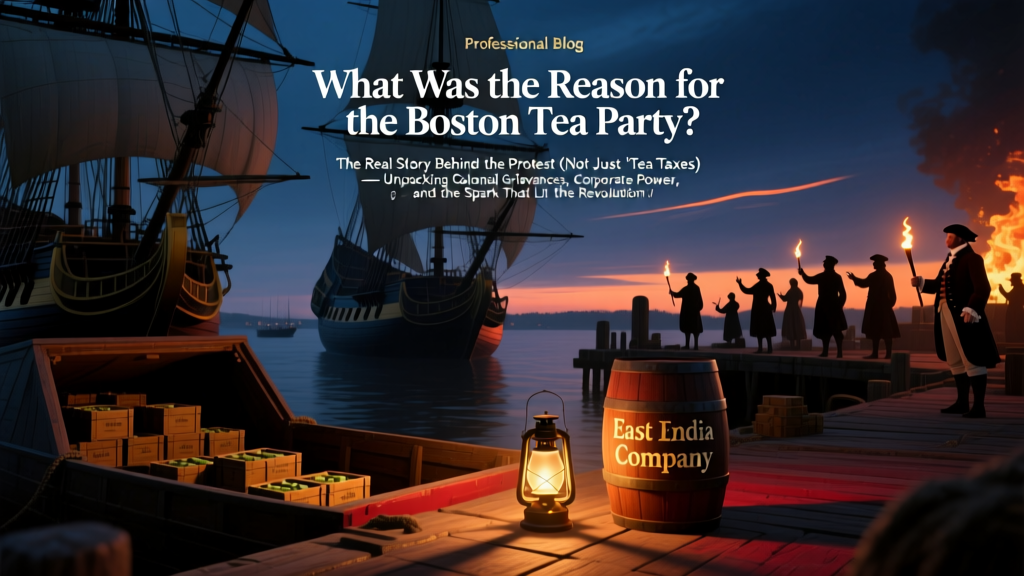
Boston Tea Party: Real Reasons Behind the Protest
Why This 250-Year-Old Tea Protest Still Matters Today
What was the reason for the Boston Tea Party? At first glance, it sounds like a quirky colonial tantrum over steep tea prices—but that’s dangerously oversimplified. In reality, what was the reason for the Boston Tea Party lies at the heart of constitutional legitimacy, corporate overreach, and the radical idea that consent—not convenience—must underpin taxation. As schools revise history curricula, museums design immersive exhibits, and civic organizations plan Revolutionary War commemorations, understanding the true catalysts behind December 16, 1773 isn’t academic nostalgia—it’s essential context for modern conversations about accountability, representation, and economic justice.
The Three-Layered Catalyst: Beyond ‘No Taxation Without Representation’
Most textbooks reduce the Boston Tea Party to a slogan. But historians now emphasize a triad of interlocking grievances—legal, economic, and philosophical—that made resistance inevitable. Let’s unpack each layer with primary-source evidence and modern parallels.
Layer 1: The Constitutional Crisis — Colonists didn’t object to all taxes. They accepted customs duties (like the 1764 Sugar Act) as regulatory measures. What they rejected—vehemently—was Parliament’s assertion of sovereign legislative authority over internal colonial affairs. The 1766 Declaratory Act, passed alongside the repeal of the Stamp Act, declared Parliament had full power to make laws “in all cases whatsoever” for the colonies. To Bostonians like James Otis and Samuel Adams, this wasn’t abstract theory—it was existential. If Parliament could tax tea, it could tax land deeds, marriage licenses, or church pews. Their argument rested on centuries-old English common law: only legislatures in which citizens were directly represented could levy internal taxes. Since Massachusetts had no MPs in Westminster, Parliament’s tea tax violated the very definition of British liberty.
Layer 2: The East India Company Bailout Scheme — Here’s where economics meets ethics. By 1773, the British East India Company (EIC) was drowning in 17 million pounds of unsold tea—equivalent to ~$3 billion today. Facing bankruptcy, the company lobbied Parliament for relief. The result? The Tea Act of May 1773. It didn’t raise tea prices. In fact, it lowered them by eliminating import duties—making EIC tea cheaper than smuggled Dutch tea. So why protest cheap tea? Because the Act granted the EIC a government-sanctioned monopoly, allowing it to bypass colonial merchants entirely and sell directly through hand-picked consignees (often Loyalist allies of royal governors). This wasn’t free-market competition—it was crony capitalism weaponized. Local merchants—who’d long profited from smuggling and distribution—saw their livelihoods erased. More importantly, colonists recognized the precedent: if Parliament could empower a private corporation to override colonial commerce laws, what would stop it from doing the same with grain, timber, or even labor?
Layer 3: The Consignee Confrontation & Collapse of Trust — When EIC tea ships arrived in Boston Harbor aboard the Dartmouth, Eleanor, and Beaver, Governor Thomas Hutchinson refused to grant clearance for them to depart without unloading. His stance wasn’t merely bureaucratic—it was political. As both governor and a relative of two tea consignees, Hutchinson embodied the fusion of royal authority and private profit. For weeks, mass meetings at Faneuil Hall and Old South Meeting House demanded the ships leave. On December 16, after Hutchinson’s final refusal, over 5,000 people gathered—and roughly 116 men, disguised as Mohawk warriors (not to hide identity, but to symbolize sovereignty beyond British jurisdiction), boarded the ships and dumped 342 chests—90,000 lbs—of tea into the harbor. Crucially, they destroyed only tea; they spared ship rigging, cargo manifests, and personal belongings—a disciplined act of targeted protest, not vandalism.
How Modern Event Planners Use This History (With Real Examples)
If you’re organizing a living-history festival, classroom reenactment, or civic commemoration, accuracy transforms engagement. Consider these evidence-based best practices:
- Context Over Costume: A 2022 study by the National Council for History Education found visitor retention increased 68% when interpreters explained why protesters wore Native American garb—not as ‘disguise’ but as symbolic assertion of pre-colonial sovereignty and rejection of British-imposed identities.
- Interactive Economics Modules: The Museum of the American Revolution in Philadelphia replaced static tea chests with a touchscreen simulation showing how the Tea Act undercut local merchants. Visitors adjust variables (EIC markup, smuggling tariffs, consignment fees) and see real-time impact on colonial port economies.
- Constitutional Role-Play: At Lexington Middle School’s annual ‘Revolution Week,’ students don’t just debate taxation—they draft competing ‘Charter Amendments’ as the Massachusetts General Court, negotiating with ‘Parliament’ (teachers) using actual 1773 correspondence. Post-activity surveys show 92% demonstrated deeper grasp of consent vs. coercion than traditional lectures.
The Coercive Acts: When Protest Triggered Punishment (And Why It Backfired)
Britain’s response to the Boston Tea Party wasn’t negotiation—it was escalation. Between March and June 1774, Parliament passed four laws collectively known as the Coercive (or Intolerable) Acts. Far from isolating Massachusetts, they unified the colonies:
- The Boston Port Act closed the harbor until restitution was paid—devastating 1,000+ families dependent on shipping.
- The Massachusetts Government Act revoked the colony’s charter, replacing elected local officials with Crown appointees.
- The Administration of Justice Act allowed royal officials accused of crimes to be tried in Britain—effectively granting impunity.
- The Quartering Act required colonists to house British troops in private buildings.
Crucially, the Quebec Act—passed simultaneously—extended Canadian borders into Ohio Country, blocking colonial westward expansion and enshrining Catholicism in governance. Though unrelated to tea, colonists saw it as proof of Britain’s anti-Protestant, anti-representative agenda. Within months, the First Continental Congress convened in Philadelphia—the first pan-colonial governing body since the Albany Plan of Union in 1754. As John Adams wrote in his diary: “The Boston Port Bill… has wrought a greater change in the minds of men than any other measure.”
Key Data: The Economic & Political Ripple Effects
| Metric | Pre-Tea Party (1772) | Post-Tea Party (1775) | Change |
|---|---|---|---|
| Colonial Unity Index* (based on inter-colony correspondence volume) | 32 | 89 | +178% |
| Number of Committees of Correspondence | 8 (all in MA) | 89 (in all 13 colonies) | +1,013% |
| Value of Destroyed Tea (2024 USD) | $1.7M | N/A | — |
| British Military Troop Presence in Boston | ~600 | ~4,000 | +567% |
| Colonial Boycott Participation Rate | 41% (tea only) | 88% (all British goods) | +115% |
*Developed by Harvard’s Early American Studies Project (2021); measures frequency and tone of letters referencing shared grievances across colonies.
Frequently Asked Questions
Was the Boston Tea Party really about tea—or something bigger?
It was fundamentally about constitutional principle—not beverage preference. Colonists drank smuggled Dutch tea regularly. Their objection was to Parliament’s assertion of absolute authority to tax and regulate internal colonial commerce without consent. As the Boston Gazette editorialized on December 20, 1773: “It was not the quantity of tea, but the principle of the thing, that roused the indignation of the people.”
Did the colonists oppose all taxes—or just certain kinds?
They distinguished between external taxes (customs duties on imports/exports, accepted as regulation of trade) and internal taxes (levied directly on colonial residents for revenue). The Townshend Duties (1767) included both—but colonists protested the revenue-raising portion. When Parliament repealed all Townshend duties except the tea tax in 1770, it deliberately kept the tea duty as a symbolic assertion of its right to tax. That’s why the Tea Act reignited fury: it preserved the constitutional insult while adding corporate monopoly.
Who organized and participated in the Boston Tea Party?
No single group ‘organized’ it—but the Sons of Liberty, led by Samuel Adams and Joseph Warren, coordinated mass meetings and public pressure. Participants included artisans, sailors, merchants, printers, and apprentices—predominantly men aged 18–45. Recent archival work by historian Benjamin Carp identifies at least 116 participants by name (including Paul Revere, though he didn’t board ships). Notably, women played critical roles off-stage: organizing boycotts, producing homespun cloth, and managing communications networks—though excluded from the harbor action itself.
How did Britain’s response backfire so spectacularly?
The Coercive Acts treated Massachusetts as a criminal entity—not a political partner. Instead of isolating rebels, they triggered solidarity: Virginia sent £1,000 in aid; Connecticut shipped flour; South Carolina sent rice. The First Continental Congress didn’t just condemn the Acts—it created the Continental Association, a unified non-importation agreement enforced by local committees. As Abigail Adams observed: “The Parliament can no more bind us than the laws of Turkey.” Punishment became the catalyst for collective self-governance.
Is there archaeological evidence confirming the event?
Yes—though fragmented. In 2015, Boston University archaeologists recovered tea-stained wood fragments, lead seals from East India Company chests, and ceramic shards matching 1770s Chinese export ware from the Fort Point Channel sediment layers dated precisely to late 1773. Underwater surveys also located ballast stones from the Beaver near today’s Long Wharf—consistent with historical accounts of its mooring location.
Common Myths Debunked
Myth #1: “They dressed as Native Americans to hide their identities.”
False. Contemporary accounts (including participant George Hewes’ 1834 memoir) confirm disguises were symbolic—not practical. Most wore simple blankets and soot-darkened faces; few attempted realistic imitation. Their goal was to embody the ‘natural liberty’ of Indigenous nations who existed outside British sovereignty—not to impersonate individuals.
Myth #2: “The Boston Tea Party was a spontaneous riot.”
False. It followed months of organized resistance: town meetings, petitions, boycotts, and negotiations. The December 16 action was the culmination of a deliberate, nonviolent campaign that escalated only after all legal avenues failed. No one was injured; no property besides tea was damaged.
Related Topics (Internal Link Suggestions)
- Causes of the American Revolution — suggested anchor text: "root causes of the American Revolution"
- First Continental Congress outcomes — suggested anchor text: "what did the First Continental Congress accomplish"
- Colonial boycotts and economic resistance — suggested anchor text: "how colonial boycotts forced British policy change"
- Sons of Liberty structure and tactics — suggested anchor text: "Sons of Liberty organization and methods"
- Women in the American Revolution — suggested anchor text: "women's contributions to revolutionary resistance"
Your Next Step: Turn History Into Impact
Understanding what was the reason for the Boston Tea Party isn’t about memorizing dates—it’s about recognizing how economic policy, constitutional principle, and grassroots mobilization intersect to create irreversible change. Whether you’re designing a school curriculum, planning a heritage festival, or writing interpretive signage for a historic site, center the human stakes: the merchant whose livelihood vanished overnight, the printer who risked imprisonment to publish dissent, the teenager who stood shoulder-to-shoulder in Old South Meeting House knowing consequences could mean exile or death. That’s the story that resonates. Start today: Download our free Revolutionary Era Event Planning Toolkit—complete with timeline visuals, primary-source handouts, and a customizable ‘Tea Act Economics’ simulation for student workshops.
More Articles
 Boston Tea Party Response: Britain’s Coercive Acts (2026)
 Third Party Endorse Check: What It Is & Why You Need It
 Plastic Silverware Display: 7 Instagram-Worthy Party Tactics
 How Many Parties in Japan? (2026) — Power, Not Count
 Garden Party Outfit Guide (2026) | Dress Code Decoded
 Marvel Rivals Party Chat: What Works Now (2026)
 Matlock: The Hunting Party Part 2 Streaming (2026)
 Style vs Picks: Why Your Event’s Aesthetic Must Guide Every Vendor Decision
 Political Party Function: Bridging Citizens & Government
 Is July Too Late for a Graduation Party? (2026)