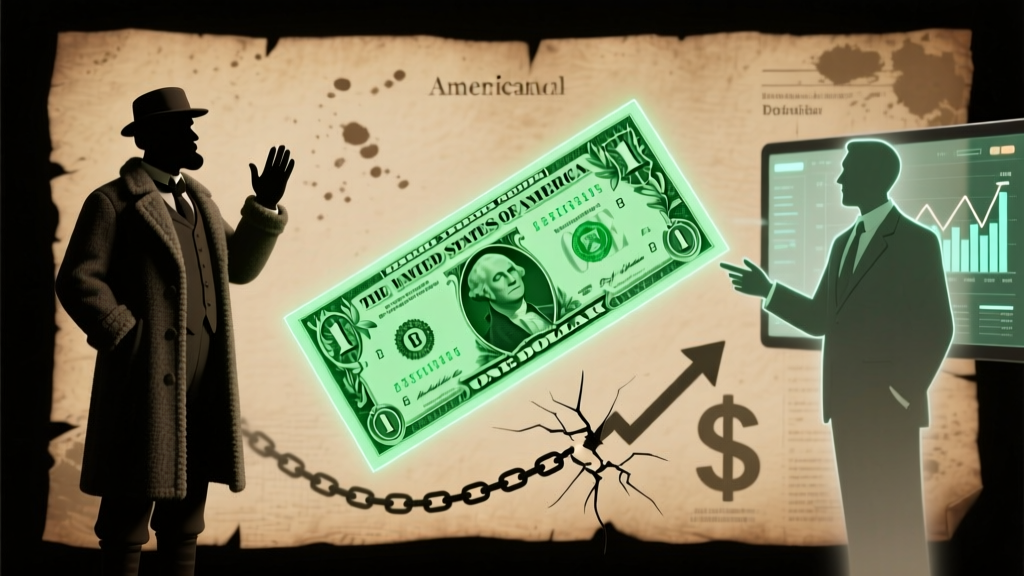
Greenback Party: Origins, Impact & Legacy
Why Understanding What Was the Greenback Party Matters More Than Ever
If you’ve ever wondered what was the Greenback Party, you’re not just digging into a dusty footnote of 19th-century U.S. politics—you’re uncovering the DNA of today’s economic populism. Born from farmer outrage, veteran hardship, and banker backlash, this short-lived but seismic political force reshaped Congress, inspired the Populist Party, and planted seeds for the Federal Reserve, income tax, and even modern debt jubilee movements. In an era of soaring inflation, student loan crises, and renewed calls for currency reform, the Greenbackers’ story isn’t history—it’s a warning, a playbook, and a mirror.
The Crisis That Forged a Party: Civil War Debt & the ‘Crime of ’73’
The Greenback Party didn’t emerge from ideology—it erupted from trauma. After the Civil War, the U.S. government had issued over $450 million in paper money—‘greenbacks’—not backed by gold or silver. These notes kept the Union economy afloat during wartime, but they also fueled inflation and created a two-tiered monetary system: gold-backed dollars for elites, depreciating greenbacks for farmers and laborers.
Then came the Specie Payment Resumption Act of 1875, which mandated that greenbacks be redeemed for gold starting in 1879—and the Coinage Act of 1873, dubbed the ‘Crime of ’73’ by critics for demonetizing silver. Overnight, the money supply contracted by nearly 20%. Prices collapsed: wheat dropped from $1.25/bushel in 1867 to $0.57 in 1894. Farmers who’d borrowed in greenbacks now owed creditors in scarce, appreciating gold. Wages stagnated while debt burdens doubled. This wasn’t abstract economics—it was foreclosures, tenant evictions, and grain riots across the Midwest and South.
The Greenback Party formed in 1874—not as a fringe protest, but as a coalition of organized agrarian alliances (like the National Grange), labor unions (including the Knights of Labor), abolitionist veterans’ groups, and radical economists like George Henry Evans. Their platform was audaciously simple: preserve greenbacks as legal tender, expand the money supply through government-issued currency, and end the gold standard’s stranglehold on credit. They weren’t anti-capitalist—they were pro-*access*. As their 1876 platform declared: “The right to issue money is a sovereign function of government—not a private privilege.”
How the Greenbackers Won (and Lost) Elections—Without Winning the Presidency
Despite never capturing the White House, the Greenback Party achieved remarkable electoral traction in a brutally two-party system. In 1876, their presidential candidate Peter Cooper—a 85-year-old industrialist, inventor, and philanthropist—took 81,737 votes (0.7% nationally) but won over 15% in Kansas and 12% in Iowa. By 1880, James B. Weaver, a former Union general and Iowa congressman, ran on the Greenback-Labor ticket and secured over 300,000 votes (3.3%)—carrying no states, but delivering double-digit showings in six, including Texas (12.3%) and Nevada (14.1%).
Crucially, Greenbackers didn’t just run candidates—they changed the game. They pioneered grassroots tactics still used today: door-to-door canvassing with bilingual pamphlets (Spanish/English in Texas, German in Wisconsin), coordinated ‘Greenback Day’ rallies featuring brass bands and cooperative fairs, and early data-driven campaigning using county-level crop price maps to target messaging. In Illinois’ 1878 congressional elections, Greenback candidates unseated three incumbent Republicans by tying farm foreclosures directly to gold-resumption policies—and won with slogans like ‘Bread or Bullets’ and ‘More Money, Less Misery.’
Their decline wasn’t due to irrelevance—it was strategic absorption. By 1892, most Greenback activists had merged into the People’s (Populist) Party, carrying forward core demands: the subtreasury plan, graduated income tax, direct election of senators, and—yes—free silver. When William Jennings Bryan electrified the 1896 Democratic convention with his ‘Cross of Gold’ speech, he wasn’t inventing new ideas—he was reciting Greenback catechism verbatim.
Policy Legacy: From ‘Fiat Folly’ to Federal Reserve Reality
Contemporary critics dismissed greenbacks as ‘rag money’ and their advocates as cranks. Yet nearly every major Greenback demand became federal law within 50 years:
- Government-issued fiat currency? The Federal Reserve Act of 1913 authorized Federal Reserve Notes—legal tender not redeemable in gold after 1933.
- Income tax to fund public works? The 16th Amendment (1913) enabled progressive taxation—exactly as Greenbackers proposed to finance infrastructure and education.
- Regulation of railroads and monopolies? The Interstate Commerce Act (1887) and Sherman Antitrust Act (1890) emerged directly from Greenback lobbying.
- Direct election of senators? Achieved via the 17th Amendment (1913), a cornerstone of their democratic reform agenda.
Even their most ridiculed idea—debt relief for distressed borrowers—resurfaced in the New Deal’s Home Owners’ Loan Corporation (1933), which refinanced 1 million mortgages, and again in 2009’s Making Home Affordable program. Modern proposals like student loan cancellation, Medicare negotiation, and central bank digital currency (CBDC) echo Greenback logic: that monetary sovereignty must serve broad public welfare—not just creditor interests.
Lessons for Today’s Economic Activists
What can organizers fighting inflation, housing insecurity, or student debt learn from the Greenbackers? Three hard-won insights stand out:
- Frame economics as morality, not math. Greenbackers didn’t lead with M1 money supply charts—they told stories: ‘Your father fought at Shiloh so you could own land—not rent it from a Chicago banker.’ Moral clarity built coalitions across race and region (though their record on racial inclusion was deeply flawed—more on that below).
- Build infrastructure before elections. They spent years organizing Grange halls, printing presses, and cooperative grain elevators—not just campaign signs. Their 1878 Kansas victory followed 3 years of establishing 212 local greenback clubs and 47 cooperative stores.
- Embrace tactical flexibility. When the gold standard proved immovable, they pivoted to silver expansion, then antitrust, then labor rights—always anchoring demands in tangible relief.
A mini case study: In 1884, Greenback-aligned farmers in Minnesota launched the ‘Wheat Pool’—a collective bargaining co-op that withheld 40% of the state’s harvest from Chicago grain traders. Within weeks, prices rose 18%. Though short-lived, it demonstrated that economic power resided not in Washington alone—but in coordinated, localized action.
| Greenback Party Demand (1874–1888) | Opposition Argument | Outcome & Timeline | Modern Parallel |
|---|---|---|---|
| Abolish the gold standard; maintain greenbacks as sole legal tender | “Destroys confidence, invites hyperinflation, harms international trade” | Federal Reserve Notes made irredeemable in gold (1933); Nixon ended Bretton Woods (1971) | Debate over CBDC design: programmable vs. anonymous, central bank vs. distributed ledger |
| Graduated income tax to fund public investment | “Confiscatory, violates property rights, punishes success” | 16th Amendment ratified (1913); top marginal rate peaked at 94% (1944) | Current proposals for wealth taxes, billionaire minimum tax, and IRS enforcement funding |
| Government ownership of railroads & telegraphs | “Inefficient, corrupt, stifles innovation” | Nationalized railroads briefly during WWI; Amtrak (1971) and USPS remain public | Public broadband initiatives, municipal fiber networks, and VA healthcare expansion |
| Eight-hour workday & child labor bans | “Un-American, harms competitiveness, invites socialism” | Adamson Act (1916); Fair Labor Standards Act (1938) | State-level $15+ minimum wage laws, union resurgence (UAW, Starbucks, Amazon) |
Frequently Asked Questions
Was the Greenback Party racist or exclusionary?
Yes—deeply. While some Black leaders like Frederick Douglass expressed cautious support for greenback monetary reform, the party largely ignored Reconstruction-era civil rights. Its Southern chapters often aligned with white supremacist ‘Redeemer’ Democrats to oppose Black voting rights—viewing racial hierarchy as compatible with economic populism. This contradiction fatally weakened its moral authority and contributed to its collapse in the South after 1877.
Did the Greenback Party have any women leaders?
Yes—though under-documented. Mary Lease, later famous as a Populist orator, began her activism in Kansas Greenback circles in the early 1880s, advocating for ‘raise less corn and more hell.’ The party’s 1880 platform endorsed women’s suffrage, making it the first national party to do so—though this was largely symbolic, with minimal organizational support for female candidates.
Why did the Greenback Party disappear after 1888?
Three converging forces: (1) The rise of the Farmers’ Alliance, which offered more localized, cooperative solutions; (2) the 1886 Haymarket Affair, which tainted labor-aligned parties with anarchist associations in the press; and (3) internal fractures over whether to endorse free silver (which split moderates from radicals). By 1892, most Greenbackers joined the People’s Party—effectively dissolving their distinct identity.
Are there modern political groups inspired by the Greenback Party?
Direct lineage is thin, but ideological heirs include the Modern Monetary Theory (MMT) movement—whose scholars cite Greenback economists like William Sylvis; the Debt Collective, which organizes student and medical debt strikes; and state-level ‘public banking’ initiatives (e.g., North Dakota’s Bank of North Dakota, founded 1919). Even Bernie Sanders’ 2016 platform echoed Greenback language: ‘Our money system should serve all Americans—not just Wall Street.’
Where can I find original Greenback Party documents?
The Library of Congress holds digitized copies of the Greenback Journal (1878–1884), the 1876 and 1880 platforms, and Peter Cooper’s 1876 acceptance letter. The University of Iowa’s ‘Populist Era Collection’ includes Greenback correspondence, campaign posters, and Grange meeting minutes. All are freely accessible via loc.gov and digital.lib.uiowa.edu.
Common Myths
Myth #1: The Greenback Party was just a ‘farmer revolt’ with no urban support.
Reality: Over 40% of Greenback voters in 1880 lived in cities. Their strongest base was in industrial Ohio and Pennsylvania—where coal miners and textile workers joined forces with wheat farmers against deflationary wage cuts.
Myth #2: Greenbacks caused runaway inflation during the Civil War.
Reality: Inflation peaked at 18% annually (1864)—significant, but far lower than Confederate currency (which lost 9,000% of value). Post-war deflation (1865–1896) was far more economically destructive, especially for debtors.
Related Topics (Internal Link Suggestions)
- Origins of the Populist Movement — suggested anchor text: "how the Greenback Party paved the way for the People's Party"
- History of U.S. Monetary Policy — suggested anchor text: "from greenbacks to the Federal Reserve"
- 19th-Century Labor Movements — suggested anchor text: "Knights of Labor, Greenbackers, and the fight for fair wages"
- Reconstruction-Era Political Coalitions — suggested anchor text: "why Greenback alliances failed in the post-Civil War South"
- Modern Monetary Theory Explained — suggested anchor text: "what Greenback economics teaches us about today's MMT debate"
Conclusion & Your Next Step
So—what was the Greenback Party? It was more than a footnote. It was America’s first mass movement to challenge financial elites on their own turf: the currency itself. Its failure wasn’t due to bad ideas—it was undone by racism, timing, and the sheer difficulty of wresting monetary power from entrenched interests. But its victories—monetary sovereignty, progressive taxation, labor protections—are woven into the fabric of modern America. If you’re researching economic justice, writing a paper on Gilded Age politics, or organizing around debt relief today, don’t treat the Greenbackers as relics. Study their speeches. Map their county-level vote shares. Reprint their ‘Money Power vs. People Power’ broadsides. Then ask yourself: What’s our greenback moment—and what will we print on it? Start by downloading the Library of Congress’ free Greenback Party archive toolkit—your first act of monetary citizenship begins there.
More Articles
 A Craft Fair Timeline Template
 What Is a Single Issue Party? Explained
 Best Party Appetizers: 7 Fast, Cheap & Crowd-Pleasing (2026)
 What Party Was Richard Nixon? Republican Legacy Explained
 Why First Party Data Is Important in 2026
 How to Leave a Party in Rocket League Gracefully
 No Party Affiliation: Primary Access & Ballot Impact
 What Are Minor Parties? Truth, Impact & Myths
 Engagement Party Hosts: Who Pays in 2026?
 Change Party Affiliation NYC: 7-Minute Checklist (2026)