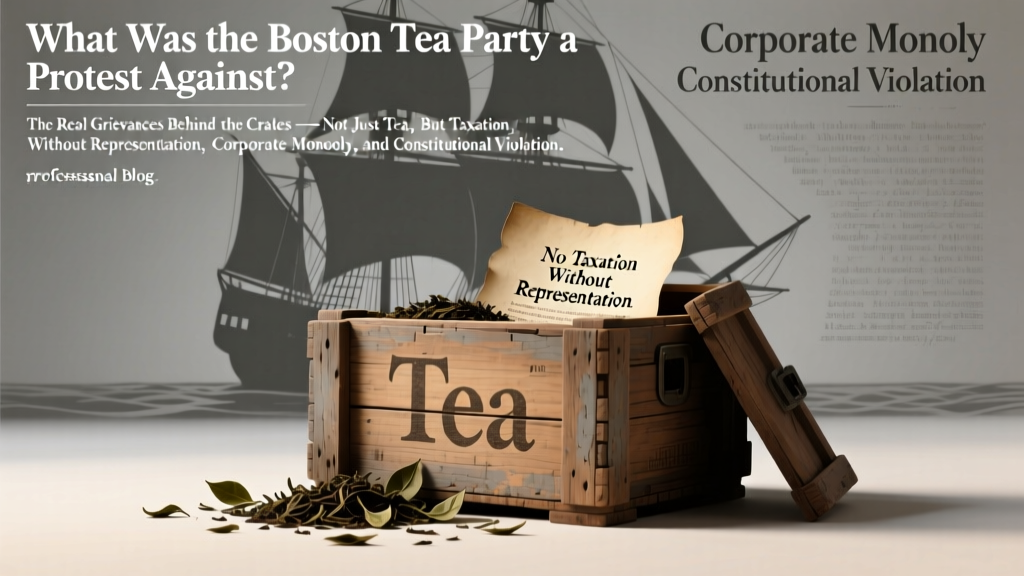
What Was The Boston Tea Party A Protest Against
Why This Question Matters More Than Ever Today
What was the Boston Tea Party a protest against? It’s not just a trivia question—it’s a foundational inquiry into how ordinary citizens respond when economic policy, corporate power, and democratic consent collide. In an era of rising corporate influence in legislation, digital surveillance, and debates over tax fairness, understanding the precise grievances behind December 16, 1773 isn’t academic nostalgia—it’s civic literacy with urgent relevance.
The Three Core Grievances: Beyond ‘They Hated Taxes’
Most textbooks oversimplify the Boston Tea Party as ‘colonists protesting taxes.’ That’s dangerously incomplete. The protest targeted three interlocking injustices—each legally documented, publicly debated, and deliberately escalated by British Parliament in 1773:
- Taxation Without Representation: The Tea Act of 1773 retained the 3-penny-per-pound duty on tea imposed by the Townshend Acts (1767)—a tax colonists had never consented to through elected representatives in Parliament. As James Otis declared in 1764, ‘Taxation without representation is tyranny.’ This wasn’t abstract principle; it was codified in colonial charters and affirmed repeatedly in petitions to the Crown.
- Corporate Monopoly & Market Suppression: The Tea Act didn’t raise tea prices—it lowered them by granting the financially struggling British East India Company exclusive rights to sell tea directly to colonies, bypassing colonial merchants. This undercut local importers (like Boston’s John Hancock and Samuel Adams’ merchant allies), destroyed middlemen livelihoods, and established a precedent: Parliament could empower private corporations to override colonial economies.
- Constitutional Erosion & Judicial Overreach: The Tea Act also authorized customs officials to seize ships and cargo without jury trials—using admiralty courts (which lacked juries) instead of common law courts. Colonists saw this as dismantling their inherited English rights, including trial by peers—a right enshrined in the Magna Carta and reaffirmed in colonial charters.
Crucially, colonists weren’t opposed to paying for tea—they’d happily buy Dutch or smuggled tea at lower prices. Their objection was to *how* the tea arrived: as a symbol of parliamentary supremacy over colonial legislatures and economic life.
How the Protest Was Organized: A Masterclass in Nonviolent Direct Action
The Boston Tea Party wasn’t spontaneous rage—it was a meticulously coordinated act of civil disobedience, planned over weeks by the Boston Committee of Correspondence and the Sons of Liberty. Here’s how it unfolded with disciplined precision:
- Intelligence Gathering: On November 28, 1773, the ship Dartmouth arrived carrying 114 chests of East India Company tea. Customs law required duties paid within 20 days—or cargo seized. Colonists immediately tracked arrival dates, crew movements, and customs officer schedules.
- Mass Assembly & Negotiation: Between November 29 and December 15, over 5,000 residents (nearly half Boston’s population) gathered at Old South Meeting House—the largest public space in town—for daily assemblies. Leaders like Josiah Quincy Jr. drafted formal petitions demanding the ship depart unharmed; Governor Hutchinson refused, citing royal orders.
- Strategic Disguise & Targeted Destruction: On December 16, 3–4 p.m., after Hutchinson’s final refusal, 116 men (many recorded by name in later affidavits) boarded three ships—the Dartmouth, Beaver, and Eleanor. They wore Mohawk disguises—not to ‘play Indian,’ but to obscure identities *and* invoke Indigenous sovereignty as symbolic resistance to imperial authority. They broke open 342 chests (90,000 lbs) of tea—worth £9,659 (~$1.7M today)—but damaged no other property, harmed no crew, and swept decks afterward. As eyewitness George Hewes recalled: ‘We were careful not to injure anything but the tea.’
This restraint was strategic: it distinguished lawful protest from riot, preserving moral high ground. British officials later admitted in Parliamentary hearings that the action was ‘orderly, silent, and systematic’—a fact that undermined claims of colonial lawlessness.
The Immediate Fallout: How Britain Misread the Message
Instead of addressing colonial grievances, Parliament responded with punitive legislation—the Coercive (Intolerable) Acts of 1774—which backfired spectacularly:
- Boston Port Act: Closed Boston Harbor until tea was paid for—devastating the city’s economy and uniting other colonies in sympathy.
- Massachusetts Government Act: Revoked the colony’s charter, replacing elected officials with royally appointed ones and banning town meetings without governor approval.
- Administration of Justice Act: Allowed royal officials accused of crimes to be tried in Britain—removing accountability to local juries.
- Quartering Act: Required colonists to house British soldiers in private homes.
These acts transformed localized grievance into continental unity. Within months, the First Continental Congress convened in Philadelphia (September 1774), adopting the Declaration of Rights and Grievances—and initiating coordinated nonimportation agreements. As John Adams wrote in his diary: ‘The Boston Port Bill… united all America.’
What the Tea Party Reveals About Modern Civic Engagement
Today’s organizers—from climate activists blocking fossil fuel infrastructure to digital rights advocates challenging surveillance laws—draw direct inspiration from the Boston Tea Party’s playbook. Its enduring power lies in three replicable principles:
- Target Symbolic Infrastructure: Like dumping tea to reject monopolistic trade policy, modern protests target pipelines (symbolizing fossil fuel dependence) or data centers (symbolizing surveillance capitalism). The act must visibly represent the systemic injustice.
- Build Broad-Based Legitimacy: The Tea Party succeeded because it emerged from transparent, mass assemblies—not secret cabals. Today, successful movements use open-source platforms, participatory budgeting, and live-streamed decision-making to mirror this transparency.
- Accept Consequence, Reject Violence: Participants knew they risked treason charges (punishable by hanging). Yet they refused property damage beyond the targeted commodity. This moral clarity forced opponents to confront the legitimacy of the grievance—not the tactics.
A 2023 Pew Research study found that 78% of Americans aged 18–34 view civil disobedience as ‘justified when laws violate fundamental rights’—a statistic echoing colonial arguments. The Boston Tea Party remains less a relic than a living methodology.
| Grievance | Colonial Argument (1773) | British Counterargument | Modern Parallel |
|---|---|---|---|
| Taxation Without Representation | “No taxation without consent of elected representatives” — affirmed in Massachusetts Charter (1691) | “Virtual representation”: colonists represented in Parliament by virtue of being British subjects | U.S. territories (e.g., Puerto Rico, D.C.) pay federal taxes but lack voting representation in Congress |
| Corporate Monopoly Power | East India Company granted exclusive trade rights, destroying colonial merchants’ livelihoods and undermining local economies | “Economic efficiency”: monopoly would stabilize tea market and reduce smuggling | Big Tech platform policies that ban third-party apps or favor owned services (e.g., Apple’s App Store rules, Amazon’s preference for private-label goods) |
| Judicial Accountability | Admiralty courts denied jury trials for customs violations—violating Magna Carta and colonial charters | “Necessary expedience”: juries in colonies were biased and refused to convict violators | Federal use of military commissions or FISA courts for domestic surveillance cases, bypassing civilian juries |
Frequently Asked Questions
Was the Boston Tea Party really about tea—or something deeper?
It was almost entirely symbolic. Colonists drank smuggled Dutch tea (cheaper and untaxed) and had boycotted British tea for years. The protest targeted the *principle*: Parliament’s assertion of absolute authority to tax and regulate colonial commerce without consent. As Samuel Adams wrote in 1773, ‘The cause of Boston… is the cause of America.’
Did any colonists oppose the Boston Tea Party?
Yes—prominent moderates like John Adams initially called it ‘magnificent’ but later expressed concern over escalation. Loyalist merchants (e.g., Andrew Oliver) condemned it as destructive and unlawful. Even some Patriots, like Benjamin Franklin, offered to reimburse the East India Company—though he later reversed his position after Britain imposed the Coercive Acts.
How much tea was destroyed—and what was its modern value?
342 chests containing 90,000 pounds (45 tons) of tea—mostly Bohea, Congou, and Singlo varieties. Adjusted for inflation and relative economic output, historians estimate its 2024 equivalent value between $1.2 million and $1.7 million. Crucially, colonists destroyed only tea—not ships, rigging, or crew belongings.
Were there similar tea protests in other colonies?
Yes—though Boston’s was the most dramatic. In Charleston, SC, tea was seized and stored (never destroyed); in Philadelphia and New York, ships were turned away outright. Annapolis saw the burning of the ship Peggy Stewart after its owner paid the tea duty—proving the issue wasn’t the tea itself, but the principle of payment.
Why did protesters dress as Mohawk people?
Not as mockery—but as deliberate political theater. Mohawk nations were sovereign entities who resisted British control. Wearing their regalia signaled alliance with Indigenous resistance to empire and asserted colonial self-determination. Modern scholars emphasize this was performative sovereignty—not cultural appropriation in the contemporary sense.
Common Myths
- Myth #1: Colonists dressed as Native Americans to hide their identities. While disguise helped, primary sources (like Hewes’ memoir) confirm the Mohawk symbolism was intentional and widely understood—as an assertion of alternative sovereignty, not mere anonymity.
- Myth #2: The protest was universally supported by colonists. Polling didn’t exist, but letters, newspapers, and town meeting minutes show sharp divisions: Boston’s merchant elite largely backed it; rural farmers were skeptical; Loyalists openly condemned it. Support solidified only after Britain’s harsh response.
Related Topics (Internal Link Suggestions)
- Causes of the American Revolution — suggested anchor text: "root causes of the American Revolution"
- Townshend Acts Explained — suggested anchor text: "what were the Townshend Acts"
- First Continental Congress Outcomes — suggested anchor text: "results of the First Continental Congress"
- Sons of Liberty Organization — suggested anchor text: "who were the Sons of Liberty"
- Coercive Acts Impact — suggested anchor text: "how the Intolerable Acts united the colonies"
Conclusion & Your Next Step
So—what was the Boston Tea Party a protest against? It was a unified, principled stand against taxation without representation, corporate capture of governance, and the dismantling of legal rights. It wasn’t anti-tea. It was pro-constitution. Pro-accountability. Pro-self-determination. Understanding this transforms it from a schoolroom anecdote into a living framework for ethical civic action today. If you’re planning a classroom lesson, community reenactment, or civic dialogue series, start not with costumes or crates—but with the three grievances: representation, monopoly, and due process. Download our free Boston Tea Party Discussion Guide—complete with primary source excerpts, role-play scenarios, and modern parallel case studies—to turn historical insight into actionable dialogue.
More Articles
 How to Decorate Birthday Party Table (2026)
 How Political Parties Support Democracy
 How to Throw a Halloween Party (2026)
 What Is the Rave Party? (2026)
 Which Party Has the Most Billionaires? (2026)
 Bonfire Party Outfit Formula: Stay Comfortable (2026)
 Are Parti Poodles More Expensive? (2026)
 Best Dice in Super Mario Party: Data-Driven Analysis
 Texas One-Party Consent Recording: Legal Limits (2026)
 How to Make Fruit Punch for a Party (2026)