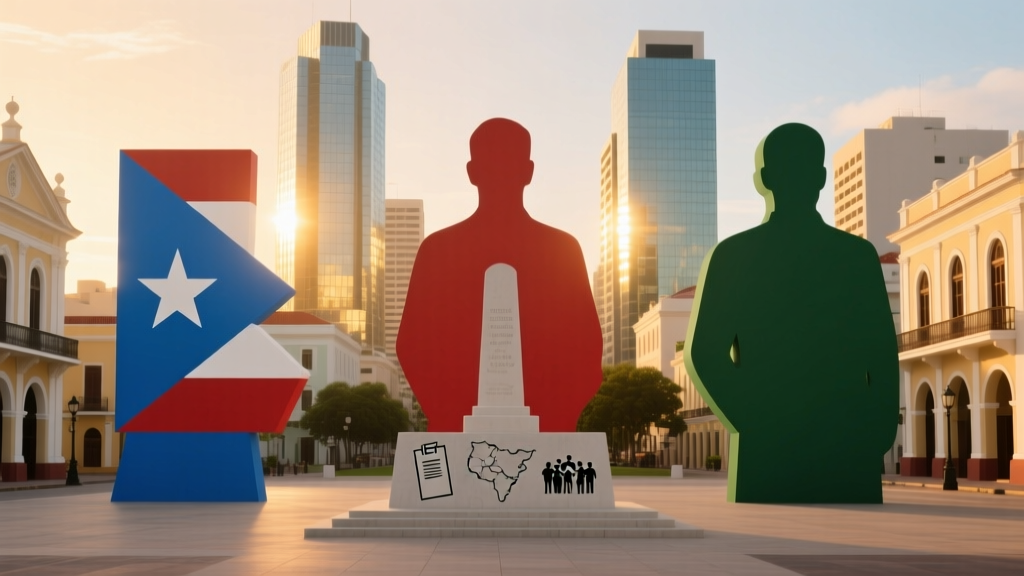
Puerto Rico Political Parties: Histories, Platforms, Impact
Why This Question Matters More Than Ever
If you've ever asked what are the 3 major political parties in Puerto Rico, you're not just looking for names—you're seeking clarity in a landscape where politics directly shapes your taxes, education funding, disaster recovery timelines, and even whether your voice counts in U.S. presidential primaries. With Puerto Rico facing historic fiscal oversight, climate vulnerability, and an unresolved political status debate, understanding these three dominant parties isn’t academic—it’s essential for informed civic action, relocation decisions, business strategy, or even family conversations about identity and future.
The Big Three: Beyond Labels to Lived Reality
Puerto Rico’s political ecosystem is unique—not because it lacks parties, but because its three major parties organize almost exclusively around one defining question: What should Puerto Rico’s ultimate political relationship with the United States be? Unlike mainland U.S. parties that diverge primarily on economics or social policy, Puerto Rico’s parties are constitutional status vehicles first—and policy platforms second. That distinction changes everything: campaign slogans, legislative priorities, judicial appointments, and even how federal funds are advocated for or resisted.
The Popular Democratic Party (PPD), founded in 1938 by Luis Muñoz Marín, champions Estado Libre Asociado (ELA)—the current Commonwealth status. But don’t mistake ‘Commonwealth’ for static stability: the PPD has evolved from defending ELA as a permanent, dignified arrangement to advocating for its 'enhancement'—seeking greater autonomy while retaining U.S. citizenship and federal benefits. In practice, this means pushing for expanded Medicaid parity, local control over maritime laws (Jones Act reform), and bilingual federal agency access.
The New Progressive Party (PNP), established in 1967, advocates for full U.S. statehood. Its platform treats statehood not as symbolic but as a practical toolkit: equal treatment under federal programs (e.g., SNAP expansion, Medicare reimbursement parity), automatic inclusion in federal disaster relief formulas (no more FEMA approval delays), and voting representation in Congress. Crucially, the PNP does not seek assimilation—it explicitly supports preserving Spanish as the island’s primary language and protecting cultural institutions like the Instituto de Cultura Puertorriqueña.
The Puerto Rican Independence Party (PIP), founded in 1946 by Gilberto Concepción de Gracia, pursues national sovereignty through peaceful, democratic means. Its vision includes a transitional period with international oversight, debt renegotiation outside U.S. bankruptcy courts (like PROMESA’s FOMB), and reassertion of jurisdiction over natural resources—including offshore oil exploration rights and water management. While often labeled ‘idealistic,’ PIP has achieved tangible influence: its advocacy helped shape the 2022 Puerto Rico Status Act’s inclusion of independence as a federally funded plebiscite option.
How They Actually Govern: Power, Parity, and Policy Gaps
Understanding party platforms is only half the story. The real impact unfolds in governance mechanics—especially under Puerto Rico’s unicameral legislature and the governor’s veto power. Since 2000, control has alternated between PNP and PPD—but never with a unified supermajority. This structural gridlock forces coalition-building on critical issues, revealing each party’s pragmatic flexibility.
Take Hurricane Maria recovery: PNP-led administrations prioritized FEMA compliance and infrastructure hardening (e.g., $1.3B grid modernization), while PPD-led governments emphasized community-led rebuilding grants and housing-first approaches—even creating the Programa de Vivienda para la Recuperación that bypassed traditional contractors to fund homeowner cooperatives. Meanwhile, PIP legislators successfully amended the Recovery Fund’s transparency rules to require quarterly public dashboards—a win for accountability, not ideology.
Educational reform shows similar nuance. Though all three parties support bilingual instruction, they diverge sharply on governance. The PNP backed centralizing curriculum standards under the Department of Education to align with U.S. Common Core benchmarks; the PPD pushed decentralization, empowering municipal school boards to adapt content to local history and ecology; and the PIP introduced legislation mandating anti-colonial pedagogy frameworks and indigenous Taíno studies in all K–12 curricula—a bill passed unanimously in committee but stalled in full Senate vote due to fiscal concerns.
A lesser-known reality: party discipline is weaker than in the U.S. Congress. Legislators frequently break ranks—especially on ethics bills or budget allocations—making individual relationships and district needs stronger drivers than party lines. For example, in 2023, four PNP senators joined PPD colleagues to override Governor Pierluisi’s veto on a living wage increase for public sector workers—demonstrating that economic justice can temporarily eclipse status debates.
Voting Behavior Decoded: Who Supports Whom—and Why It’s Changing
Puerto Rico’s electorate is aging rapidly (median age: 45.2), yet youth turnout surged 67% in the 2020 general election—the highest since 1992. This shift is reshaping party loyalty. Traditional PPD strength in rural municipalities like Jayuya and Utuado is softening, while PNP gains are concentrated among professionals in San Juan’s banking and tech sectors. Most strikingly, PIP’s support has doubled among voters aged 18–29 since 2016—not because of ideological conversion, but due to disillusionment with both status options after PROMESA’s austerity measures and the 2019 #RickyRenuncia protests.
Socioeconomic factors also defy stereotypes. Contrary to assumptions that statehood = pro-business, small-business owners in Mayagüez overwhelmingly backed PPD in 2020—citing fears that statehood would trigger higher minimum wages before federal tax credits phased in. Conversely, unionized teachers in Caguas voted 72% PNP, trusting its promise of federal Title I parity over PPD’s local funding pledges.
Religious affiliation plays a subtle role too. Evangelical congregations—now 22% of the population—lean PNP (61%) on moral issues like abortion access restrictions, yet many pastors publicly endorse PIP’s anti-corruption stance, creating internal tension. Meanwhile, Catholic dioceses have issued joint statements with PPD on poverty alleviation but criticized PIP’s environmental platform as insufficiently urgent on coastal erosion.
Key Differences at a Glance
| Feature | Popular Democratic Party (PPD) | New Progressive Party (PNP) | Puerto Rican Independence Party (PIP) |
|---|---|---|---|
| Core Status Goal | Enhanced Commonwealth (ELA Mejorado) | U.S. Statehood | Full Sovereign Independence |
| Federal Tax Treatment | Maintains current IRS Code §933 exemption for local income | Full application of U.S. federal income tax (with deductions/credits) | Establishes independent tax authority; seeks bilateral treaties |
| U.S. Citizenship | Preserved under current ELA; seeks statutory guarantee | Automatic and permanent for all residents | Offers dual citizenship option during transition; no U.S. passport post-independence |
| 2024 Key Legislative Priority | Passage of the Puerto Rico Self-Determination Act (S. 2945) | Advocacy for H.R. 2757 (Puerto Rico Status Act) implementation | Securing UN decolonization committee review of U.S. oversight |
| Recent Electoral Performance (2020) | 32.7% gubernatorial vote; 23 seats in House | 32.9% gubernatorial vote; 34 seats in House | 13.9% gubernatorial vote; 1 seat in House |
Frequently Asked Questions
Does Puerto Rico have Democrats and Republicans like the U.S. mainland?
No—Puerto Rico’s major parties are not branches of the U.S. Democratic or Republican parties. While PPD members often align with mainland Democrats on social spending and PNP members with Republicans on tax policy, both parties run candidates under their own banners in local elections. Notably, Puerto Ricans cannot vote in U.S. presidential general elections, so party affiliation here is rooted in status, not federal partisan dynamics.
Can independents vote in Puerto Rico’s primary elections?
Yes—but only if they affiliate with a party 30 days before the primary. Unlike some U.S. states, Puerto Rico uses closed primaries: voters must declare party membership to participate. However, unaffiliated voters can join any party on election day during early voting periods, creating strategic shifts—especially among younger voters testing party alignment before committing long-term.
How do these parties influence U.S. federal policy?
Directly and indirectly. Though Puerto Rico has no voting representatives, its parties lobby Congress through the Resident Commissioner’s office, coordinate with U.S.-based advocacy groups (e.g., PNP’s ties to the Republican National Committee, PIP’s work with Latin American solidarity networks), and shape federal agency rulemaking—like the 2023 CMS waiver allowing Medicaid expansion without full statehood. Their unified positions on issues like Jones Act reform or PROMESA oversight carry significant weight in congressional hearings.
Are there other active political parties beyond the big three?
Yes—though none hold legislative seats. The Movimiento Victoria Ciudadana (MVC) gained 14.5% in 2020 by rejecting status-as-the-only-issue and focusing on anti-corruption, climate resilience, and decolonial feminism. The Proyecto Dignidad party (evangelical-rooted) won 14% in 2020 but lost all seats in 2024 amid internal splits. These emerging forces signal growing demand for issue-based, non-status-centric politics—potentially fracturing the traditional triad in future elections.
Do these parties have different stances on climate change and disaster response?
Absolutely—and it’s increasingly central to their platforms. PPD emphasizes ‘adaptive sovereignty’: using Commonwealth flexibility to create island-specific climate financing mechanisms. PNP pushes for inclusion in federal climate grant programs (e.g., Inflation Reduction Act’s Clean Communities Investment Accelerator). PIP advocates for climate reparations from the U.S. and international bodies, citing historical emissions responsibility and colonial extraction. All three supported the 2023 Puerto Rico Climate Action Plan—but clashed fiercely over whether offshore wind projects should be federally licensed (PNP) or locally controlled (PPD/PIP).
Debunking Common Myths
Myth #1: “The PIP is a fringe party with no real influence.”
Reality: Though holding only one House seat, PIP co-authored the landmark 2022 Puerto Rico Status Act, secured inclusion of independence in federally funded plebiscites, and led successful legal challenges against PROMESA’s Financial Oversight Board—forcing greater transparency in fiscal decisions affecting pensions and education budgets.
Myth #2: “Statehood would automatically mean higher taxes for all residents.”
Reality: Federal income tax would apply, but Puerto Rico’s existing sales tax (11.5%) and property taxes are far higher than most U.S. states’. Analysis by the Center for a New Economy shows median households would see net tax reductions due to expanded EITC, Child Tax Credit, and Medicaid reimbursements—offsetting new federal liabilities.
Related Topics (Internal Link Suggestions)
- Puerto Rico status referendum history — suggested anchor text: "Puerto Rico plebiscite results since 1967"
- How Puerto Rico's government works — suggested anchor text: "Puerto Rico's constitution and branches of government"
- Cost of living in Puerto Rico by city — suggested anchor text: "San Juan vs. Ponce cost comparison"
- Tax incentives for businesses in Puerto Rico — suggested anchor text: "Act 20 and Act 22 explained"
- Voting rights for U.S. territories — suggested anchor text: "Why Puerto Ricans can't vote for president"
Your Next Step: Move Beyond Observation to Engagement
Now that you understand what are the 3 major political parties in Puerto Rico—not just their names but their operational logic, electoral realities, and policy fingerprints—you’re equipped to do more than read headlines. Subscribe to the nonpartisan Centro de Estudios Públicos newsletter for monthly legislative trackers. Attend a virtual town hall hosted by the Puerto Rico Elections Commission (CEE) before the 2024 November general election. Or—if you’re considering relocation—schedule a free consultation with a local civic navigator who can match your values (e.g., climate action, education equity, economic mobility) to the districts and representatives most aligned with your priorities. Politics here isn’t abstract. It’s pavement, power grids, classroom supplies, and hospital staffing levels—and your awareness is the first lever of change.
More Articles
 Hulu Watch Party: How to Host One (2026)
 How to Plan for Birthday Party: Stress-Free Framework
 How Political Parties Work: Demystified
 How to Serve Brownies at a Party Like a Pro
 How to Host a Hot Tub Party Safely (2026)
 Where To Go For Birthday Parties (2026)
 What Is Chief of Party? Role, Salary & vs. PM (2026)
 How to Make a Party Private in Fortnite (2026)
 Party Bus Milwaukee: 7-Step Booking Guide (2026)
 Labour Party Tenure: 1945–2026 | Historical Breakdown