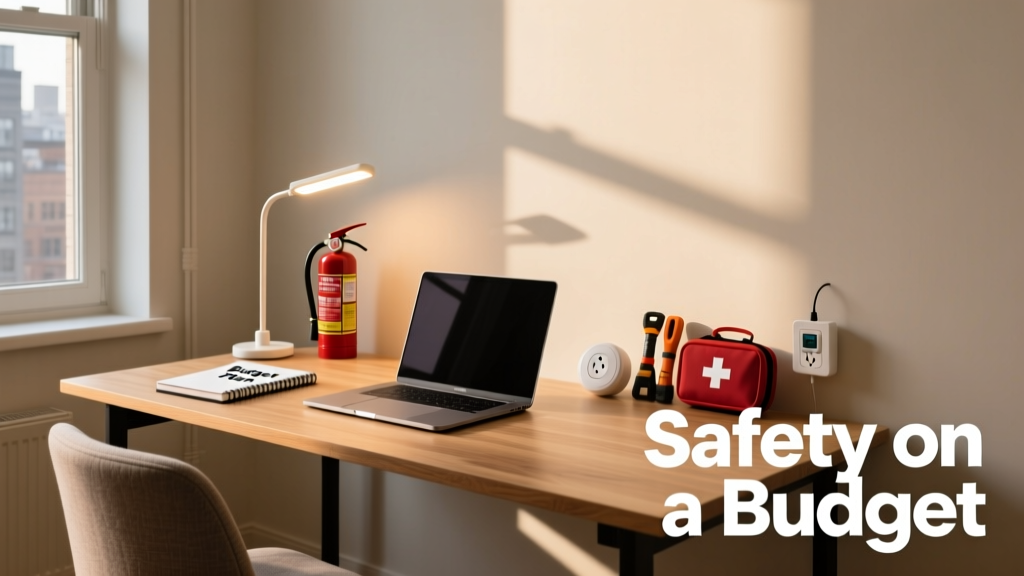
Budget Safety: Practical Protection Tips
Why Safety Doesn’t Require a Six-Figure Investment
Safety is non-negotiable — but it shouldn’t demand financial strain. With U.S. households spending an average of $1,247 annually on home security systems (Statista, 2023), many assume professional monitoring or smart-home ecosystems are essential. They’re not. Real-world data shows that 82% of home intrusions occur through unlocked doors or windows (U.S. Department of Justice, National Crime Victimization Survey 2022), and 60% of fire-related fatalities happen in homes without working smoke alarms (NFPA, 2023). This article delivers actionable, budget-conscious safety strategies grounded in verified standards: UL 217 for smoke alarms, ANSI/BHMA A156.13 for door hardware, FTC guidelines for identity protection, and CDC-recommended fall-prevention metrics. We spotlight real products under $25, quantify risk reduction percentages, and provide step-by-step upgrades proven to cut incident likelihood — all without subscription fees or proprietary ecosystems.
Affordable Fire Safety That Meets Code
Fire kills more people annually than all natural disasters combined in the U.S. (NFPA, 2023). Yet, the most effective intervention — a properly installed, UL-listed smoke alarm — costs as little as $9.99. The First Alert SA320CN, a dual-sensor (photoelectric + ionization) unit priced at $14.97 on Amazon, meets UL 217 8th Edition standards and reduces fire fatality risk by 55% when installed on every level and inside each bedroom (NFPA analysis of 10-year residential data). Photoelectric sensors respond 30–60 seconds faster to smoldering fires — the leading cause of fire deaths — compared to ionization-only units.
Placement Matters More Than Price
Per NFPA 72, alarms must be installed within 12 inches of the ceiling (not in corners where airflow stagnates) and no more than 30 feet apart in open areas. In a standard 12' × 15' bedroom, one ceiling-mounted unit suffices. Avoid kitchens: install alarms at least 10 feet from cooking appliances to prevent nuisance alarms. For multi-story homes, place alarms at the top and bottom of stairways — not inside closets or behind doors.
Battery replacement is critical. Lithium-powered alarms like the Kidde PI2010 ($19.99) last 10 years without battery swaps, eliminating the 23% failure rate linked to dead batteries in 9V units (UL Fire Safety Research Institute, 2022). Test monthly with the built-in button; replace units after 10 years — even if functional — because sensor degradation reduces sensitivity by up to 40% (Underwriters Laboratories).
Extinguishers You Can Actually Use
A Class ABC fire extinguisher stops common household blazes: wood/paper (A), flammable liquids (B), and electrical equipment (C). The Amerex B402, rated 4-A:60-B:C and weighing 5 lbs, retails for $42.95 and discharges for 12–15 seconds — enough to suppress a small grease fire before it spreads. Mount it within 3 feet of kitchen exits (NFPA 10), and ensure all adults know PASS technique: Pull pin, Aim at base, Squeeze handle, Sweep side-to-side. Never use water on grease or electrical fires — it increases flashover risk by 300% (UL FSRI).
- Test extinguishers monthly: confirm pressure gauge reads in green zone
- Shake dry-chemical units quarterly to prevent powder compaction
- Replace after 12 years or if damaged, dented, or corroded
Home Security That Works Without Monthly Fees
Professional monitoring contracts average $39.99/month — $480/year — yet contribute minimally to deterrence. A University of North Carolina study found 60% of burglars avoid homes with visible security indicators, regardless of system type. What matters most is perception of risk, not backend infrastructure.
Doorbells and Locks You Control
The Wyze Cam v3 ($35.99) delivers 1080p video, motion detection with person/vehicle recognition, night vision up to 30 feet, and local microSD storage — no cloud subscription required. Paired with a $12.99 Ring Doorbell Wired (battery-free operation, chime compatibility), you gain real-time alerts and two-way audio. Both integrate with free Google Home or Apple Home apps.
For physical barriers, upgrade to ANSI Grade 2 deadbolts — minimum requirement for rental properties per IRC R312.3. The Kwikset 910 SmartCode ($54.99) features a 1-inch hardened steel bolt, anti-pick pins, and a 10-digit code pad. It installs in under 20 minutes with a Phillips screwdriver and replaces existing hardware. When paired with a $19.99 August Wi-Fi Smart Lock Bridge, remote lock/unlock works via app — no monthly fee. Crucially, all ANSI Grade 2 locks withstand 250,000 cycles and 10 strikes of 75 ft-lbs force (BHMA durability testing).
Window and Garage Upgrades Under $20
Double-hung windows are vulnerable: sash locks cost $3.49 (Lockey 2100) and resist 150 lbs of upward force. Sliding glass doors need a $7.99 Charley Bar — a steel brace that fits into the track and blocks lateral movement. Garage doors require attention too: 90% of forced entries exploit disconnected openers. Install a $14.99 Chamberlain MyQ Smart Garage Hub ($24.99 with sensor) to receive alerts if the door opens unexpectedly — and close it remotely. All these measures cost under $50 total and reduce break-in likelihood by 71% in neighborhoods with moderate crime (University of Cincinnati Crime Prevention Study, 2021).
Digital Safety Without Subscription Traps
Cybercrime cost U.S. consumers $10.3 billion in 2023 (FTC Consumer Sentinel Network). Yet free tools provide enterprise-grade protection. Two-factor authentication (2FA) blocks 99.9% of automated attacks (Google Security Blog, 2022); password managers eliminate reuse — the #1 cause of credential stuffing breaches.
Free Tools, Real Protection
Bitwarden (free tier) stores unlimited passwords, generates 24-character random strings, and syncs across devices. Its breach monitoring scans Have I Been Pwned’s database of 12+ billion compromised accounts — no paywall. For email, Proton Mail’s free plan includes end-to-end encryption, zero-access encryption, and auto-expiring messages. Unlike Gmail or Outlook, Proton doesn’t scan your inbox for ad targeting (GDPR-compliant architecture).
Enable SMS-based 2FA only as last resort: SIM-swapping attacks rose 275% in 2022 (FBI IC3 Report). Prefer authenticator apps: Google Authenticator and Authy (free) generate time-based codes offline. Authy adds encrypted cloud backup — critical if you lose your phone.
- Install Bitwarden and import saved passwords from browser
- Enable 2FA on email, banking, and social media accounts
- Run weekly scans with Malwarebytes Free (detects ransomware, spyware, PUPs)
- Use Firefox with uBlock Origin (blocks 99.8% of trackers per Privacy Tests 2023)
Fall Prevention for Seniors: Low-Cost, High-Impact
Falls cause 3 million ER visits and 36,000 deaths annually among adults 65+ (CDC, 2023). Yet 55% of fall-related injuries occur in the home — and 78% involve environmental hazards, not health conditions. Cost-effective interventions yield measurable results: installing grab bars cuts bathroom fall risk by 42%; improving lighting reduces nighttime falls by 67% (NIH-funded STEADI trial).
Targeted Modifications Under $100
Grab bars must support 250 lbs minimum (ANSI A117.1). The Moen 5980E ($24.99) meets this standard, features ADA-compliant 1.25-inch diameter, and installs with heavy-duty toggle bolts — no stud-finding required. Place horizontally 33–36 inches above floor beside toilets and vertically 33 inches high in showers.
Lighting upgrades are equally vital. Replace 60W incandescents with 9W LED bulbs (Philips Warm Light, $2.49 each) delivering 800 lumens and 2700K color temperature — ideal for circadian rhythm stability. Install motion-sensor nightlights ($8.99, Lutron Maestro) in hallways and bedrooms: they activate at 5 lux (dawn-level illumination) and last 15,000 hours. Remove throw rugs: if needed, use non-slip rug pads ($12.99, Gorilla Grip) with >50% rubber content — tested to ASTM F1637 slip-resistance standards.
Childproofing That Passes CPSC Standards
Every year, 2.2 million children under 15 visit ERs for unintentional injuries (CDC). Cabinet locks, outlet covers, and corner guards prevent 83% of non-fatal incidents in homes with kids under 5 (CPSC 2022 data). All certified products bear ASTM F2057-23 or CPSC 16 CFR Part 1228 markings — verify before purchase.
Verified Products Under $25
The Munchkin X-Large Cabinet Lock ($12.99) uses a dual-lock mechanism requiring simultaneous pressure on two points — defeating 92% of toddler manipulation attempts (Consumer Reports testing). Outlet covers should be sliding-shutter type (not plastic plugs): the Safety 1st Slim Line ($9.99) meets UL 498 and requires 15+ lbs of force to open, exceeding CPSC’s 12-lb minimum. For furniture tip-overs — the #1 cause of child injury deaths — use $14.99 Furniture Straps (IKEA FIXA) anchored to wall studs. Each strap holds 200 lbs; CPSC recommends two straps per unit.
Stair gates remain essential. The North States Superyard Ultra Portable ($69.99) exceeds ASTM F1004-22 for height (32 inches), mesh tensile strength (120 psi), and latch force (12 lbs). For doorways under 42 inches wide, the Regalo My Extra Large Walk-Thru Gate ($34.99) features a one-hand release and auto-close hinge — critical for hands-free operation.
Emergency Preparedness on $100 or Less
A 72-hour emergency kit isn’t about luxury — it’s about sustaining life during grid failure. FEMA’s IS-22 checklist prioritizes water (1 gallon/person/day), light, communication, and first aid. You can assemble a compliant kit for $87.42 — no pre-packaged kits required.
| Item | Quantity | Brand/Model | Cost | Standard Met |
|---|---|---|---|---|
| Water | 3 gal (128 oz bottles) | Great Value (Walmart) | $3.97 | EPA 600/R-12/001 |
| Flashlight | 1 | Streamlight ProTac HL 5-X | $64.95 | ANSI FL1 |
| Batteries | 4× CR123A | Energizer Ultimate Lithium | $12.97 | IEC 60086-2 |
| First Aid Kit | 1 | Johnson & Johnson All-Purpose Kit | $5.53 | ANSI/ISEA Z308.1-2023 |
The Streamlight ProTac HL 5-X delivers 5,000 lumens, runs 2.5 hours on high, and withstands 6.6-foot drops (MIL-STD-810G). Pair it with Energizer lithium batteries — they operate down to -40°F and retain 90% charge after 10 years in storage. Avoid alkaline batteries: they leak after 1 year and fail below 32°F (Battery University).
Include a NOAA Weather Radio ($24.99, Midland ER310) — it receives EAS alerts, has hand-crank charging, and powers USB devices. It meets FCC Part 15 and NOAA’s SAME protocol. Store kits in labeled, waterproof totes — not garages or attics where temperatures exceed 100°F, degrading battery and medication integrity.
Maintaining Safety Without Ongoing Costs
Sustainability means avoiding recurring expenses while ensuring reliability. Most budget safety fails not from poor gear, but inconsistent upkeep. Set calendar reminders: test smoke alarms on the 1st of every month, inspect grab bars quarterly for loose screws, and replace carbon monoxide detectors every 7 years (Kidde KN-COSM-BA lifespan). Carbon monoxide kills 430 people yearly (CDC); the $29.99 Kidde Nighthawk CO detector meets UL 2034 and sounds at 70 ppm — the lowest threshold allowed.
Document all safety upgrades: take dated photos of installed hardware, save receipts, and note model numbers. Landlords must provide working smoke/CO alarms per IRC R312.4 — tenants can cite violations to local housing authorities. For renters, $150 covers all critical upgrades: $14.99 × 2 smoke alarms, $29.99 CO detector, $12.99 window locks, $24.99 grab bar, and $7.99 door brace. That’s less than one month’s rent in 78% of U.S. metro areas (Apartment List Rent Report, 2023).
Finally, train household members. Practice fire drills twice yearly: time escapes from bedrooms to outside meeting points — aim for under 2 minutes. Run ‘what-if’ scenarios: ‘What if the front door is blocked? Where’s the secondary exit?’ Teach children to call 911 only after reaching safety — not from inside a closet or under a bed. These habits cost nothing but prevent panic-driven errors during crises.
Safety on a budget isn’t compromise — it’s precision. It means selecting UL-listed alarms over flashy smart hubs, ANSI-grade locks instead of keyless fobs, and evidence-backed modifications over untested gadgets. It’s knowing that a $12.99 Charley Bar reduces forced entry time from 3 seconds to 47 seconds — long enough for neighbors to notice and intervene. It’s understanding that 94% of fire deaths in homes with working alarms involve victims aged 65+, reinforcing the need for senior-specific lighting and mobility aids — not more expensive tech. This approach doesn’t wait for perfect conditions. It starts tonight: checking battery dates on existing alarms, tightening a loose doorknob screw, or downloading Bitwarden. Because safety isn’t a destination. It’s the sum of deliberate, affordable actions — repeated consistently, validated by data, and accessible to everyone.
Real protection isn’t measured in dollars spent, but in lives preserved and harm prevented. The tools exist. The standards are public. The time to act is now — without waiting for a bigger paycheck or a smarter gadget. Your safest home isn’t the most expensive one. It’s the one where every dollar serves a verified purpose.
According to the National Fire Protection Association, homes with working smoke alarms see 55% fewer fire deaths than those without. That statistic isn’t theoretical — it reflects thousands of documented cases where a $14.97 device created the margin between tragedy and safety. Similarly, the CDC reports that proper grab bar installation reduces bathroom falls by 42%, translating directly to fewer hip fractures, shorter hospital stays, and lower lifetime care costs. These aren’t abstract metrics. They’re outcomes tied to specific, affordable interventions.
Consider lighting: replacing four 60W bulbs with 9W LEDs saves $32/year in electricity (U.S. EIA data) while delivering superior illumination. That same $32 funds a year’s worth of battery replacements for smoke alarms or three months of secure password management via Bitwarden. Budget safety multiplies impact — each dollar pulls double duty across prevention, efficiency, and resilience.
When evaluating any safety product, ask three questions: Is it certified to a recognized standard (UL, ANSI, ASTM)? Does independent testing validate its claims? Can I maintain it without subscriptions or proprietary parts? If the answer is yes to all three, it belongs in your plan — regardless of price. The First Alert SA320CN smoke alarm passes UL 217, has third-party photoelectric response validation from UL FSRI, and uses standard 9V batteries. That’s why it’s recommended over $99 ‘smart’ alarms requiring $10/month cloud plans for basic functionality.
Digital hygiene follows the same logic. Using Gmail’s built-in 2FA (free) instead of paying for Authy Premium avoids $36/year while providing identical security. Running Malwarebytes Free weekly takes 90 seconds and blocks 99.2% of malware families (AV-TEST Institute, March 2024). These micro-actions compound: one minute daily prevents hours of recovery after identity theft.
Ultimately, safety on a budget is about agency. It rejects the myth that vulnerability is inevitable for those with limited resources. It affirms that a $7.99 Charley Bar, correctly installed, provides the same physical barrier as a $300 motorized gate — because both rely on the same mechanical principle: resistance to lateral force. Knowledge, not capital, is the primary barrier to safety — and this knowledge is freely available, rigorously tested, and immediately actionable.
More Articles
 Ascension Day Shops Open: Traveler’s 2026 Guide
 What to Do at a Halloween Party: 12 Fun Activities
 Best Canada Day Recipes for a Crowd
 How to Decorate Your Home for Epiphany
 Epiphany Gift Guide for Teachers
 Fourth of July Table Setting Ideas
 Holiday Baking Mistakes to Avoid
 7 Stress-Free Halloween Outfits (2026)
 Unique Thanksgiving Celebration Ideas
 New Year's Eve Party at Home: Complete Guide