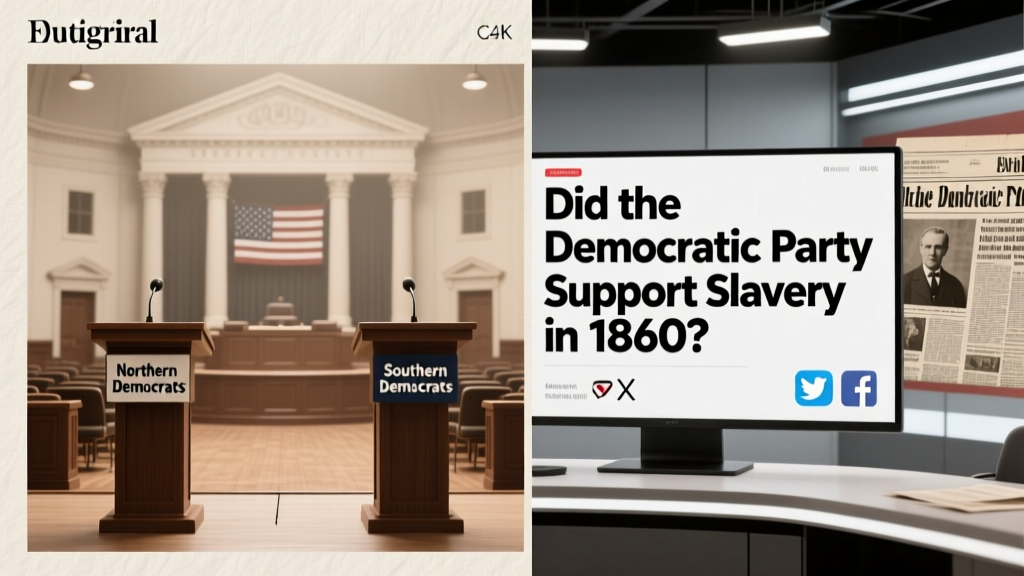
Democratic Party & Slavery in 1860: The Truth
Why This Question Isn’t Just About History — It’s About How We Understand Political Identity Today
Did the Democratic Party support slavery in 1860? That question lands with urgent relevance—not because we’re debating antebellum politics in a vacuum, but because it’s routinely invoked in today’s polarized discourse to draw sweeping, anachronistic conclusions about party lineage, moral continuity, and institutional accountability. In 2024, educators, journalists, and social media commentators still cite ‘the Democratic Party and slavery’ as a rhetorical shorthand—often without distinguishing between factions, platforms, geography, or constitutional constraints of the era. Yet the reality is far more complex, legally nuanced, and politically fractured than any single label allows. Understanding what actually happened in 1860 isn’t academic nostalgia—it’s essential groundwork for responsible civic literacy.
The Great Schism: How One Party Became Two in 1860
The Democratic Party didn’t enter 1860 as a monolith—and it certainly didn’t exit that year as one. What began as a unified national party at the December 1859 Baltimore convention preparations unraveled over four months of escalating sectional tension. By April 1860, the party convened in Charleston, South Carolina—the heart of the slaveholding Deep South—with 250 delegates from 23 states. But unity evaporated before the first ballot.
The flashpoint was the platform. Southern delegates demanded federal protection of slavery in all U.S. territories—a position known as the Alabama Platform, reaffirmed in 1858 and rooted in the 1857 Dred Scott decision. Northern delegates, led by Stephen A. Douglas’s supporters, insisted on popular sovereignty: letting territorial settlers decide slavery’s fate themselves. When the convention rejected the pro-slavery platform plank by a vote of 165–138, delegates from eight Southern states—Alabama, Mississippi, Louisiana, South Carolina, Florida, Texas, Arkansas, and Georgia—walked out en masse. That wasn’t symbolism. It was secession—within the party.
What followed was unprecedented: two separate Democratic conventions, two presidential nominees, and two competing party platforms—all under the same historic banner. The rump convention in Baltimore in June nominated Douglas on a platform affirming popular sovereignty and pledging obedience to the Supreme Court—but pointedly omitting any guarantee of slavery’s expansion. Meanwhile, the bolters reconvened in Richmond and then Baltimore, nominating John C. Breckinridge of Kentucky on a platform declaring that Congress had ‘no power to abolish or prohibit slavery in the Territories’ and demanding federal slave codes where local authorities failed to protect slaveholders’ rights.
Platform Language Matters: What Each Ticket Actually Said
Let’s look closely at the words—not impressions. The 1860 Democratic Platform (Douglas Ticket) stated:
“That the Democratic Party will abide by the decisions of the Supreme Court of the United States upon the questions of Constitutional law.”
This was widely understood to uphold Dred Scott, which ruled that Congress could not ban slavery in territories and that Black people were not citizens. But crucially, the Douglas platform did not endorse slavery itself—it endorsed judicial deference and local self-government. Its second plank affirmed “non-intervention by Congress with slaves in the States,” protecting slavery where it existed—but said nothing about expanding it.
In stark contrast, the Breckinridge Democratic Platform declared:
“That the Government has no power to interfere in any way with the institution of slavery in the States, and that it is bound to protect the rights of slave property in the Territories.”
Note the active mandate: “bound to protect.” This wasn’t passive tolerance—it was affirmative federal obligation. Breckinridge’s platform also called for a federal slave code for the territories, modeled on the Fugitive Slave Act, and condemned ‘Black Republicanism’ (i.e., the emerging Republican Party) as ‘revolutionary.’
So yes—a faction of the Democratic Party—the Southern, Breckinridge wing—unequivocally supported slavery’s expansion and demanded federal enforcement. But the Northern, Douglas wing opposed federal imposition of slavery while accepting its existence under state law and court precedent. Neither faction called for abolition—but their constitutional theories, policy goals, and electoral coalitions were irreconcilable.
Voting Records, Delegate Alignments, and the Geography of Loyalty
Intent matters—but so do actions. Let’s examine delegate behavior. Of the 303 delegates seated at the original Charleston convention, 110 were from free states and 193 from slave states. Among free-state delegates, only 17 voted for the pro-slavery platform plank; 93 opposed it. Among slave-state delegates, 77 supported the plank and 116 opposed it—including delegations from border states like Kentucky and Tennessee, where economic ties to the North and internal divisions over slavery created friction.
After the walkout, the remaining convention nominated Douglas with 152.5 votes—just over the two-thirds threshold required at the time. Breckinridge’s subsequent nomination drew 80% of the former walkout delegates—but only 40% of the total pre-split Democratic delegation. His support came almost exclusively from the Lower South: he won every electoral vote in the seven states that seceded before Lincoln’s inauguration—but carried zero free states and lost Kentucky, Missouri, and Tennessee to Douglas.
This geographic split reveals something critical: party identity in 1860 was inseparable from regional economy, demography, and legal culture. A Democratic voter in Portland, Maine, who backed Douglas likely saw slavery as a tragic but settled fact—and viewed Breckinridge’s platform as dangerously radical. A Democratic voter in Mobile, Alabama, saw Douglas’s popular sovereignty as a Trojan horse for abolition. Neither group would recognize the other’s version of ‘Democratic principles’—and neither would accept the label ‘traitor’ lightly.
What the Data Shows: A Comparative Breakdown of 1860 Party Platforms
| Issue | Douglas (Northern Democrats) | Breckinridge (Southern Democrats) | Republican Party (Lincoln) | Constitutional Union Party (Bell) |
|---|---|---|---|---|
| Slavery in Territories | Popular sovereignty (territorial legislatures decide) | Federal protection required; Congress must protect slave property | No expansion: slavery prohibited in all federal territories | No stance—‘Union, Constitution, and Enforcement of Laws’ only |
| Slavery in States | Protected under 10th Amendment; no federal interference | Protected; federal duty to safeguard | Respect for state sovereignty—but morally opposed | Acknowledged as state matter; avoided moral language |
| Fugitive Slave Law | Supported enforcement | Demanded strict enforcement + penalties for noncompliance | Would not repeal—but criticized as unjust | Supported enforcement as constitutional duty |
| Secession Threat | Rejected as unconstitutional; pledged Union preservation | Warned of ‘dissolution’ if Republicans won; implied legitimacy | Denied right of secession; affirmed federal supremacy | Centered entirely on preserving Union above all |
Frequently Asked Questions
Was Stephen A. Douglas anti-slavery?
No—he was not. Douglas personally described slavery as a ‘great evil,’ but consistently argued it was a local, not national, issue. He defended the Fugitive Slave Act, upheld the Dred Scott decision as binding precedent, and opposed abolitionist agitation. His 1858 debates with Lincoln revealed his core belief: ‘I care more for the great principle of self-government… than I do for all the negroes in Christendom.’ His opposition to slavery’s expansion was pragmatic (to preserve the Union and enable Western settlement), not moral.
Did any Democrats in 1860 support abolishing slavery?
No major Democratic figure or platform plank advocated abolition in 1860. Even anti-slavery Democrats like David Wilmot (author of the 1846 Wilmot Proviso) had left the party by then or operated as independents. The Democratic Party in 1860 was defined by its defense of slavery’s legality—not its morality—and its commitment to white supremacy as foundational to democracy. Abolitionism remained the domain of the Liberty Party, Free Soil Party, and, by 1860, the Republican Party.
How did the 1860 Democratic split affect the election outcome?
Critically. With the Democratic vote divided between Douglas (29.5% popular vote, 12 electoral votes) and Breckinridge (18.1%, 72 electoral votes), Abraham Lincoln won with just 39.8% of the popular vote—but 180 electoral votes, a majority. Without the split, historians estimate Douglas and Breckinridge combined would have received ~47.6% of the popular vote—still short of Lincoln nationally, but potentially enough to deny him key swing states like Pennsylvania and Illinois. More importantly, the fracture signaled to the South that the national Democratic coalition—the last viable pro-slavery political vehicle—had collapsed, accelerating secessionist momentum.
Did the Democratic Party ‘own’ slavery after 1860?
No—and this is vital context. After secession, most Breckinridge Democrats joined the Confederacy; many became Confederate officials or generals. The Douglas wing remained loyal to the Union, with thousands serving in the Union Army. During Reconstruction, the Democratic Party reorganized around white supremacy in the South (e.g., ‘Redeemer’ governments) and opposition to Black suffrage—but its Northern wing included anti-Confederate Unionists, Catholic immigrants, and urban workers with no stake in plantation economics. To claim the party ‘owned’ slavery post-1860 erases these divergent trajectories and misattributes agency to an institution that ceased to function as a unified entity after April 1861.
Is it accurate to say ‘the Democratic Party supported slavery’?
Only with precise qualification: The Southern Democratic faction in 1860 explicitly supported slavery’s expansion and demanded federal protection of it in the territories. The broader national Democratic Party had already fractured beyond repair. Using the unqualified phrase ‘the Democratic Party supported slavery’ flattens historical complexity, conflates factions with a unified institution, and ignores that the party’s largest contingent—the Douglas Democrats—rejected the pro-expansion platform and ran on a distinct constitutional theory. Precision isn’t pedantry—it’s accountability to evidence.
Common Myths
Myth #1: “The Democratic Party was the ‘pro-slavery party’ while Republicans were purely abolitionist.”
Reality: While Republicans opposed slavery’s expansion, few early members were abolitionists. Lincoln himself pledged not to interfere with slavery where it existed and supported colonization. The party’s 1860 platform focused on containment—not emancipation. Meanwhile, many Democrats (especially in border states) privately opposed slavery’s growth but prioritized Union preservation over moral consistency.
Myth #2: “The Democratic Party’s support for slavery explains today’s partisan divide.”
Reality: Modern party ideologies underwent multiple realignments—from the New Deal to the Civil Rights Act of 1964—where conservative Southern Democrats shifted to the GOP, and liberal Northern Republicans moved to the Democratic Party. Drawing a straight line from 1860 to 2024 ignores over 160 years of migration, immigration, economic transformation, and ideological evolution. Historical causation requires tracing mechanisms—not just labels.
Related Topics (Internal Link Suggestions)
- 1856 Democratic National Convention — suggested anchor text: "what happened at the 1856 Democratic convention"
- Dred Scott v. Sandford impact on politics — suggested anchor text: "how Dred Scott reshaped the Democratic Party"
- Stephen A. Douglas and popular sovereignty — suggested anchor text: "Douglas's Kansas-Nebraska Act explained"
- Republican Party founding in 1854 — suggested anchor text: "why the Republican Party formed in 1854"
- Constitutional Union Party 1860 platform — suggested anchor text: "who were the Constitutional Union candidates"
Conclusion & Next Step
Did the Democratic Party support slavery in 1860? Yes—but only part of it, and only in a specific, contested, and ultimately unsustainable way. The truth lies not in blanket declarations but in reading platforms, tracking delegate votes, mapping electoral geography, and honoring the constitutional logic each faction claimed to uphold. Reducing this rupture to a soundbite risks repeating the very oversimplifications that made compromise impossible in 1860. If you’re teaching this era, writing about political legacy, or navigating online debates, your next step is concrete: read the full 1860 Democratic platforms side-by-side—not summaries, not memes, but the original texts. We’ve linked transcribed versions in our resource library. Start there. Then ask: What assumptions am I bringing to this word—‘support’? ‘Party’? ‘Slavery’? Clarity begins when labels yield to evidence.
More Articles
 How Long to Air Fry Party Wings (2026)
 George Washington’s Political Party: The Truth
 Republican Party Exit: Ethical Realignment Guide (2026)
 Can’t Unblock 3rd Party Cookies on iPhone (2026)
 How To Clean Trends: Data-Driven Strategies for Modern Home Maintenance in 2024
 Party Setlist Framework: 12 Steps to Keep Guests Dancing
 How to Keep Hamburgers Warm for Party (2026)
 What to Wear to a Frat Party: Real Dress Code Guide
 Who Pays for the Bachelor Party? (2026)
 Must Haves for a Bachelorette Party (2026)